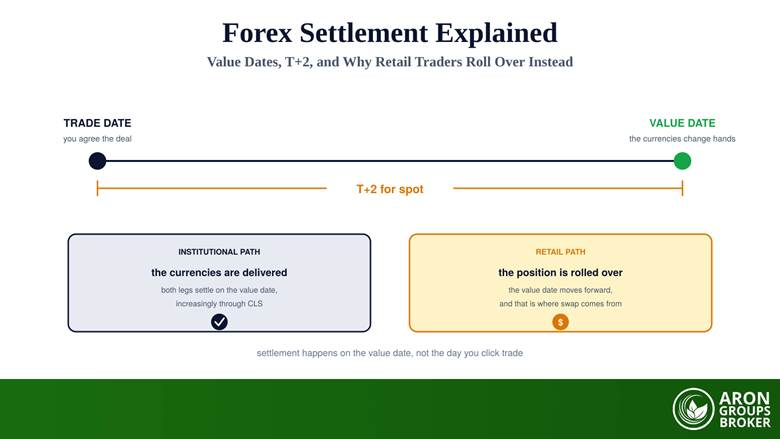

Forex settlement is the process that actually completes a trade: the exchange of the two currencies between buyer and seller. It does not happen when you click trade. It happens on the value date, which for spot forex is normally two business days later, and understanding that gap explains several things retail traders otherwise experience as unexplained charges.
The reason to care is practical rather than academic. If you have ever wondered where your overnight swap comes from, why Wednesday costs three times as much to hold a position through, or why your broker never asks whether you want a delivery of euros, all three answers live in settlement mechanics. Knowing them is part of understanding what a position actually is, which is foundational to how to trade forex at all.
Below: trade date against value date, the T+2 standard and its exceptions, settlement risk and the system built to remove it, the retail pivot where rollover replaces delivery, where your swap comes from, why Wednesday is charged three times, deliverable against cash-settled products, and the risks that remain.
- Settlement is the actual exchange of the two currencies, and it takes place on the value date rather than the trade date.
- Spot forex normally settles T+2, two business days after the trade; USD/CAD and a few others settle T+1.
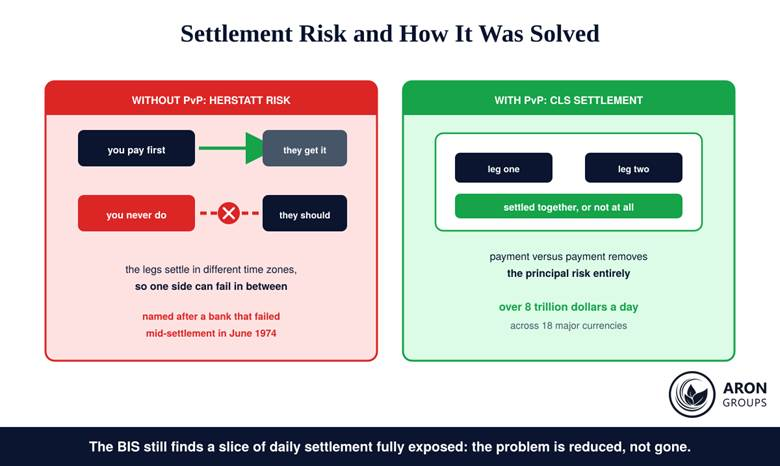
- Because the two legs settle in different time zones, one side can pay and not receive, which is settlement risk, known as Herstatt risk after a 1974 bank failure.
- CLS removes that risk for major currencies by settling both legs simultaneously, payment versus payment, at a scale now above eight trillion dollars a day.
- Retail traders almost never settle: the broker rolls the position to the next value date, and that rollover is exactly what generates the overnight swap.
What Is Forex Settlement?
A currency trade has two distinct moments. Execution is when the price is agreed, and settlement is when the money moves. For most of the market’s history the second moment was the whole point: banks and corporates trade currencies because somebody needs to hold, spend, or receive them. Settlement is the delivery of that obligation, and given that daily foreign exchange turnover runs into trillions of dollars, as the BIS triennial survey documents, the plumbing that completes those trades is a serious piece of financial infrastructure rather than an administrative afterthought.
Risk Disclosure
CFDs are complex instruments and come with a high risk of losing money rapidly due to leverage. You should consider whether you understand how CFDs work and whether you can afford to take the high risk of losing your money. Past performance is not indicative of future results. This content is provided for educational purposes only and does not constitute investment advice.
Trade Date and Value Date
The trade date is the day the deal is struck. The value date, also called the settlement date, is the day both parties must actually exchange the currencies. Every convention in this article follows from that separation, and it exists for a mundane reason: moving money between banking systems in different countries takes time, and both sides need to confirm, match, and instruct their correspondent banks before anything can be paid.
The T+2 Standard and Its Exceptions
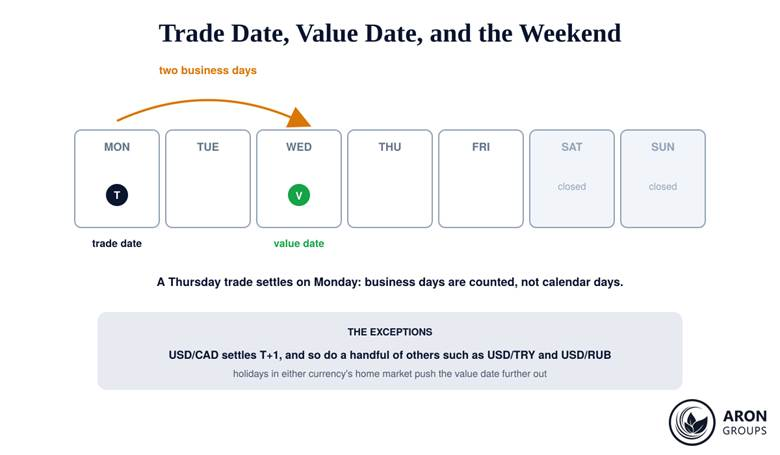
Spot forex settles on T+2: two business days after the trade date. Business days matter more than the number, because weekends and public holidays are skipped rather than counted. A Monday trade settles on Wednesday, but a Thursday trade settles on Monday, and a holiday in either currency’s home market pushes the date further out again.
Two business days, not two calendar days: the weekend and any holiday push the value date along.
| Convention | Which pairs | Practical note |
|---|---|---|
| T+2 | The great majority of spot pairs, including EUR/USD | The standard cycle; weekends and holidays are skipped |
| T+1 | USD/CAD, and others such as USD/TRY and USD/RUB | One business day, so the roll schedule differs |
| Same day | Rare and niche in FX | Used only in specific arrangements, not a retail norm |
| Forward dates | Any agreed date beyond spot | Priced from the spot rate plus the interest differential |
The cycle decides when the value date falls, which in turn decides when a rollover happens and what it costs.
Settlement Risk, Herstatt, and CLS
Here is the problem the two-day gap creates. The two legs of a currency trade settle in different national payment systems, operating in different time zones, so they are rarely simultaneous. One party can pay out its side and then find the counterparty has failed before paying back. That is settlement risk, and because it exposes the whole amount rather than just a price movement, it is also called principal risk. It has a name from history: on 26 June 1974 the German authorities closed Bankhaus Herstatt part-way through the settlement day, after which its New York correspondent suspended dollar payments from its account, leaving counterparties who had already paid Deutsche marks with nothing coming back. Herstatt risk has been the industry’s shorthand ever since.
Pay first and hope, or settle both legs together: payment versus payment is what removed the principal risk.
The industry’s answer was Continuous Linked Settlement, run by CLS Bank. It settles both legs of a trade simultaneously on a payment-versus-payment basis, so one currency only moves if the other does, which eliminates principal risk outright for eligible trades. CLS now settles an average of more than eight trillion dollars a day across eighteen of the most traded currencies, and its multilateral netting means only a small fraction of that gross value actually needs funding. Even so, the BIS’s analysis of the 2025 Triennial Survey found that while around 90% of daily settlement now uses methods that eliminate or reduce settlement risk, roughly 1.4 trillion dollars a day still settles on a gross bilateral basis and remains fully exposed. The problem has been reduced substantially, not abolished.
The Retail Reality: You Almost Never Settle
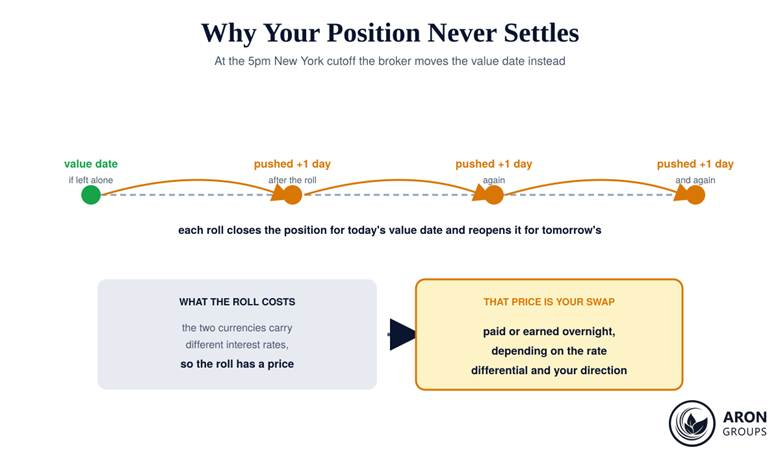
Now the pivot that matters to most readers. If you trade a retail account, you are almost certainly never going to settle a currency trade, and your broker has no expectation that you will. Retail trading is leveraged and margin-based, positions are netted internally, and traders are there for the price difference rather than because they need Japanese yen on Thursday. So when a position’s value date approaches, the broker does not deliver anything. It performs a rollover: closing the position for the current value date and reopening it for the next one, which keeps your exposure alive and pushes delivery permanently into the future. The mechanics of that are worth understanding because they show up on your statement, and because sound risk management includes knowing every cost you carry.
Each roll pushes the value date forward one more day, and the price of doing so is the swap.
Q: Could I ever be asked to take delivery of currency?
A: On a standard leveraged retail account, no; the account is not built for it and the broker rolls positions instead. Delivery belongs to the institutional and corporate market, where somebody genuinely needs the currency. If you ever trade a genuinely deliverable product, the documentation will make that unmistakable.
Where Your Swap Comes From
This is the single most useful thing settlement explains. Rolling a position forward is economically a pair of transactions, and because the two currencies carry different interest rates, moving the value date has a price. That price is the overnight swap, sometimes called tom-next financing: you earn it if the currency you are long pays a higher rate than the one you are short, and you pay it when the relationship runs the other way. It is applied after the market’s daily cutoff, around 5pm New York time, which is why swap appears on positions held through that moment and not on trades opened and closed within a session.
The practical consequence is that swap is not a broker fee invented to catch you out; it is the interest differential between two currencies, passed through a mechanism that exists because you did not want to take delivery. It also means holding period matters to cost in a way that is entirely predictable. A day trader can ignore swap almost entirely. A swing or position trader cannot, because over weeks it becomes a real line item, and a strategy with thin expectancy can be turned negative by financing alone.
Rule
Look up the swap rates for the pairs you hold overnight before you build a longer-term strategy around them, not after. On some pairs the differential is large enough to dominate the trade’s arithmetic, and it is published in advance rather than being a surprise.
Why Wednesday Is Charged Three Times
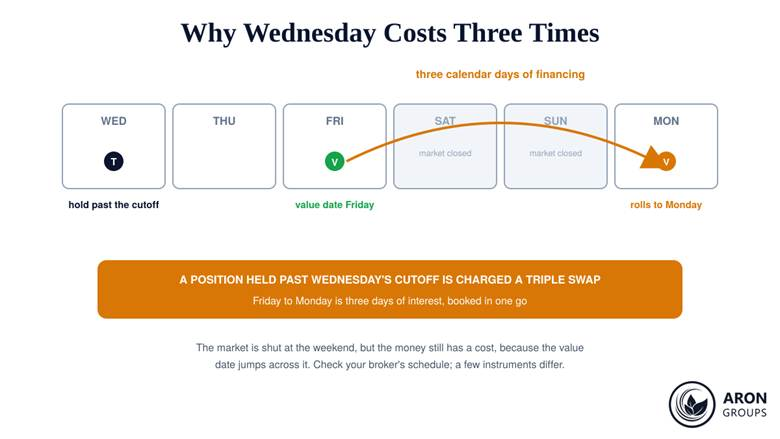
Follow the value dates and this stops being mysterious. A spot trade held through Wednesday’s cutoff has a value date of Friday. Rolling it forward one business day moves that value date to Monday, because Saturday and Sunday are not business days. That is three calendar days of financing rather than one, so the roll is booked as a triple swap.
Friday to Monday is three calendar days of financing, charged in a single roll.
Mini Example: The Wednesday Bill
A trader holds a position paying 4 dollars of swap per night. Monday and Tuesday cost 4 dollars each. On Wednesday the roll spans the weekend, so the charge is roughly 12 dollars, and the trader who budgeted 4 finds three times that on the statement.
Nothing went wrong and nothing was hidden. The market is closed on Saturday and Sunday, but money still carries a cost across those days, and the value date jumped over them. Most brokers apply the triple charge on Wednesday for the majority of instruments, though a few differ, which is worth checking on the specific symbols you trade.
Deliverable and Cash-Settled Products
It helps to separate two things that both get called settlement. Spot and forward contracts can be physically deliverable, meaning the currencies genuinely change hands on the value date. Retail contracts for difference are cash-settled: you settle the price difference and never the currency, which is why no delivery question ever arises. Non-deliverable forwards sit in the same family, settling a difference in dollars because the underlying currency cannot legally be delivered offshore. The instruments differ, but the principle is identical, and recognising it makes each of them easier to reason about, including when you are modelling costs in a systematic way.
Risks That Remain for Retail Traders
Even without settling anything yourself, settlement-adjacent risk does not vanish. Counterparty and liquidity risk is the main one: your broker relies on liquidity providers and banking relationships, and a failure upstream can disrupt pricing and execution even though your own position is netted internally. Value-date timing around public holidays is the second, since an unexpected holiday can shift a value date and change when a roll is applied, occasionally producing a larger-than-expected swap charge; the economic calendar is worth checking for market holidays as well as for data. Regulators’ advisories on off-exchange currency trading make the general point that a regulated counterparty with transparent processes is the practical defence against both.
Swap-Free Accounts and Where Aron Groups Fits
Because rollover generates interest, the overnight swap raises a religious-compliance question for some traders, since interest is riba. Swap-free or Islamic accounts exist to address it by removing the standard overnight charge, and at Aron Groups the Islamic ECN account is both swap-free and commission-free. One honest caveat applies wherever you open such an account: check what replaces the swap, because some providers substitute an administration fee or apply conditions after a certain holding period, and the account types page is the place to confirm the current terms.
For everyone else the practical steps are small. Find the swap figures for your symbols on the MetaTrader 5 platform before you hold anything overnight, watch a Wednesday roll happen once on a demo account so the triple charge is never a surprise, and fold financing into your cost assumptions the same way you fold in spread.
Then judge the result over time rather than per trade: if financing is quietly flattening your equity curve, a small account is a cheap place to discover that, and position sizing should account for holding costs on longer trades.
Conclusion
Settlement is the unglamorous half of a currency trade and it explains more of your statement than most analysis does. Execution agrees the price; settlement moves the money, on the value date, which for spot is normally two business days out. Because the two legs land in different time zones, the market spent decades building payment-versus-payment infrastructure to stop one side paying and receiving nothing, and the residual exposure is now a fraction of what it was.
For retail traders the chain is shorter and worth memorising: you do not settle, so your position is rolled, so the value date moves, so you pay or earn the interest differential, and on Wednesday you pay three days of it at once. None of that is hidden, all of it is published in advance, and building it into your cost assumptions is the sort of unremarkable diligence that separates a professional trader from someone puzzled by their own statement. Keep capital preservation ahead of curiosity, and let the mechanics work for you rather than surprise you.
Frequently Asked Questions
Quick answers to the questions traders ask most about forex settlement, value dates, and rollover.
What is forex settlement?
It is the completion of a currency trade: the actual exchange of the two currencies between buyer and seller. It happens on the value date rather than the trade date, and for spot forex the value date is normally two business days after execution.
What does T+2 mean in forex?
T+2 means settlement takes place two business days after the trade date. Weekends and public holidays are skipped, so a Monday trade settles on Wednesday while a Thursday trade settles on the following Monday. A few pairs, notably USD/CAD, settle T+1.
Why do I pay a swap on positions held overnight?
Because your broker rolls the position to a new value date rather than delivering the currency, and rolling has a price equal to the interest differential between the two currencies. You pay it or earn it depending on which currency you are long and the relative rates, and it is applied after the daily cutoff around 5pm New York time.
Why is Wednesday’s swap triple?
A spot position held through Wednesday’s cutoff has a Friday value date, and rolling it one business day forward moves that to Monday. That is three calendar days of financing rather than one, so it is charged as a triple swap. A few instruments follow a different schedule, so check your broker’s specification.