
icon icon Home
icon icon Accounts
icon icon Quick start
icon icon Symbols

Funding Rate: How Perpetual Futures Keep Longs and Shorts in Balance, and What the Rate Tells You

Author
Walter Writes
Walter Writes
calendar Last update: 19 October 2026
watch Reading time: 9 min

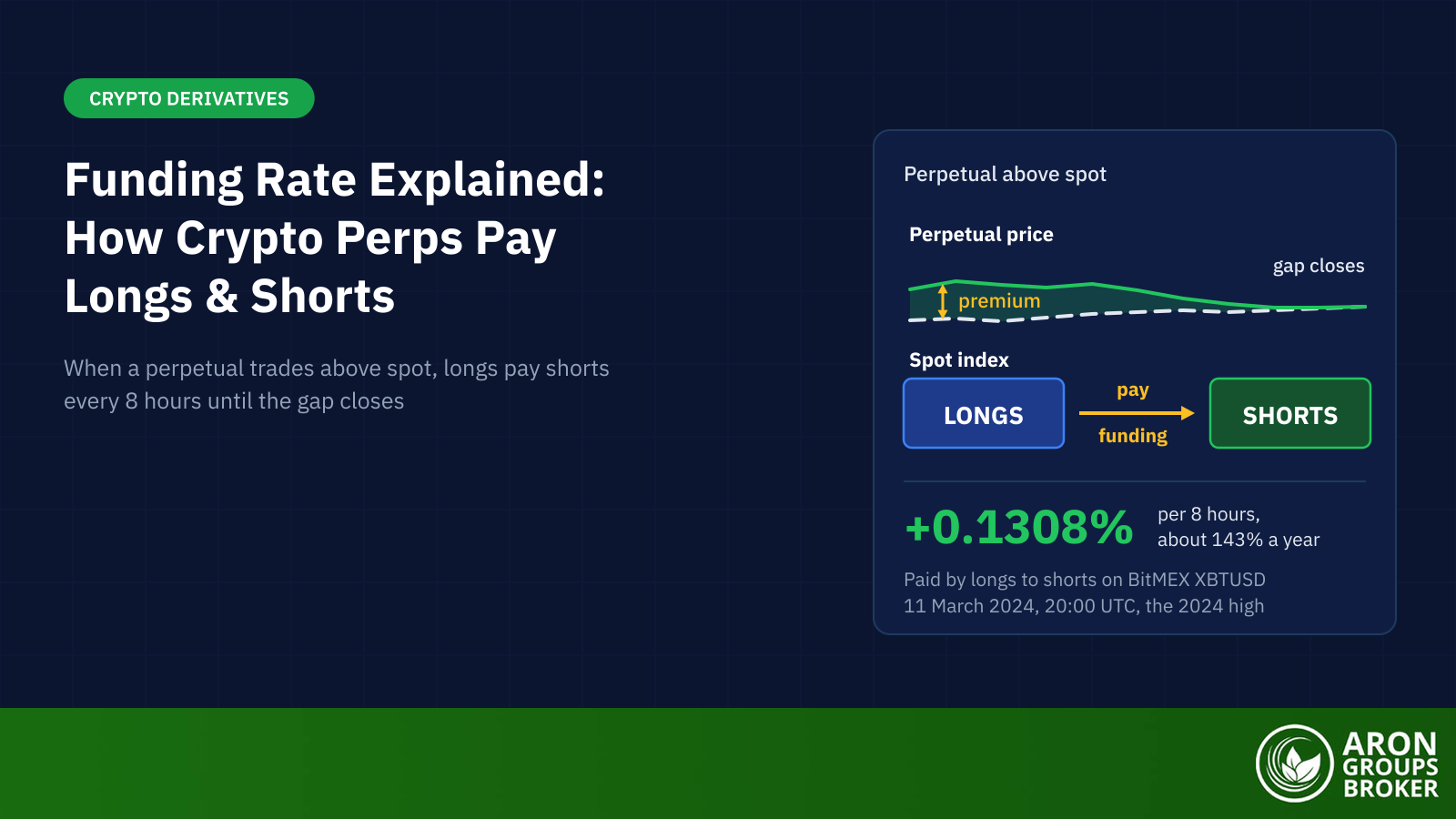
A funding rate is a periodic payment exchanged directly between traders who are long and short a perpetual futures contract. Because a perpetual never expires, nothing forces its price back to spot at settlement. Funding does that job: when the perpetual trades above spot, longs pay shorts, and when it trades below, shorts pay longs.

Funding now shapes most crypto trading. Spot was just 18% of volume on centralised crypto exchanges in February 2026, according to CoinGecko, and perpetuals made up the other 82%. BitMEX retired XBTUSD, the contract that introduced funding, on 16 September 2026. On 7 October 2026 bitcoin funding on OKX printed just 0.0025%, a quarter of the usual baseline.

This guide covers who pays whom and when, the exchanges’ formula and a decade of data. It then shows how traders read funding, earn it and compare it with a CFD swap.

bookmark
Key Takeaways
  • A funding rate is a payment between longs and shorts in a perpetual future, usually every 8 hours at 00:00, 08:00 and 16:00 UTC, and Binance and OKX say they keep none of it.
  • The fee is position value times the rate: a $50,000 long at +0.02% pays $10 every 8 hours, or $30 a day, even if the price never moves.
  • Binance, OKX and Bybit fix funding at 0.01% per 8 hours whenever the premium sits between -0.04% and +0.06%; that baseline equals about 10.95% a year.
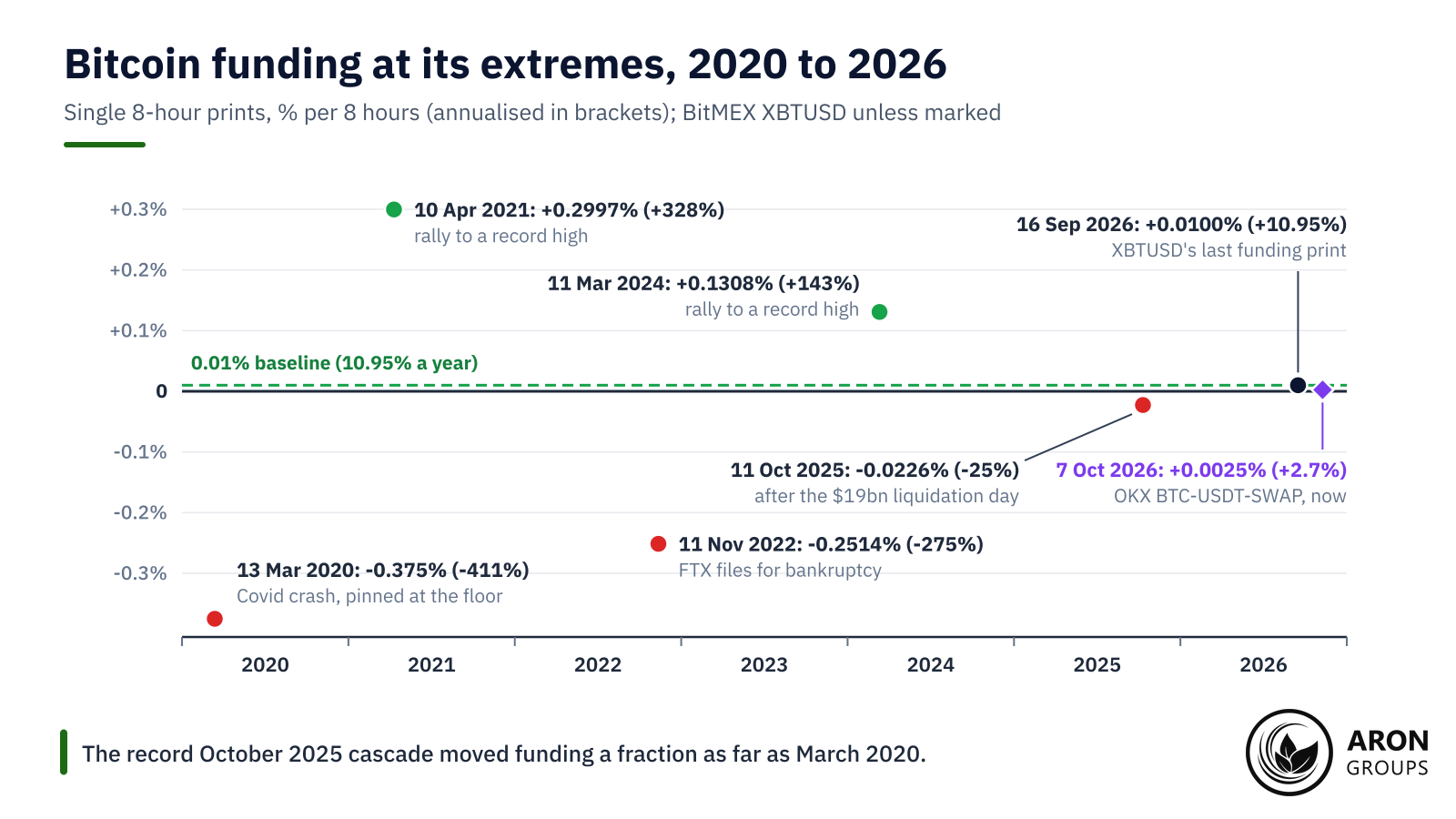
  • Extremes have shrunk: BitMEX's XBTUSD printed -0.375% per 8 hours in March 2020 but only -0.0226% after the record $19 billion liquidation day of 10 October 2025.
  • At OKX's bitcoin average of 0.00457% per 8 hours, about 5% a year to 6 October 2026, the delta-neutral basis trade earns roughly what cash does after fees.

What Is a Funding Rate?

A funding rate is a small, recurring transfer between the two sides of a perpetual futures contract. It is set so that holding the more crowded side costs money. The rate is quoted as a percentage of position value per funding interval, usually 8 hours. Positive means longs pay; negative means shorts pay.

sms-star

Risk Disclosure
Trading forex and CFDs carries a high level of risk and can result in the loss of all your capital. This content is educational and is not investment advice. Never risk money you cannot afford to lose.
Why Perpetuals Need Funding

An ordinary future must match the spot price at expiry, so arbitrage pulls the two together as expiry nears. A perpetual has no such anchor, and leveraged demand could push it far from the asset it tracks. Funding replaces the expiry: the gap is settled in small pieces every few hours, paid by whichever side pushes the price away from spot.

From Shiller's Idea to BitMEX's XBTUSD

The idea is older than crypto: in 1993 the economist Robert Shiller proposed a perpetual futures contract that would cash settle every day. BitMEX launched the first crypto version, XBTUSD, on 13 May 2016 with up to 100x leverage. Its 8-hour funding formula is now used, with small variations, by Binance, OKX, Bybit and Hyperliquid. The contract was settled at 12:00 UTC on 16 September 2026, and BitMEX stopped all trading a week later.

How Regulators Describe It

In a 29 May 2026 op-ed, CFTC Chairman Michael Selig described a perpetual as a derivative with no fixed expiration date. Its counterparties “periodically exchange a funding rate payment, similar to variation margin”, designed to keep its price near spot. The same day the CFTC approved KalshiEX’s BTCPERP, a bitcoin perpetual that went live on 3 June 2026 with 8-hour funding. It followed long-dated perpetual-style futures from Coinbase Derivatives and Cboe in 2025.

How Funding Works: Who Pays Whom, and When

Funding flows from the side pushing the price away from spot to the side pushing it back. Binance states that it charges no fees on funding payments, and OKX says it keeps no part of them.

Positive and Negative Funding

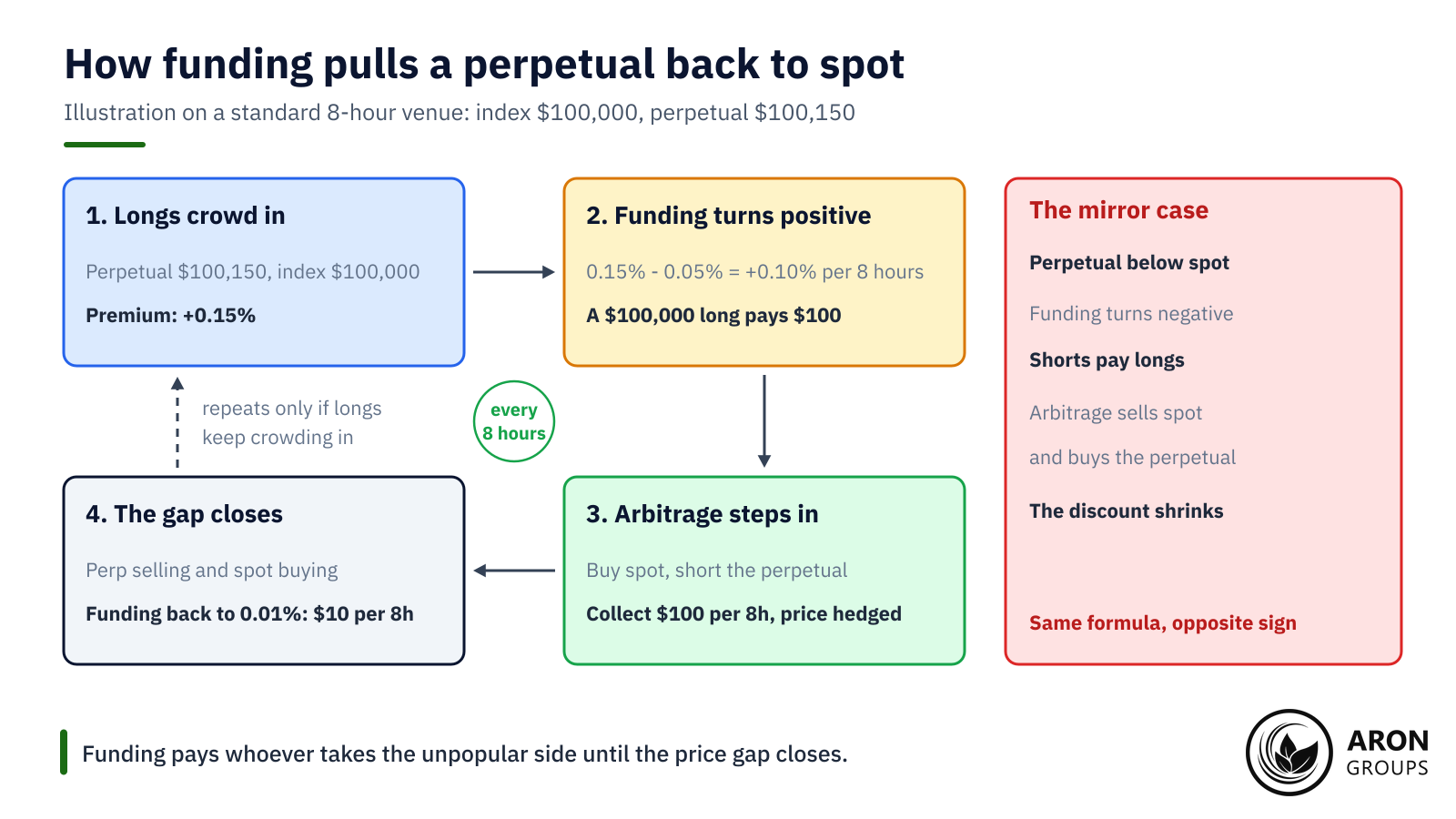
When leveraged buyers bid the perpetual above its spot index, funding turns positive and longs pay shorts, making longs costlier and shorts more rewarding. Below the index, funding turns negative and shorts pay longs.

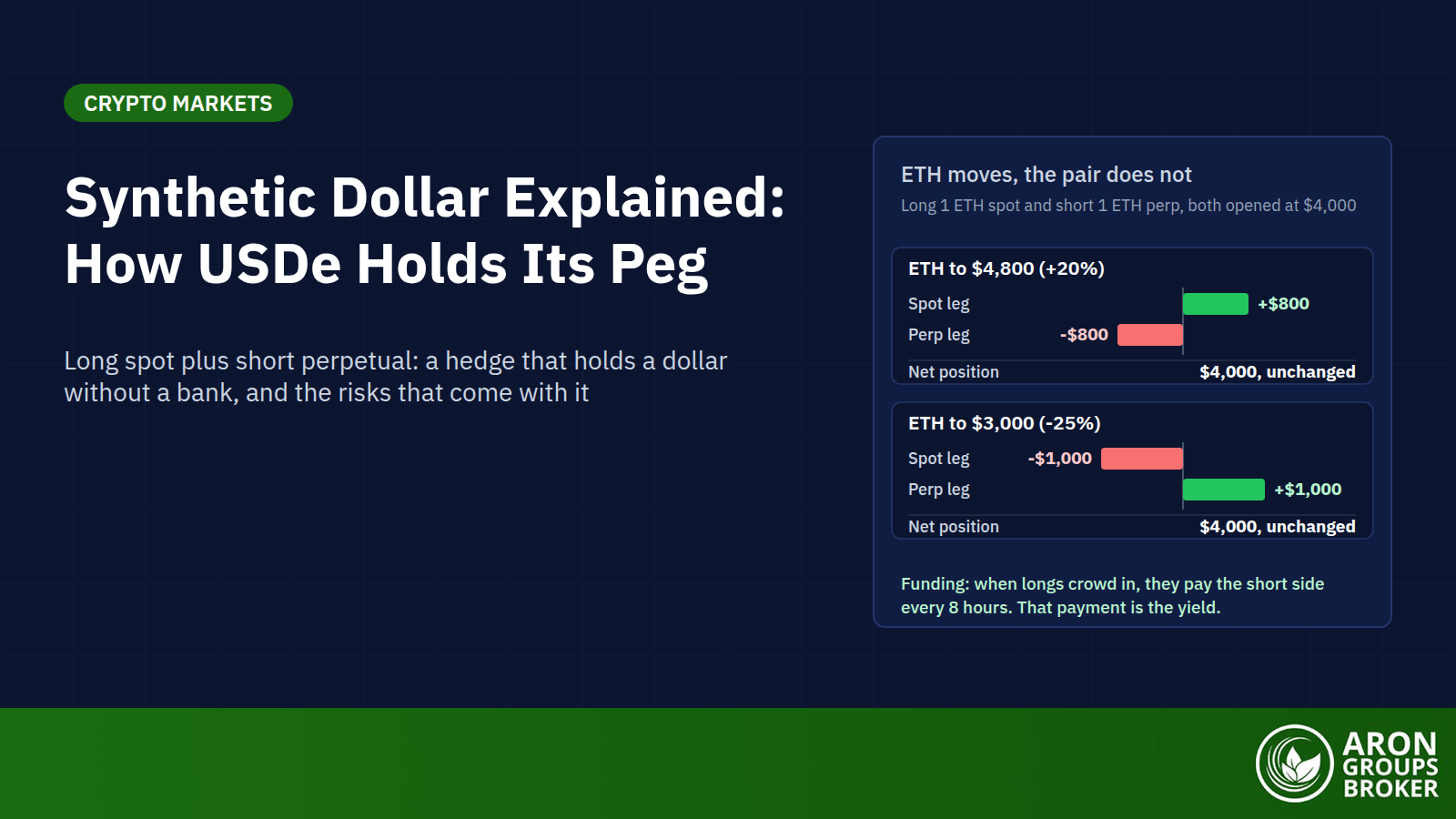
The payment also recruits arbitrage. A trader who buys spot and shorts the perpetual collects positive funding with no net price exposure. Such trades sell the perpetual and buy spot, which narrows the gap.

A +0.15% premium makes a $100,000 long pay $100 every 8 hours, and the arbitrage it attracts closes the gap.

When You Pay, and on What

Most centralised exchanges settle funding every 8 hours, at 00:00, 08:00 and 16:00 UTC, and only positions open at the timestamp pay or receive it. Close before it and you owe nothing. OKX notes that its assessment can take up to a minute, so a position opened just after the timestamp may still be caught.

The fee is sized on the full position, not the margin: position value at the mark price times the funding rate. A 10x position therefore pays ten times what its margin suggests. Hyperliquid pays every hour, at one eighth of the 8-hour rate.

How Exchanges Calculate the Rate

Binance, OKX and Bybit publish nearly the same formula: an average premium index plus a clamped interest term, then capped. The interest term sets the resting level and the premium carries the market signal.

The Interest Component

The interest component is fixed at 0.01% per 8 hours, or 0.03% a day, on all three exchanges. It echoes the first perpetual, which charged daily interest based on dollar and bitcoin lending rates. Over a year, 0.01% per 8 hours comes to 10.95% simple, or about 11.6% compounded.

The Premium and the Clamp

The premium index measures how far the perpetual trades from its spot index. It uses the average fill price for a set order size, 20,000 USDT on OKX’s bitcoin contract, rather than the last trade. Binance samples it every 5 seconds and OKX and Bybit every minute, weighting later readings more.

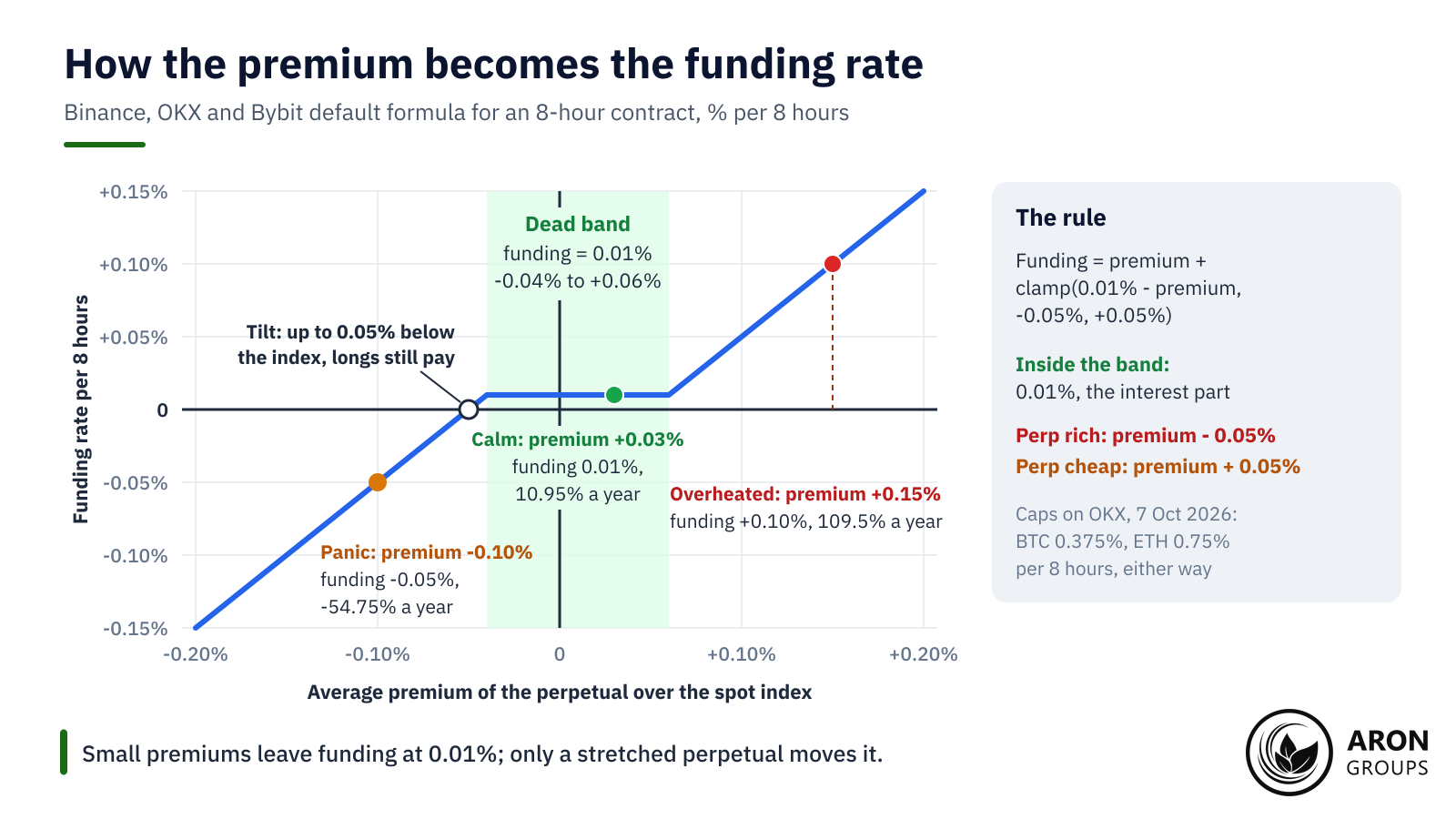
The clamp is the part most traders miss. Funding equals the interest rate exactly whenever the premium sits between -0.04% and +0.06%, so calm markets print 0.01% again and again. Outside that band, funding equals the premium minus 0.05% when the perpetual is rich, and the premium plus 0.05% when it is cheap.

The band tilts towards longs paying: with the perpetual 0.045% below its index, longs still pay +0.005%, and funding turns negative only below -0.05%. OKX’s bitcoin funding was positive in 88 of the 100 intervals to 6 October 2026, mostly below 0.01%. Under the formula, that means the contract traded slightly below its index.

A +0.15% premium becomes +0.10% funding and a -0.10% premium becomes -0.05%; inside the band funding stays at 0.01%.

Caps and Faster Clocks

Binance caps major contracts such as BTCUSDT at 0.75 times the maintenance margin ratio and most others at 2% per interval. OKX’s caps on 7 October 2026 were 0.375% for bitcoin and 0.75% for ether. When a rate hits its cap, all three exchanges shorten the interval, down to one hour, so the crowded side pays more often.

Funding as a Cost of Carry

For anyone holding a leveraged perpetual for days or weeks, funding is a running cost or income, whatever the price does. It is charged on the full position and comes out of margin. A long hold at a high rate can therefore push an account towards liquidation without any adverse move.

Mini Example: A $50,000 Long Paying 0.02% Every 8 Hours

Say you hold a $50,000 bitcoin perpetual long while funding sits at +0.02% per 8 hours. Each settlement costs $50,000 x 0.02% = $10, so you pay $30 a day and $900 over 30 days, even if the price never moves.

If the position runs at 10x leverage on $5,000 of margin, that $900 is 18% of your margin in a month. Bitcoin would have to rise 1.8% over those 30 days just to cover the funding.

At 0.01% per 8 hours the cost is 0.03% a day, or 10.95% a year. At 0.02% it is 21.9% a year, at 0.05% it is 54.75% and at 0.10% it is 109.5% of the position’s value.

Reading Funding as a Sentiment Gauge

Funding is a sentiment gauge built from money changing hands, not from surveys. It shows what leveraged traders are paying to keep a bet open, every few hours.

What a Decade of Bitcoin Funding Shows

Funding is positive far more often than negative, because crypto traders lean long. BitMEX Research found XBTUSD funding positive in 71.4% of periods from May 2016 to May 2025. In the third quarter of 2025, bitcoin funding on Binance and BitMEX was positive more than 92% of the time.

XBTUSD funding sat at its -0.375% floor for six straight intervals from 13 March 2020, as bitcoin fell almost half in a day. It reached +0.2997% on 10 April 2021, four days before a record high. It printed -0.2514% on 11 November 2022 as FTX filed for bankruptcy, and +0.1308% on 11 March 2024, about 143% a year.

XBTUSD funding hit -0.375% in March 2020 but only -0.0226% after the record liquidation day of 10 October 2025.

The record liquidation day barely registered. After more than $19 billion of positions were liquidated on 10 October 2025, XBTUSD’s lowest print was -0.0226%. Glassnode still reported aggregate funding at its weakest since 2022. BitMEX Research links the calmer extremes to arbitrage capital, from ETF basis trades to Ethena.

In early October 2026 the gauge reads cool. OKX’s bitcoin funding averaged 0.00457% per 8 hours over the 100 intervals to 6 October, about 5% a year, with 12 negative prints. Ether averaged 0.00421% over its 100 intervals to 7 October, about 4.6% a year, and SOL and XRP last settled at 0.01%.

Funding, Open Interest and Price Together

Funding means most alongside open interest, the number of contracts still open, and price. Rising open interest with rising positive funding means new leveraged longs are crowding in and paying up. That is stored energy for a long squeeze if the price turns.

Negative funding into falling prices and rising open interest means shorts are crowding in, which sets up a short squeeze when sellers run out. Falling open interest with funding back near 0.01% usually means leverage has been flushed out.

Why Extremes Warn but Do Not Time

Extreme funding is a contrarian warning, not a timing signal. XBTUSD funding printed above 0.1% in 18 of the 42 intervals between 9 and 22 February 2021, yet bitcoin did not peak until mid-April. Crowded positioning can stay crowded, and expensive, for weeks.

Research from the Bank for International Settlements supports the warning. A 2023 BIS working paper, measuring the futures premium on bitcoin and ether, found carry averaged above 10% a year and reached up to 60%. It also found that high carry predicted future price crashes.

Q: Does negative funding mean the price is about to rise?
A: Not on its own. Negative funding shows shorts are paying to stay in, which adds squeeze risk if the price turns up, but shorts can be right for a long time. Check open interest and price before treating it as a signal.

The Basis Trade: Earning Funding While Delta-Neutral

Because funding is usually positive, a trader can collect it without betting on direction: buy spot and short the same amount of the perpetual. The legs act as a hedge, so the value stays flat while the short collects funding. This is the cash-and-carry, or basis, trade.

A Worked Example

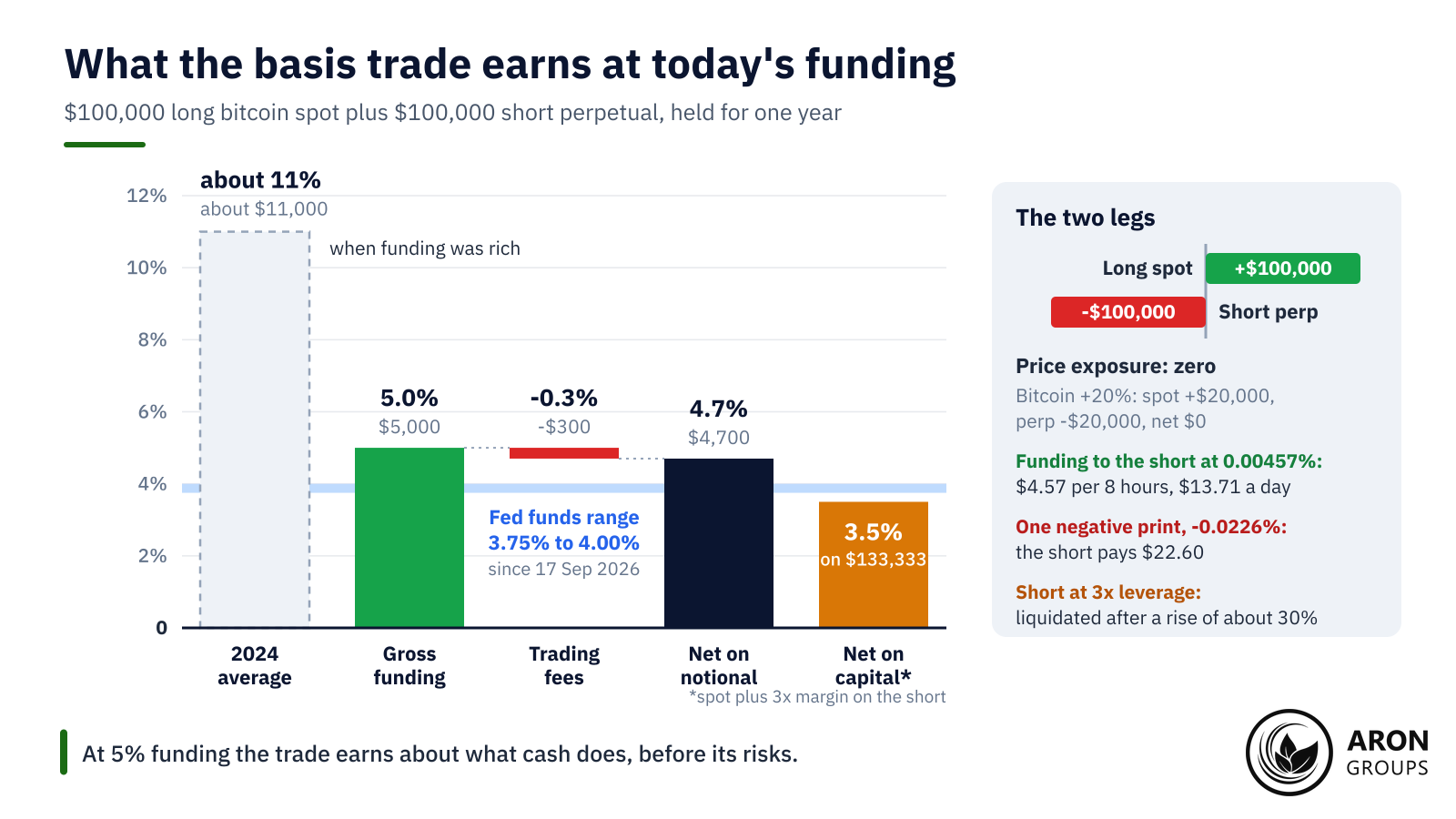
Buy $100,000 of bitcoin spot and short $100,000 of the perpetual. A 20% move either way gains $20,000 on one leg and loses it on the other. At OKX’s 0.00457% average, the short collects $4.57 every 8 hours, about $5,000 a year.

Trading in and out at Binance’s base rates, 0.10% per spot trade and 0.05% per perpetual trade, costs $300 and leaves about $4,700. If the short is margined separately at 3x, the trade ties up $133,333 and earns about 3.5%, below the Fed’s 3.75% to 4.00% target range.

At early October 2026 funding the basis trade nets about 3.5% on capital, below the Fed's 3.75% to 4.00% range.

What Can Go Wrong

Funding can flip: a print of -0.0226%, like the one after 10 October 2025, makes the short pay $22.60 per $100,000 instead of receiving. The exchange holding the short is a counterparty too, as FTX customers learned in November 2022.

The short leg can also be liquidated in a spike. Posted at 3x leverage, it is wiped out after a rise of roughly 30%. The spot leg has gained as much, but in another account.

USDe: The Basis Trade at Scale

Ethena’s USDe packages this trade as a dollar token that trades like a stablecoin. Its backing pairs crypto with short perpetuals, whose funding, with staking and other income, pays the yield. Supply was $4.97 billion on 7 October 2026, according to DefiLlama, against about $14.8 billion in early October 2025. Ethena’s own three-year back-test found bitcoin funding negative on 15.9% of days.

Funding Rate vs a CFD Swap

A crypto CFD has its own carrying cost, the overnight swap. Both charge you for holding leverage over time. Funding, however, passes between traders, while a CFD swap is debited or credited by the broker, your counterparty. The table below sets the two side by side.

FeaturePerpetual funding rateCrypto CFD overnight swap
Who pays whomLongs pay shorts when positive; shorts pay longs when negativeThe broker debits or credits your account
CounterpartyOther traders; Binance and OKX keep no part of itThe broker that prices the CFD
IntervalUsually every 8 hours (00:00, 08:00, 16:00 UTC); some venues every 1 or 4 hoursOnce for each night a position is held, at the platform's rollover
How the rate is setFormula: premium to spot plus a 0.01% interest term, then cappedFinancing costs passed on from liquidity providers
Can it be income?Yes, for whichever side is being paidOnly if the swap rate for your side is positive
TransparencyLive rate, history and formula published by the exchangeSwap rates listed in the symbol's contract specification
Where you see itThe exchange's funding historyThe Swap column in MetaTrader 5

Perpetual funding and a crypto CFD swap compared. Sources: Binance, OKX and Bybit funding rules; Aron Groups swap glossary.

Who Can Trade Which

The UK’s FCA has banned the sale of crypto derivatives, CFDs and futures alike, to retail consumers since 6 January 2021. It confirmed in August 2025 that the ban would stay. Platform access varies by country, and users in restricted regions face added legal, access and custody risk.

The Honest Limits of the Funding Rate

Funding only sees leverage in perpetuals. When bitcoin fell to $60,000 late on 5 February 2026, the drop was led by spot selling. XBTUSD funding printed 0.01% at the next two settlements and dipped only to -0.0306% on 7 February.

Rates also differ by venue and contract, so one exchange’s print is a sample, not the market. Aggregators such as Coinglass average venues whose formulas, caps and intervals differ. Annualised figures assume a rate lasts a year, which extremes rarely do.

Where Aron Groups Fits

Aron Groups does not offer perpetual futures, so you will not pay or receive funding with it. It offers crypto CFDs such as BTCUSD, ETHUSD, SOLUSD and XRPUSD on MetaTrader 5. There the carrying cost is an overnight swap, charged or paid by the broker. The Islamic account discounts swaps and gives 3 swap-free days on listed crypto symbols.

Margin works as on any leveraged CFD, with a margin call at 100% margin level. Stop-out comes at 50%, or 40% on Islamic and VIP accounts. The Nano account trades crypto CFDs from 0.01 nano lots, and a demo account shows how swaps accrue before you risk capital.

Conclusion

A funding rate is the price of keeping a perpetual tied to spot. It is a small payment, every few hours, from the crowded side to the other. The formula pins it at 0.01% in calm markets and lets it swing only when the premium stretches.

Read it as a cost, a gauge and an income. At 0.02% per 8 hours a $50,000 long pays $900 a month, and extreme readings flag crowding. Delta-neutral traders earned it as yield, about 5% a year on bitcoin in early October 2026.

Treat extreme funding as a warning about leverage, not a timer. Check it against open interest and price before acting.

Frequently Asked Questions

Short answers to common questions about funding rates.

Who pays the funding rate, longs or shorts?

When the rate is positive, longs pay shorts; when it is negative, shorts pay longs. The exchange only passes the money between them.

How often is the funding rate paid?

Every 8 hours on most centralised exchanges, at 00:00, 08:00 and 16:00 UTC. Some contracts settle every 4 hours or hourly, and exchanges speed up settlement when a rate hits its cap.

What is a normal funding rate?

The resting level on Binance, OKX and Bybit is 0.01% per 8 hours, about 10.95% a year. Readings well above 0.05% per 8 hours point to crowded longs, and deeply negative readings to crowded shorts.

Can you make money from funding rates?

Yes, by holding the side that receives it, usually through a long spot and short perpetual position. At about 5% a year on bitcoin in early October 2026, that nets close to cash rates after fees. Exchange and liquidation risk come on top.

Continue Reading
not-found
calendar 19 October 2026
Rate this article

Leave a Reply

Your email address will not be published. Required fields are marked *

No thanks