
icon icon Home
icon icon Accounts
icon icon Quick start
icon icon Symbols

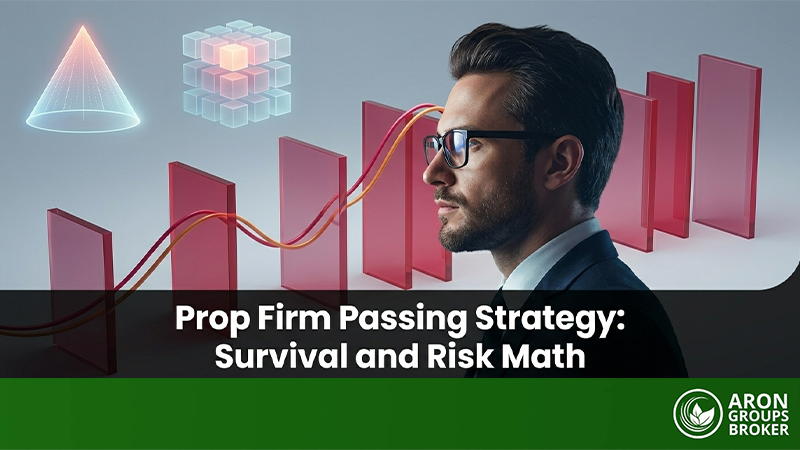
Mastering Prop Firm Challenges Through Risk Math, Not Profit Targets

Author
Abe Cofnas
Abe Cofnas
calendar Last update: 19 May 2026
watch Reading time: 10 min

Most traders approach prop firm challenges like a sprint to 10% profit. They’re wrong. The data tells a different story: 90-95% of participants fail these evaluations, and the primary cause of failure in prop firm evaluations is hitting the Daily Drawdown limit.

This isn’t about trading skills alone. It’s about understanding that prop firm challenges are structured statistical tests where variance, path dependency, and rule compliance determine survival. Your edge means nothing if you breach drawdown limits before it can manifest. It is crucial to thoroughly understand the rules of each prop firm to avoid disqualification and maximise your chances of passing.

This guide reframes the challenge as a survival problem with executable rules: probability math, position sizing, drawdown control, psychological discipline, and the structural differences between firm models. Treat it as a playbook for staying alive long enough to let an edge play out.

bookmark
Key Takeaways
  • Prop firm challenges are probability and survival games, not races to hit profit targets as fast as possible.
  • Most traders fail not because their trading strategy is bad, but because they ignore risk-of-ruin, variance, and firm rules like daily and overall drawdown limits are the real enemies.
  • Passing prop firm challenges requires small, repeatable risk per trade (typically 0.25-0.5%), high probability setups, and strict protection against revenge trading and random trades.
  • Adapting your trading approach to each prop firm's evaluation rules (daily DD, trailing DD, consistency rules, no-time-limit firms) is as important as your entries and exits.
  • Aron Groups Broker offers prop trading, copy trading, and MT5 access, which can be used to practice and refine your strategy before risking your own money on paid evaluations.
What Prop Firm Challenges Actually Measure

Prop firm evaluations function as structured statistical tests of risk behaviour, not simple “make 8-10% and you’re funded” tasks. The challenge measures whether you can generate consistent returns while never violating absolute loss boundaries, It’s a fundamentally different game than trading your personal account.

Prop firm challenges typically require traders to achieve predefined profit targets, often ranging from 5% to 10%, while adhering to strict drawdown limits. These trading rules include risk management parameters, profit targets, and maintaining discipline, These are essential elements for passing the evaluation.

Here’s what a typical 2024-2026 challenge looks like:

What Prop Firm Challenges Actually Measure

Passing a prop firm challenge means achieving two simultaneous goals: reaching the profit target AND avoiding all rule violations. Traders must carefully read and understand the specific rules of each firm, as breaking any rule can lead to disqualification, even if the trader is profitable.

Why Profitable Systems Still Fail: Path Dependency

Why do many traders fail despite having profitable systems? Path dependency. The sequence of wins and losses interacts with tight drawdown limits. A trader with a 55% win rate and 1:1.5 reward ratio might still breach the daily limit after a normal losing streak, so they’ve eliminated before their edge can play out.

The challenge is a survival game. Your primary metric is “probability of still being alive when the account hits the profit target.”

sms-star

Rule: Treat survival, not speed, as the optimisation target. A 5% account that's still alive on day 20 beats an 8% account already eliminated.

The Math Behind Passing: Risk-to-Target vs Max Drawdown

Understanding how a firm calculates drawdown is crucial for effective trade management during evaluations. Let’s work through concrete numbers.

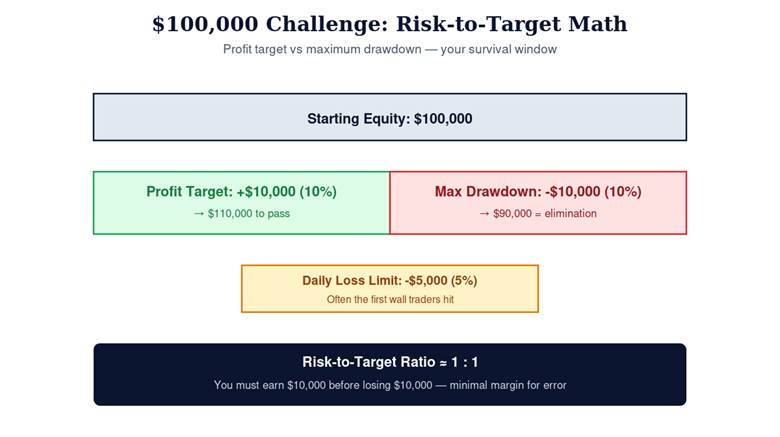
Example: $100,000 Challenge

  • Profit target: $10,000 (10%)
  • Daily loss limit: $5,000 (5%)
  • Maximum drawdown: $10,000 (10%)

Prop firm challenges typically require traders to achieve predefined profit targets while adhering to strict maximum drawdown limits, which serve as a key risk management parameter. Traders must stay within these limits throughout the evaluation to successfully secure funding.

Notice the “challenge leverage”: you must earn $10,000 before you lose $10,000. Your risk-to-target ratio is approximately 1:1, it means any high-volatility approach has minimal margin for error.

Two Risk Models Compared

Consider an equity curve path: A trader risking 1.5% per trade with a 55% win rate might win 3, lose 4 in sequence. That’s -1.5% net on paper, but the four consecutive losses (-6%) breached the 5% daily limit on day one. Eliminated despite positive expectancy.

The expected path to passing favours modest daily returns. At 0.5-0.75% net daily growth over 20 trading days, you reach 10-15% profit with maximum drawdown likely staying under 4%. Successful traders often break their profit targets into smaller milestones, aiming for consistent daily gains of 0.5-0.75%.

Q: Why does a 1:1 risk-to-target ratio make most strategies fragile?

A: Because variance is symmetric but consequences are not. The drawdown ends your account; the profit target only ends the phase. You need asymmetric protection on the downside.

Risk-of-Ruin, Variance, and Why Profitable Traders Still Fail

Risk-of-ruin is the core metric that separates prop firm evaluation success from failure. It measures the probability that your equity hits the stop-out level before you hit the profit target.

In plain terms: given your win rate, risk-to-reward ratio, and risk per trade, what are the odds you breach drawdown limits before reaching your goal?

Example Calculation

A trader with 50% win rate, 1:2 risk to reward ratio, risking 1% per trade on a 10% DD account. Using binomial probability, a losing streak of 7-8 trades (which occurs roughly once every 100-200 trades) pushes them to -7-8% drawdown, nearly triggering elimination.

Variance is the killer. Even a strong edge produces 6-10 trade losing streaks naturally. Monte Carlo simulations show 70-80% ruin rates for unoptimized systems in prop environments.

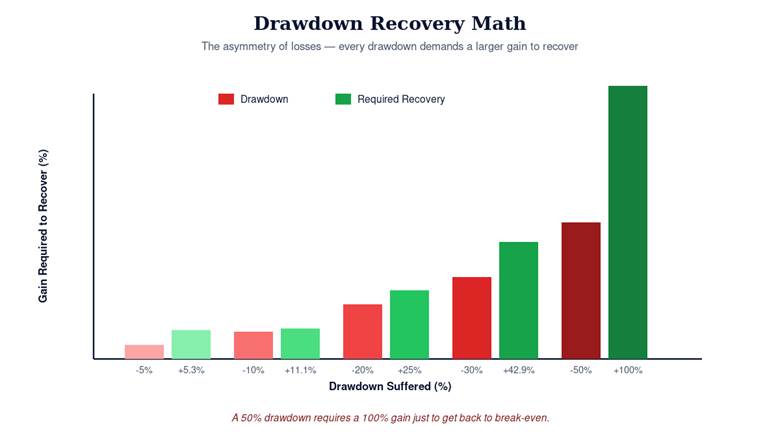
Drawdown Recovery Math

Mastering Prop Firm Challenges Through Risk Math, Not Profit Targets

This asymmetry explains why traders fail when they allow large swings during evaluation.

Many profitable traders fail challenges because their personal accounts tolerate 20-30% drawdowns with unlimited retries. Prop firms prioritize capital preservation, requiring traders to limit risk and avoid large drawdowns. When these traders apply their usual style to 5-10% drawdown rules, volatility wipes them out.

Developing robust trading psychology is essential for maintaining discipline and managing risk during prop firm challenges, helping traders stick to their strategy under pressure.

sms-star

Rule: Define your maximum acceptable drawdown before the challenge starts, and treat it as the wall — not a soft target.

Aggressive vs Conservative Passing Models

There’s no single “best” prop firm passing strategy. Instead, there are models optimized for different personalities, time horizons, and rule structures.

Aggressive vs Conservative Passing Models

Aggressive Model

  • Risk per trade: 1-2%
  • Target timeline: 3-7 trading days
  • Relies on 2-3 high probability setups daily
  • Higher risk-of-ruin (65-85% failure probability in simulations)
  • Requires iron emotional discipline

Conservative Model

  • Risk per trade: 0.25-0.5%
  • Target timeline: 20-40 trading days
  • Survives 40-60 trades, letting edge manifest
  • Lower risk-of-ruin (5-15% in simulations)
  • Buffers against emotional variance

$100k Challenge Comparison

When Aggressive Works

  • Traders with thoroughly tested, high win-rate intraday systems
  • Significant experience with consistent execution
  • No-time-limit or flexible time rules
  • Traders who can genuinely accept 65%+ failure probability

When Conservative Works Best

  • Most traders, especially those prone to revenge trading or impulsive trades
  • Firms with strict daily loss limits or trailing drawdown
  • Multi-step verification challenges
  • Anyone who struggles with maintaining discipline under pressure

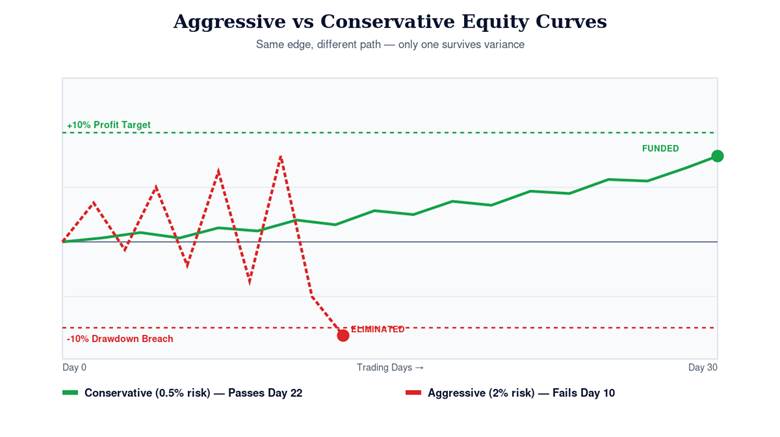
Visualize the equity curves: aggressive shows sharp swings with quick pass or fail resolution. Conservative shows a shallow zig-zag pattern, it’s slower but steadier, with higher survival odds.

sms-star

Key Notes:

  • Aggressive models have higher EV per challenge but devastating failure rates over many attempts.
  • Conservative model survives variance and compounds across multiple funded accounts.
  • Your choice should match the rule structure, not your impatience.
Designing a Prop-Firm-Ready Trading Strategy

A reliable trading strategy for prop challenges must be built around the firm’s rules first, then optimized for market edge. Your trading plan should include clear and realistic goals using the SMART framework: Specific, Measurable, Achievable, Relevant, and Time-bound.

Core Principles

Only trade high-conviction ‘A+’ setups that show strong confluences to maximize success. A well-structured trading plan acts as a personal guide, helping traders stay disciplined and make informed decisions rather than treating trading like gambling.

Your detailed plan must forbid random trades. Every trade should be tagged to a predefined setup with written criteria:

  • Timeframe and structure
  • Entry trigger
  • Stop placement logic
  • Target reasoning

Compatible Trading Styles

Short-term trading techniques, such as scalping and day trading, focus on quick trades and leverage intraday price movements, making them effective for meeting prop firm challenge requirements.

Each trading style must define average stop size, expected win rate, and maximum expected losing streak so risk-of-ruin can be estimated. Strategies for prop trading must align with the specific time and instrument restrictions of the firm.

Aron Groups Broker’s MT5 environment provides a testing ground where you can practice your exact strategy with realistic spreads and execution conditions.

Position Sizing Optimization for Challenges

Position sizing is a key component of risk management, allowing traders to determine how much of their account to risk on each trade based on their risk tolerance and account size.

Risk-Per-Trade Bands

Lot Size Calculation Example

EURUSD trade, $100,000 account, 0.5% risk ($500), 40-pip stop:

  • Pip value (standard lot): $10
  • Lot size = $500 ÷ (40 × $10) = 1.25 lots

ATR-Adjusted Sizing

Use 1.5-2x the 14-period ATR for stop distance. If EURUSD ATR is 30 pips, your stop becomes 45-60 pips. Recalculate lot size to maintain consistent monetary risk.

Dynamic De-Leveraging Rules

  • After two consecutive losses: cut position size by 50%
  • Return to normal only after equity recovers to previous high
  • This prevents emotional overexposure

Traders should typically risk only 1-2% of their account per trade to manage risk effectively and avoid significant drawdowns. Position sizing should also account for correlated pairs, EURUSD and GBPUSD together shouldn’t exceed your daily risk tolerance.

Mini Example: Sequenced Losses on a 0.5% Risk Plan (text-only scenario)

Imagine you take six trades over two sessions at 0.5% risk each. You lose three in a row (-1.5%), win one (+1%), then lose two more (-1%). Net result is -1.5%. Under any 5% daily DD rule, you are still well inside the survival window — and your psychological capital is intact for tomorrow.

Now run the same sequence at 2% risk: -6% on the three early losses, +4% on the winner, -4% on the two losses that follow. Net is -6%, but you were eliminated before the recovery trades even printed.

Managing Daily and Overall Drawdown: Practical Framework

Effective risk management is crucial for passing prop firm challenges, as it helps traders control losses and protect their capital. More traders fail from DD breaches than from failing to hit profit targets.

Personal Risk Grid (Stricter Than Firm Rules)

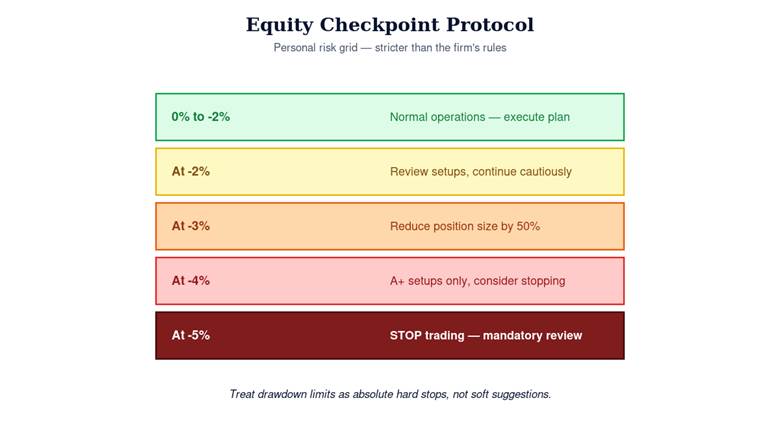
Traders should treat drawdown limits as absolute ‘hard stops’ to manage risk effectively. Managing drawdowns is essential; traders should set personal loss limits that are stricter than the prop firm’s rules to maintain emotional control.

Personal Risk Grid (Stricter Than Firm Rules)

Equity Checkpoint Protocol:

  • At -2%: Review setups, continue cautiously
  • At -3%: Reduce position size by 50%
  • At -4%: A+ setups only, consider stopping for day
  • At -5%: Stop trading, mandatory review

Locking In Gains: Once up +5%, reduce risk so a single bad day cannot erase more than 30% of accumulated profits. This is disciplined risk management in action.

A strong risk management strategy includes setting clear stop-loss orders at logical technical levels to prevent significant losses. To successfully pass a prop firm evaluation, it is essential to manage risk rather than chase profits.

sms-star

Rule: Build the personal grid before the challenge starts. Mid-drawdown is the worst possible moment to write rules.

Psychological Capital: Managing Your Mind Like a Risk Budget

Nearly 80% of traders struggle because of poor emotional control and decision-making under pressure, highlighting the importance of emotional discipline in trading success.

Psychological capital is finite. Energy, focus, and emotional tolerance deplete with volatility, drawdowns, and pressure to pass. Many traders fail prop firm evaluations not from poor risk management of their strategy but from emotional spirals.

Concrete Routines

  • Pre-market checklist (5 minutes): review key levels, news, emotional state
  • Defined trading window: e.g., London/NY overlap only
  • Maximum 5 trades per day
  • Post-session review: attribute outcomes to setup quality vs execution

Psychological Rules

  • 60-minute cooldown after any loss >0.75%
  • Never increase lot size immediately after a loss
  • Mandatory journal entry before resuming after losing streak

Documenting trades and emotional states in a trading journal can help identify psychological triggers and improve performance. Rate your stress, confidence, and impulsivity (1-10 scale) each session to identify patterns.

Emotions like fear, greed, and hope can derail even the best trading plans, making it crucial for traders to recognize these feelings and pause before making decisions.

Building confidence through practice is essential for emotional discipline; when traders trust their strategy, they are less likely to make impulsive decisions. Successful traders develop pressure management techniques, viewing each trading day as independent and focusing on the process rather than the outcome.

Q: Why does psychological capital matter as much as financial capital in a prop challenge?

A: Because almost every blown account in evaluation history was technically possible to avoid — but the trader was out of patience, sleep, or composure before the rule fired.

Adapting to Different Prop Firm Rule Structures

Each prop firm’s rulebook materially changes optimal passing strategy. Disciplined traders must tailor their trading approach for each evaluation.

Strict Daily Drawdown Firms

  • Risk 0.5% or less per trade
  • Fewer simultaneous positions (1-2 max)
  • Hard cutoff after 50% of daily limit reached
  • Avoid holding positions through high-impact news

Trailing Drawdown Challenges

When the max drawdown line trails from peak equity, avoid large floating profit reversals. Scale out 50% at 1:1 RR to lock gains. The trailing mechanism means your “floor” rises with profits, protect it.

Consistency Rules (e.g., no day >30% of total profit)

  • Smooth your equity curve deliberately
  • Avoid oversized “hero” trades
  • Distribute gains across minimum trading days
  • Target 0.5% daily rather than sporadic 3% days

No-Time-Limit Firms

Allow ultra-conservative strategies with very low risk-of-ruin. Risk 0.25-0.3% per trade, aim for 0.3-0.5% daily growth on quality trades only. Continuous learning and patience replace speed.

News and Holding Restrictions

Use the economic calendar to filter high-impact releases. Avoid news trading during prohibited periods. Design swing strategies that comply with overnight/weekend holding bans.

sms-star

Rule: Match the strategy to the rulebook, not the other way around. Two firms with the same target can require completely different execution styles.

The Survival-First Execution Framework

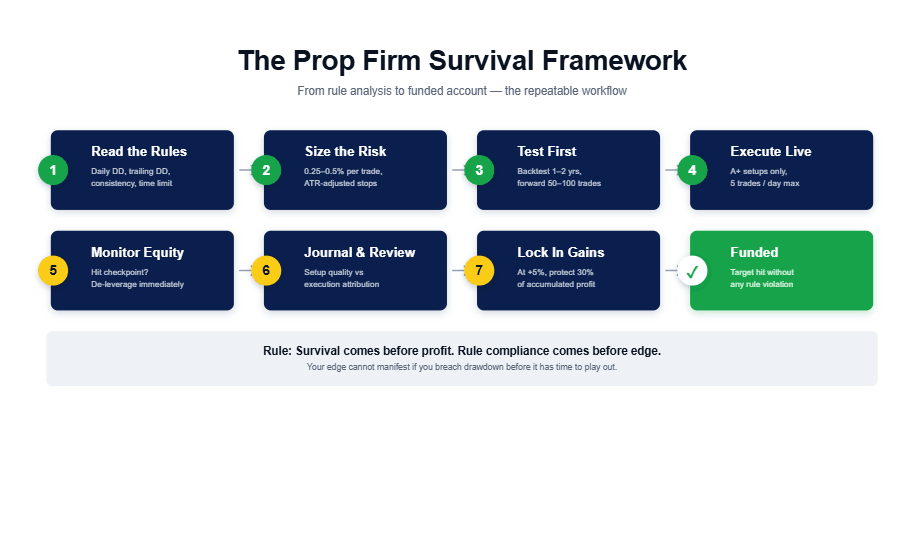
When risk control, position sizing, and psychology align with the firm’s specific rules, the challenge stops feeling like gambling and starts behaving like a repeatable process. The framework below sequences the workflow from pre-challenge planning to funded execution.

Mastering Prop Firm Challenges Through Risk Math, Not Profit Targets

Sample Passing Gameplans (Scenarios and Equity Curves)

Scenario 1: Conservative Pass

$100k challenge, 0.5% risk per trade, 55% win rate, 1:1.8 RR:

Pass achieved in 22 trading days. Smooth equity curve, never approached risk limits. Consistent profitability through disciplined execution.

Scenario 2: Aggressive Fail

$100k challenge, 2% risk per trade:

Challenge failed despite +1.8% net. The trader’s edge was positive, but variance plus high risk triggered elimination. This is why most successful traders choose conservative approaches.

Scenario 3: Midway Recovery

Trader falls -4.2% in week 1 (poor risk management of emotions). Implementation of strict rules:

  • Cuts position size to 0.25%
  • Limits trades to A+ setups only
  • No trading after any loss day

Result: Climbs from -4.2% to +10.5% over 18 days. The shift from chasing to preservation creates consistent performance and long term success.

Testing and Refining Your Prop Firm Passing Strategy

Mock evaluations on demo accounts can build confidence by replicating the firm’s rules and targets. Demo trading with prop-like rules is mandatory before paying evaluation fees.

Backtesting Requirements

  • Minimum 1-2 years of data on target instruments
  • Use MT5 or similar with realistic spreads (0.8-1.2 pips on majors)

Track not just win rate and profit factor but:

  • Maximum drawdown
  • Average losing streak
  • Standard deviation of daily returns

Backtesting allows traders to evaluate their strategies against historical market data, providing insights into potential performance before risking real capital.

Forward Testing Protocol

  • 50-100 trades minimum
  • Same leverage, time-of-day restrictions, and daily DD limits as target firm
  • Record every trade with setup type, risk size, rule compliance, and emotional state

Forward testing with demo accounts simulates live trading conditions, helping traders assess how their strategies perform in real-time and adjust accordingly.

Using a disciplined approach with backtested strategies can help maintain consistency and discipline in trading. Regularly reviewing and updating your trading plan is essential; evaluations should occur daily, weekly, and monthly to ensure adherence and identify areas for improvement.


A significant percentage of retail client accounts lose money when trading CFDs, highlighting the importance of thorough strategy testing to identify risks and improve performance before live trading.

Q: How close should the demo setup mirror the live challenge?

A: Identical leverage, identical spreads, identical daily loss cap, identical trading hours. Any gap between demo and live is exactly the variable that breaches you in real conditions.

Conclusion

Passing a prop firm isn’t about having a “good” trading strategy, it’s about managing risk-of-ruin, variance, and psychological capital under strict rules. Maintaining a 1:2 or better risk-to-reward ratio helps ensure profitability even with a win rate below 50%, but only if you survive long enough to realise it.

Survival and rule compliance come first. Traders should avoid overtrading and stick to their trading plan to achieve better outcomes and prevent emotional trading. Design risk parameters that let your edge play out: master risk management before chasing profits.

Build a written plan with concrete numbers like risk per trade, daily loss cap, maximum trades, profit target breakdown by phase. Test thoroughly on a broker like Aron Groups before paying challenge fees for a funded account.

Traders who approach evaluations as statistical, rule-bound businesses rather than emotional gambles dramatically increase their chances of being among the small group who consistently secure and keep funded accounts. Identify patterns in your trading performance, refine your trading approach, and treat each challenge as an exercise in disciplined business execution.

Continue Reading
not-found
calendar 19 May 2026
Rate this article

Leave a Reply

Your email address will not be published. Required fields are marked *

No thanks