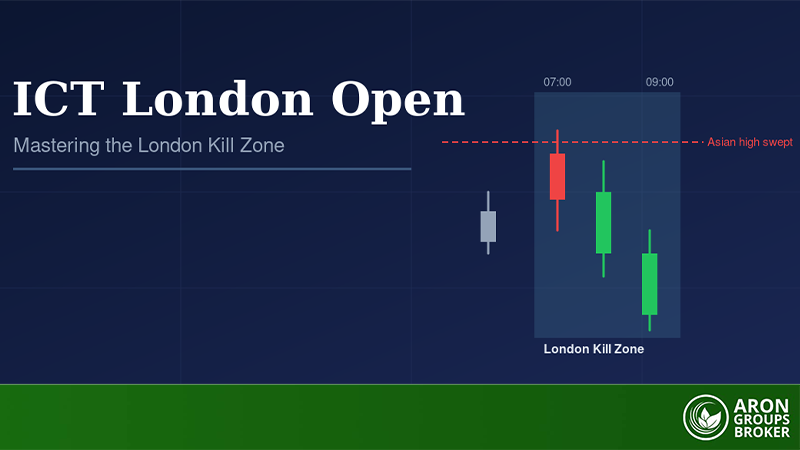

The ICT London open strategy, developed through the teachings of Michael J. Huddleston, known as the Inner Circle Trader, represents a departure from indicator-based trading towards understanding how institutional order flow actually moves markets. At its core, this approach focuses on the London kill zone, a specific two-hour window between 07:00–09:00 GMT when European banking centres activate and create the most significant price movements of the trading day.
These ICT kill zone times are based on the opening hours of each major session, such as Tokyo, London, and New York, which are critical for identifying heightened volatility and trading opportunities.
ICT kill zones are specific time periods when institutional trading activity peaks, creating predictable volatility patterns and high-probability trading opportunities. Unlike traditional indicators that lag behind price, kill zone timing aligns traders with the exact hours when smart money executes its largest orders.
Understanding time zones is crucial for aligning with major session openings, ensuring traders participate during periods of maximum liquidity. The London kill zone stands out as the most critical window for forex traders focusing on EUR/USD, GBP/USD, and related European crosses.
Consider a typical trading day where EUR/USD consolidates in a 20-pip range during the Asian session, then sweeps above the Asian high at 08:05 GMT before reversing sharply to establish the day’s low by 10:00 GMT. These market movements are often triggered by institutional activity during these key windows. This pattern (consolidation, sweep, reversal) repeats with remarkable consistency.
Rather than trading randomly throughout the day, forex traders using Aron Groups Broker can structure their entire trading session around this two-hour window, capturing the day’s directional move while avoiding the noise of off-peak hours.
- The ICT London open strategy centres on the 07:00–09:00 GMT kill zone, also known as the ICT London Killzone, which sets the daily price direction for EUR/USD and GBP/USD on approximately 70-80% of trading days.
- ICT trading emphasises focusing on specific zone times, such as the ICT London Killzone, to maximise trading precision by targeting periods of heightened institutional order flow and volatility.
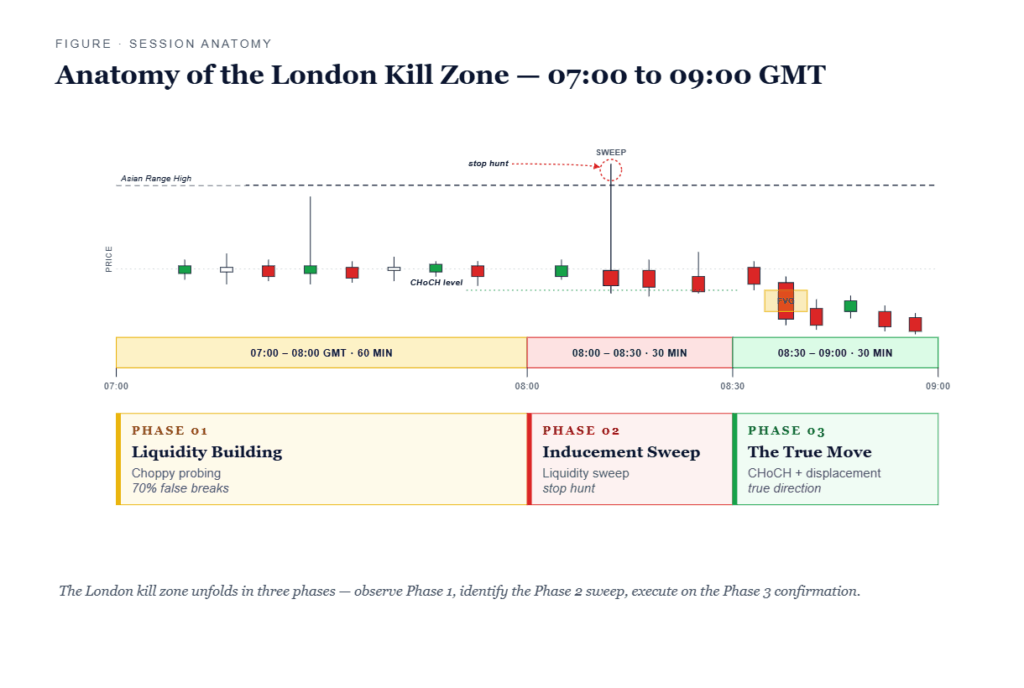
- The London kill zone typically unfolds in three phases: liquidity building (07:00–08:00), inducement sweep of Asian highs/lows (08:00–08:30), and the true directional move (08:30–09:00).
- In GMT, the London kill zone runs 07:00–09:00; in New York time, this translates to 02:00–04:00 AM EST, shifting during daylight saving time changes.
- The ICT London open strategy is designed for the ICT trader who seeks to capitalise on institutional order flow and market structure during these high-probability zone times.
- Aron Groups Broker supports this intraday trading style with tight spreads (as low as 0.0 pips on majors), fast MT5 execution under 50ms, and access to forex, gold, and indices.
- Trading the London open with defined kill zone timing eliminates the need for constant screen monitoring and reduces overtrading by focusing only on high-probability windows.
Core Concept: ICT Kill Zones and Session-Based Liquidity
ICT kill zones exist because global forex markets operate through major banking hubs that activate at specific times. These zone times are defined by the overlap of major session openings and are influenced by global time zones, which determine when heightened volatility and trading opportunities occur.
When Frankfurt opens at 07:00 GMT and London follows at 08:00 GMT, interbank liquidity surges 2-5x above average levels. According to BIS triennial survey data from 2022, London alone handles 38% of global FX turnover, making its opening hours the most significant for price discovery.
| Kill Zone | GMT Window |
|---|---|
| Asian | 20:00–00:00 |
| London Open | 07:00–09:00 |
| New York Open | 12:00–14:00 |
| New York Close | 19:00–20:00 |
Each corresponds to specific zone times when major market players begin executing their daily orders. During ICT kill zones, the probability of winning trades is significantly higher due to increased market volatility and liquidity as major institutional players execute their orders.
The relationship between these windows follows a predictable pattern: liquidity builds during the Asian trading session as price consolidates into tight ranges, creating liquidity pools at range extremes where retail traders place stop orders. The London session then sweeps these levels, engineering a false breakout, before revealing the true price direction.
New York sessions either extend the London move or reverse it entirely. Aron Groups Broker clients can focus their intraday trading around these specific windows instead of requiring constant screen time, which helps reduce overtrading and decision fatigue.
Understanding the London Kill Zone (ICT London Kill Zone / London Open)
The ICT London Killzone is a defined window for ICT trading strategies, representing the single most important period for EUR/USD, GBP/USD, and major European crosses. The ICT London Killzone occurs between 02:00 AM and 05:00 AM New York local time, coinciding with the opening of the London forex session, which is the largest trading session by volume.
In GMT terms, the standard window runs 07:00–09:00.
Frankfurt’s pre-open activity around 06:00–07:00 GMT begins probing overnight levels, but the concentrated move typically occurs when the London session opens at 08:00 GMT, marking the start of the ICT London Killzone. This combination produces the most significant two-hour window in forex trading.
The London Killzone is known for establishing the daily directional bias for major currency pairs, with a reported win rate of 85% for traders who focus on this time frame. The initial volatility during the London session opens provides key trading opportunities for ICT traders, as price action often accelerates and liquidity is swept.
During the ICT London Killzone, the most actively traded currency pairs are the Euro (EUR) and the British Pound (GBP), which often experience significant price movements due to high institutional activity. The classic London killzone pattern involves raiding the Asian session highs or Asian session lows before reversing into the true daily trend.
This sweep of liquidity triggers retail stop orders, providing institutional traders the liquidity needed to fill large positions in the opposite direction.
For Aron Groups Broker users, the most responsive instruments during this window include EUR/USD, GBP/USD, EUR/JPY, GBP/JPY, and spot gold (XAUUSD). The broker’s tight spreads become particularly valuable during these volatile moments when spreads elsewhere can widen significantly.
Phases of the ICT London Kill Zone
Understanding the three distinct phases of the London kill zone helps traders avoid premature entries and identify the optimal trade entry pattern.
Phase 1 (07:00–08:00 GMT): Liquidity Building
This first hour features choppy price action as European traders begin testing overnight levels. Price typically oscillates 10-20 pips, probing both the Asian high and low without committing to a direction.
ICT backtests suggest that false breaks occur 70% of the time during this phase. Serious traders, especially an ICT trader, avoid entries here entirely, using this time to observe which liquidity pool price is targeting and to wait for confirmation before acting.
Phase 2 (08:00–08:30 GMT): Inducement Sweep
The critical sweep phase arrives with full London liquidity. Price surges to take out the Asian range extreme, either the high or low, triggering clustered stop orders.
This creates what ICT traders call a “breaker block” or “mitigation zone.” Volume spikes as algorithmic systems execute stop hunts, and the market structure begins showing stress in the direction of the initial move. An ICT trader typically waits for confirmation during this phase as well, avoiding premature entries and focusing on institutional order flow and market inducements.
Phase 3 (08:30–09:00 GMT): The True Move
Following the sweep, a change of character (CHoCH) or market structure shift appears on the 5-minute chart. Price leaves a fair value gap, a three-candle imbalance where price skipped levels, and begins displacing in the true daily direction.
Entries at an order block or fair value gap during this phase target the opposite side of the Asian range or further liquidity pools aligned with higher timeframe bias. Community backtests show 60-75% win rates when filtering trades specifically to this confirmation phase.
Q: Why avoid entering during the first hour of the London kill zone?
A: Because phase one produces false breaks roughly 70% of the time as price probes both Asian extremes. Entering before the inducement sweep and a structural shift means trading noise rather than institutional intent, so the first hour is for observation, not execution.
Rule: Trade the confirmation after the sweep, never the sweep itself. |
Asian and New York Kill Zones: Context for the London Open
While the London kill zone remains the primary focus for EUR/USD and GBP/USD traders, understanding the Asian and New York sessions provides essential context.
The Asian Kill Zone, also known as the Asian session, typically runs from 8:00 PM to 10:00 PM EST, coinciding with the opening of the Tokyo market. In GMT, this extends from 20:00–00:00.
During the Asian Kill Zone, trading is characterised by lower volatility and range-bound price action, as institutional traders manage their positions without the full participation of European and US markets. The Asian Kill Zone is often used by traders to identify range levels that will be relevant during the subsequent London session, rather than for aggressive trading.
For traders focusing on JPY pairs like USD/JPY, EUR/JPY, or GBP/JPY, the ICT Asian kill zone offers more direct trading opportunities due to Tokyo’s influence. The Australian dollar and related AUD/NZD crosses also see elevated activity.
However, most ICT London traders use the Asian session purely for preparation, marking the range that London will subsequently target.
The New York Kill Zone occurs between 07:00 AM and 10:00 AM New York local time, coinciding with the overlap of the London and New York trading sessions, which creates high volatility and liquidity. During the New York Kill Zone, significant price movements often occur due to the influx of institutional order flow, making it a critical time for traders to execute their strategies.
This window either extends the London move, confirming the daily bias, or reverses it entirely, particularly around major US economic releases like NFP at 13:30 GMT.
Regional Variants: London Kill Zone vs York Kill Zone
Traders often refer to the New York open window as the York kill zone or NY kill zone, distinguishing it from the earlier London session. The New York Kill Zone is particularly important for trading major currency pairs that include the US dollar, as well as for US equity indices, due to the high volume of trading activity during this period.
For forex, the New York kill zone for EUR/USD runs 12:00–14:00 GMT (07:00–09:00 New York time). US indices like US500 respond more to the 13:30–15:00 GMT window around the cash open.
Traders often focus on specific time windows known as ‘kill zones’ to execute trades, as these periods are characterised by increased volatility and liquidity due to institutional trading activity.
Combining both London and New York kill zones provides two primary intraday opportunities without requiring 24-hour screen time. Aron Groups Broker traders report that this dual-zone approach reduces drawdowns compared to random day trading while maintaining sufficient opportunities.
Trading Tip: The recommendation for most retail traders is to pick one or two kill zones that fit their time zone and lifestyle. Attempting to trade all four ICT kill zones around the clock typically leads to fatigue and degraded performance.
Intraday Trading Blueprint: ICT London Open Strategy Step-by-Step
A successful London kill zone approach follows a systematic daily routine rather than reactive trading. The blueprint involves pre-session analysis, patient observation during the kill zone, precise execution on confirmation, and disciplined management afterward.
Risk management rules should limit exposure to 0.5-1% of account equity per trade, with a maximum of 2-3 trades per session. Effective trading strategies during high-volatility periods include waiting for confirmation signals after initial price movements, which helps to avoid false breakouts and enhances the probability of successful trades.
Using limit orders at pre-defined price levels (order blocks, fair value gaps) prevents chasing market orders during fast-moving candles.
Aron Groups Broker’s MT5 platform allows traders to store templates with kill-zone boxes, custom alerts, and pre-marked levels, transforming the daily London open routine into a systematic process rather than improvised decision-making.
Pre-Session Preparation Before the London Kill Zone
Complete this checklist 30-60 minutes before 07:00 GMT:
- Identify higher timeframe bias: Review daily and 4-hour charts for EUR/USD and GBP/USD. Note recent swing highs and lows, trend direction, and whether price sits above or below the 200-period moving average.
- Mark the Asian session range: Draw horizontal lines at the high and low formed between approximately 23:00–06:00 GMT. These levels become the primary targets for London sweeps.
- Identify overnight imbalances: Mark any fair value gaps or order blocks formed during the Asian session that could serve as potential entry points after the sweep.
- Note liquidity pools: Highlight equal highs, equal lows, previous day’s high and low (PDH/PDL), and any obvious stop clusters likely to attract price during the kill zone.
- Check economic calendar: Review scheduled releases between 07:00–10:00 GMT and 12:00–14:00 GMT, particularly GBP, EUR, and USD data that could amplify or distort typical kill zone behaviour.
During the London Kill Zone: Identifying the Trade Setup
Between 07:00–09:00 GMT, focus on these real-time price action tasks:
- Watch phase (07:00–08:30 GMT): Observe whether price sweeps above the Asian high or below the Asian low. Do not enter during the initial move. Trading during high-volatility periods, such as during major economic news releases, can lead to significant price movements, providing traders with opportunities to capitalise on rapid market changes, but only after confirmation.
- Await structural confirmation: Look for a change of character (CHoCH) or break of structure on the 5-minute or 1-minute chart in the direction opposite to the sweep. This shift signals potential reversal.
- Identify entry zones: Seek entries at or near an ICT order block or fair value gap created by the rejection move. The optimal trade entry typically falls within the 62-79% Fibonacci retracement of the sweep leg.
- Place precise stops: Position stop-losses 5-10 pips beyond the sweep’s extreme high or low, protecting against a secondary sweep while keeping risk defined.
- Target logical liquidity: Aim for the opposite side of the Asian range, previous day’s high or low, or the next intraday fair value gap aligned with higher timeframe bias. A 3:1 reward-to-risk ratio is standard.
After the Kill Zone: Trade Management and Session Close
Once the London kill zone window ends around 09:00 GMT:
- Scale partial profits: Take 50% off the position when price reaches the first major liquidity target, then move the stop to breakeven or better.
- Manage around news: Close or reduce exposure before major New York data at 12:30–13:30 GMT unless the trade is strongly in profit and market structure remains intact.
- Avoid forcing new entries: After 10:00–11:00 GMT, volatility typically declines. Resist the urge to chase setups that don’t meet kill zone criteria.
- Journal the session: Record screenshots of your London kill zone setups, noting entry rationale, outcome, and emotional state. This review process refines execution over weeks and months.
Instrument Focus: EUR/USD, GBP/USD, Gold and Indices Around the London Open
Different instruments respond to the London open with varying characteristics, requiring adjusted expectations and timing.
EUR/USD and GBP/USD serve as the primary focus for the London kill zone due to European institutional order flow and deep liquidity.
Did You Know? Historical tick data from 2024 shows EUR/USD sets its daily high or low between 07:00–11:00 GMT on approximately 75% of trading days.
- GBP/USD often moves even more aggressively, particularly when UK economic data releases at 07:00 GMT amplify the kill zone sweep.
- XAUUSD (gold) becomes active during both London and New York kill zones. London typically sets the session bias, while New York delivers the largest daily range expansion, often exceeding 100 pips on trending days.
The London gold fixing at 10:30 GMT creates an additional reference point, though the kill zone itself precedes this.
CFD indices like DE40 (German DAX) surge at 08:00 GMT with the European equity open, making them responsive to London kill zone concepts. US indices such as US500 and US100 respond more directly to the US session and New York kill zone timing.
Practical Examples of London Kill Zone Behaviour
Mini Example: Classic EUR/USD Sweep and Reversal (text-only scenario)
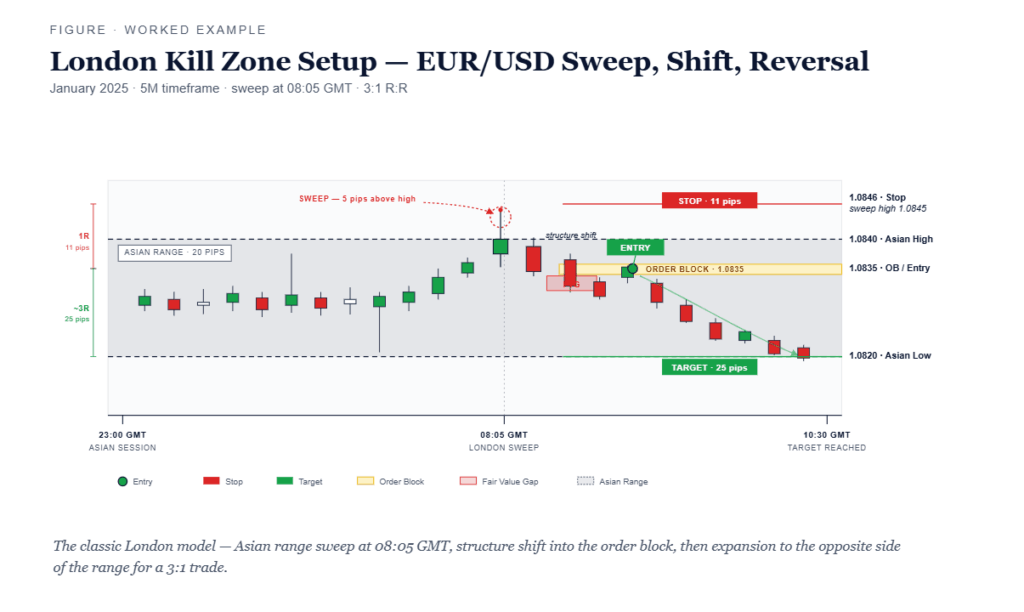
On a January 2025 trading day, EUR/USD consolidated in a tight Asian range between 1.0820–1.0840. At 08:05 GMT, price spiked to 1.0845, sweeping the Asian high by 5 pips and triggering clustered buy stops.
Within minutes, aggressive selling created a 5-minute fair value gap on the drop. A market structure shift appeared at 1.0835 near a visible order block, offering an entry opportunity.
Price then trended lower through the morning, reaching the Asian low at 1.0820 for a clean 25-pip trade, approximately 3:1 reward-to-risk.
Mini Example: GBP/USD News-Driven Continuation (text-only scenario)
Following UK inflation data at 07:00 GMT, GBP/USD swept below its Asian low, creating the appearance of bearish momentum. However, the data came in hotter than expected, and price reversed sharply after the sweep, forming a bullish order block on the 5-minute chart.
The trade setup targeted liquidity above the Asian high, then extended into the New York kill zone for an additional 40-pip expansion, demonstrating how London and New York sessions can work in sequence.
These behaviours highlight why low spreads and fast execution matter during kill zone volatility. Aron Groups Broker’s tight spreads on majors (as low as 0.0 pips) and execution under 50ms help preserve edge when prices move rapidly.
Implementing the ICT London Open Strategy with Aron Groups Broker
Translating conceptual ICT London kill zone knowledge into practice requires appropriate platform setup and broker features.
Pro Setup: On MT5 through Aron Groups Broker, traders can set chart time to GMT or their local time zone, then draw recurring kill zone boxes (07:00–09:00 GMT) on EUR/USD, GBP/USD, and XAUUSD. Templates save these markings across sessions, eliminating daily setup time. Custom alerts can trigger when price enters the kill zone or approaches Asian range extremes.
Aron Groups Broker offers tight spreads on most active pairs, which proves crucial during fast London open volatility when spreads elsewhere often widen 2x or more. For traders still developing their skills, copy trading functionality allows observation of experienced intraday traders who apply kill zone discipline.
Prop trading opportunities reward consistent execution for traders who demonstrate edge over evaluation periods.
Risk Warning: Test the ICT London open approach in a demo account first. Regardless of execution quality, careful risk management remains essential; no broker eliminates the inherent risks of forex trading.

Risk Management and Psychological Edge Around Kill Zones
The London kill zone strategy succeeds not only through timing but also through protecting capital and avoiding psychological traps.
Key risk management rules:
| Rule | Application |
|---|---|
| Trade limit | 1-3 well-defined setups per London session |
| Maximum daily loss | 2-3% of account equity |
| Position sizing | Fixed risk per trade using MT5 calculators |
| Stop placement | Beyond sweep extremes, never arbitrary |
Pre-defining stop-loss size in pips and calculating position size before each trade maintains consistent risk regardless of volatility spikes.
Restricting trading to defined kill zones addresses overtrading directly. Rather than reacting to every price fluctuation throughout the trading day, this framework provides clear boundaries.
Decision fatigue decreases, emotional control improves, and overall performance typically stabilises.
Implement a post-session review routine: evaluate whether you respected kill zone rules, risk limits, and emotional boundaries, not just the profit and loss result.
Frequently Asked Qestions
Can I trade both the London and New York kill zones on the same day?
Many experienced ICT traders focus on one primary window (usually London) and sometimes add the New York kill zone only if they remain mentally fresh and within daily risk limits. Attempting to trade Asian, London, and New York sessions in a single day typically leads to fatigue and overtrading, especially for newer retail traders.
Start by mastering one kill zone, typically the London kill zone for EUR/USD, before adding another session to your routine. Risk limits should apply across the entire trading day, not per kill zone, to avoid compounding losses through multiple sessions.
How do I handle Daylight Saving Time with the ICT London kill zone?
The London kill zone remains 07:00–09:00 London local time throughout the year, but its relationship to New York shifts when either region changes clocks. During most of the year, the London kill zone corresponds to 02:00–04:00 New York time (eastern daylight time when applicable), but may shift to 03:00–05:00 during overlapping DST changes in March and November.
Set MT5 charts on Aron Groups Broker to your preferred server time and confirm kill zone windows with an up-to-date world clock or economic calendar. Update trade plans and chart templates whenever DST changes occur, typically on the second Sunday of March and November in the US.
Do ICT kill zones work on all timeframes?
Kill zones are time-of-day concepts, not timeframe-specific, but execution typically occurs on 1-minute, 5-minute, and 15-minute charts for intraday entries. Higher timeframes like 4-hour and daily define bias and key price levels before the kill zone opens, while lower timeframes provide precise entries once the sweep and reversal occur.
Very low timeframes (tick charts or 1-minute during news) can produce excessive noise, so many traders blend 5-minute structure with 1-minute refinement for their London open strategy. Backtest one or two timeframe combinations rather than constantly switching to develop consistent pattern recognition.
Can the ICT London open strategy be used on crypto or exotic forex pairs?
ICT kill zones were derived mainly from highly liquid instruments like EUR/USD, GBP/USD, major JPY crosses, gold, and major index futures.
Some crypto pairs and exotic forex crosses may show weaker or irregular kill zone behaviour due to different liquidity profiles and market participants. If interested in crypto CFDs on Aron Groups Broker, first master kill zones on majors, then cautiously test whether similar patterns hold on your chosen crypto instruments.
Lower liquidity increases spreads and slippage during volatile kill zones, requiring adjusted position sizes.
Is the ICT London open strategy suitable for complete beginners?
While the London kill zone framework helps beginners avoid random trading, it still requires understanding of basic forex concepts, risk management, and chart reading.
Start on a demo account through Aron Groups Broker, practising simple London open scenarios (Asian range sweep and reversal) before committing live funds. Focus on one or two pairs like EUR/USD and GBP/USD, one kill zone, and a single entry model instead of attempting all ICT concepts simultaneously.
Historical data for backtesting ICT London open rules is readily available, and traders should verify the strategy’s edge on their specific instruments before committing significant capital.
No strategy, including the silver bullet strategy or ICT London open approach, guarantees consistent profits. The market dynamics of forex markets ensure that losses remain an inherent possibility regardless of methodology.