
icon icon Home
icon icon Accounts
icon icon Quick start
icon icon Symbols

Synthetic Dollars: How Delta-Neutral Hedging Holds a Dollar Peg Without a Bank, and Why It Is Not Risk-Free

Author
Abe Cofnas
Abe Cofnas
calendar Last update: 16 October 2026
watch Reading time: 9 min

A synthetic dollar is a crypto token that holds a value of about one US dollar without cash and Treasury bills behind it. Instead of reserves, it uses a hedge: long spot crypto paired with an equal short position in perpetual futures. The leading example is USDe, which its issuer Ethena deliberately calls a synthetic dollar rather than a stablecoin.

It matters now because the design has been through a full cycle. USDe grew to about $14.8 billion in early October 2025, was shaken by the 10 October liquidation wave, and stood at $4.9 billion on 3 October 2026, according to DefiLlama. Its staked yield has fallen from above 35% in early 2024 to 4.76% on 28 September 2026, which shows how volatile the engine is.

This guide explains the delta-neutral mechanism with worked dollar figures, where the yield comes from, how the design differs from USDT, DAI and the failed UST, and the four risks that matter. It also covers the GENIUS Act, the FX-market meaning of the term, and what a CFD trader can take from it.

bookmark
Key Takeaways
  • A synthetic dollar keeps a $1 value with a hedge, long spot crypto against a short perpetual, not with cash reserves in a bank.
  • The hedge is delta-neutral: in the worked example a $4,000 ETH position gains or loses nothing net whether ETH goes to $4,800 or $3,000.
  • The yield is the funding rate paid to the short leg plus staking rewards; sUSDe paid 4.76% on 28 September 2026 against above 35% in early 2024.
  • USDe supply peaked near $14.8 billion in October 2025 and was $4.9 billion on 3 October 2026; the token traded at $0.65 on one exchange for about 40 minutes on 10 October 2025.
  • The Reserve Fund held $62 million on 7 February 2026, under 1% of supply, enough for months of negative funding but not for an exchange or smart-contract loss.

What Is a Synthetic Dollar?

A synthetic dollar is a token engineered to be worth $1 through offsetting positions rather than through assets that are themselves worth $1. Ethena’s documentation says USDe “is not the same as a fiat stablecoin like USDC or USDT” but “a synthetic dollar, backed with crypto assets and corresponding short futures positions”. The backing exists, but it is a trade, not a deposit.

sms-star

Risk Disclosure
Trading forex and CFDs carries a high level of risk and can result in the loss of all your capital. This content is educational and is not investment advice. Never risk money you cannot afford to lose.
Why the issuer avoids the word stablecoin

A fiat stablecoin promises redemption from reserves; a synthetic dollar promises that a hedged portfolio will keep its dollar value. Germany’s BaFin found “serious deficiencies” at Ethena’s German entity under MiCA and on 14 April 2025 ordered it to reverse the issuance of its USDe tokens. Ethena has since wound down that entity and does not offer sUSDe to EU or EEA residents.

How minting and redemption keep the price near $1

Whitelisted market makers mint USDe by delivering roughly $100 of collateral for about 100 tokens, and redeem the other way. If USDe trades at $0.99 on an exchange, they buy it and redeem near $1; at $1.01 they mint and sell. That arbitrage, not a bank balance, pins the market price to the backing.

How Delta-Neutral Hedging Holds the Peg

The protocol holds spot crypto such as bitcoin, ether or staked ether and sells an equal amount of perpetual futures against it. A perpetual, as the CFTC chairman put it in May 2026, is a derivative with “no fixed expiration date” whose counterparties “periodically exchange a funding rate payment” that keeps its price close to spot.

What delta-neutral means

Delta measures how much a position’s value changes when the underlying price moves by $1. A long coin has a delta of +1, a short perpetual on the same coin has a delta of -1, and together they net to zero. A hedge with zero delta is indifferent to price, which is what a dollar token needs.

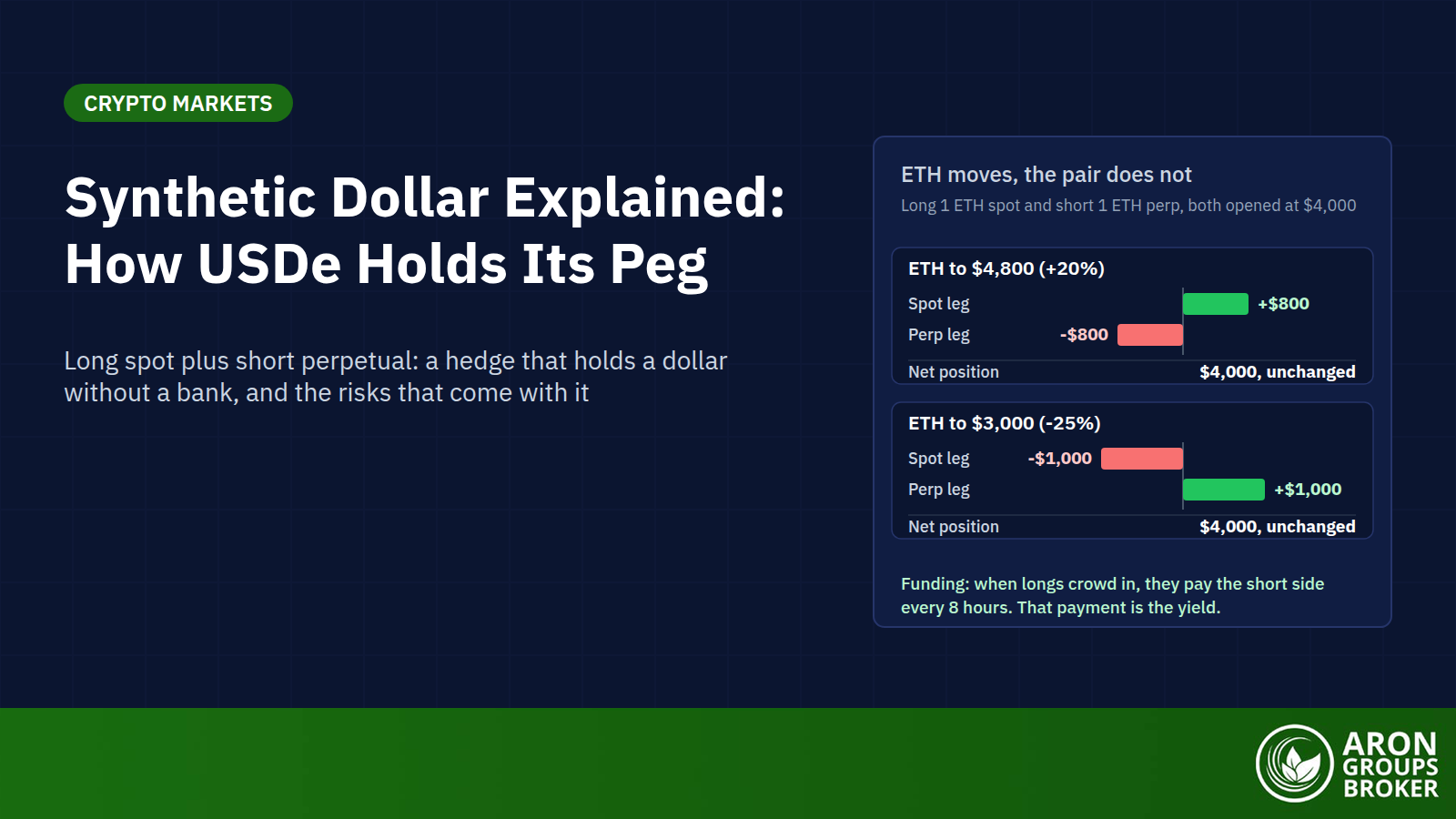
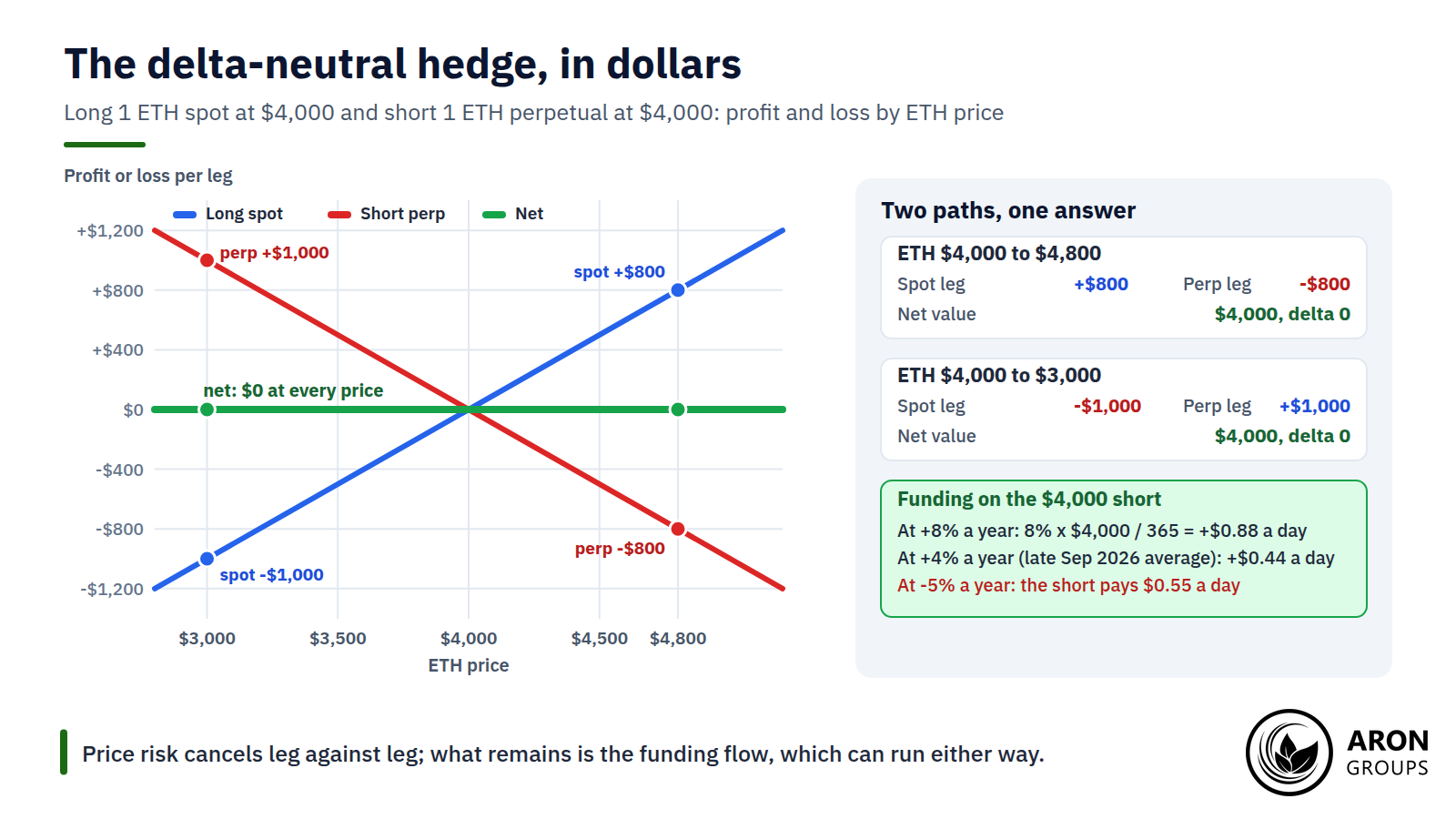
At every ETH price the spot and perpetual legs sum to zero, so the $4,000 position keeps its value and only the funding flow remains.

Mini Example: One Hedged ETH, Two Price Paths

Suppose ETH trades at $4,000. The protocol buys 1 ETH for $4,000 and sells one ETH perpetual at $4,000. Net delta is zero and the position is worth $4,000.

If ETH rises 20% to $4,800, the spot leg gains $800 and the short loses $800. If ETH falls 25% to $3,000, the spot leg loses $1,000 and the short gains $1,000. Either way the net value is still $4,000, so 4,000 USDe can be minted against it.

Funding is the part that moves. At an annualised 8%, longs pay the short leg 8% of $4,000 divided by 365, about $0.88 a day. At the late September 2026 average of roughly 4%, that is $0.44 a day. At -5%, the short pays $0.55 a day, and the Reserve Fund, not the hedge, has to cover it.

Where the Yield Comes From: Funding Plus Staking

A synthetic dollar earns from two flows unrelated to the dollar. The first is funding: when traders crowd into leveraged longs, the perpetual trades above spot and longs pay shorts every eight hours. The second is staking, because the spot leg can be held as staked ether, which earned about 2.2% a year in August 2026. Ethena passes the combined revenue to holders who stake USDe for sUSDe.

The cash-and-carry trade, tokenised

Buying an asset and selling its future against it to collect the spread is the basis trade, also called cash-and-carry, a strategy funds have run for decades. A synthetic dollar packages that trade into a token. On 25 September 2026 Ethena announced it was extending the engine to tokenised equities on Binance, where equity perpetuals carried more than $2.9 billion of open interest and a six-month average basis of 3.56% a year.

What the yield has done since 2024

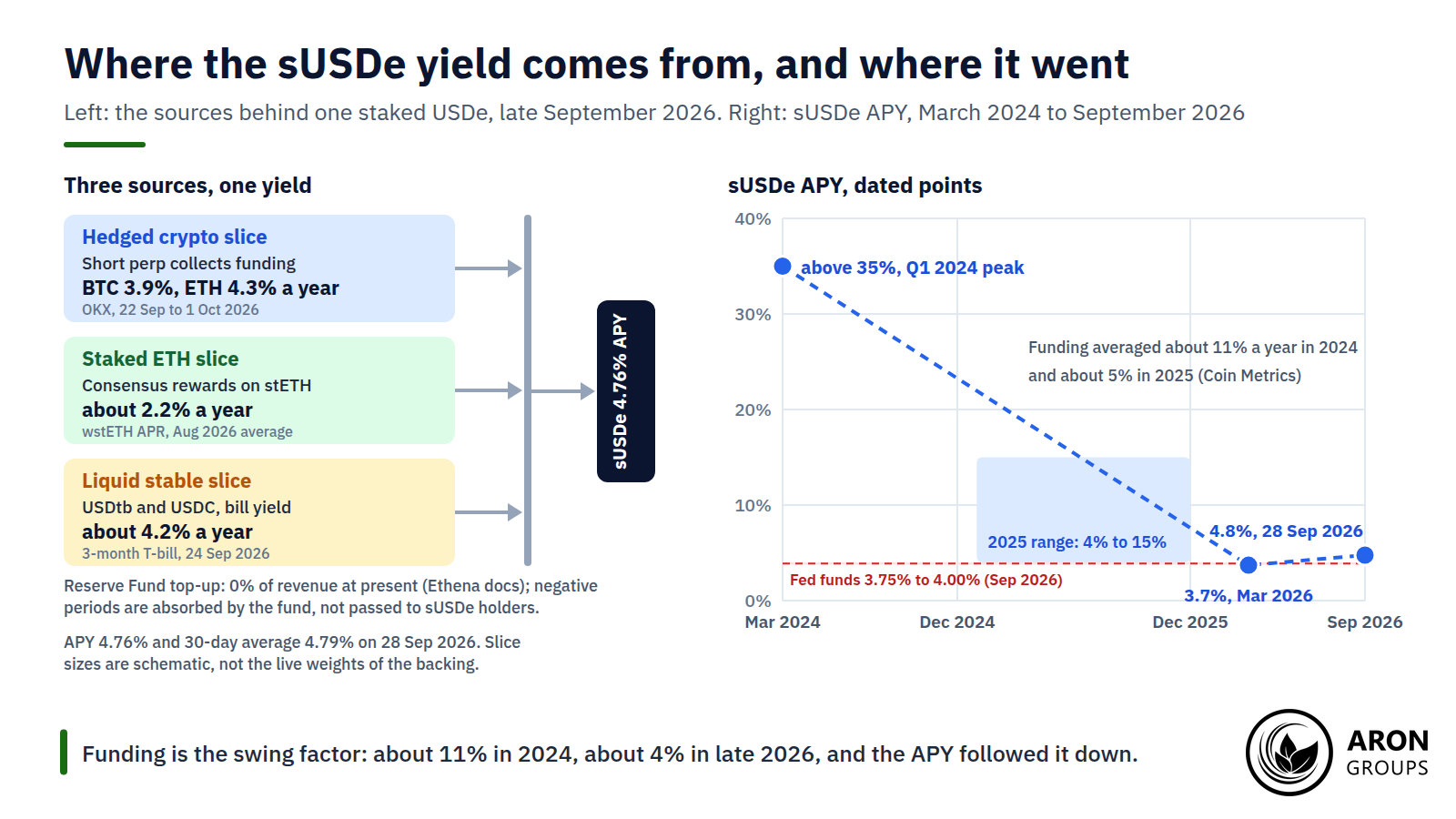
Funding drives the yield. Coin Metrics data put aggregate funding at about 11% annualised in 2024 and about 5% in 2025 to October. sUSDe followed: above 35% at its early 2024 peak, 4% to 15% in 2025, 3.7% in March 2026 and 4.76% on 28 September 2026. On OKX, BTC perpetual funding averaged 3.9% annualised between 22 September and 1 October 2026, with 7 of 30 eight-hour intervals negative.

Funding, staking and bill yield feed one sUSDe rate; as funding fell from about 11% in 2024 to about 4% in late 2026, the APY fell with it.

The Fed’s target range has been 3.75% to 4.00% since its 16 September 2026 hike, so the synthetic dollar now pays little more than cash, and the ENA incentives that subsidised early growth ended on 30 September 2026.

The Four Kinds of Crypto Dollar

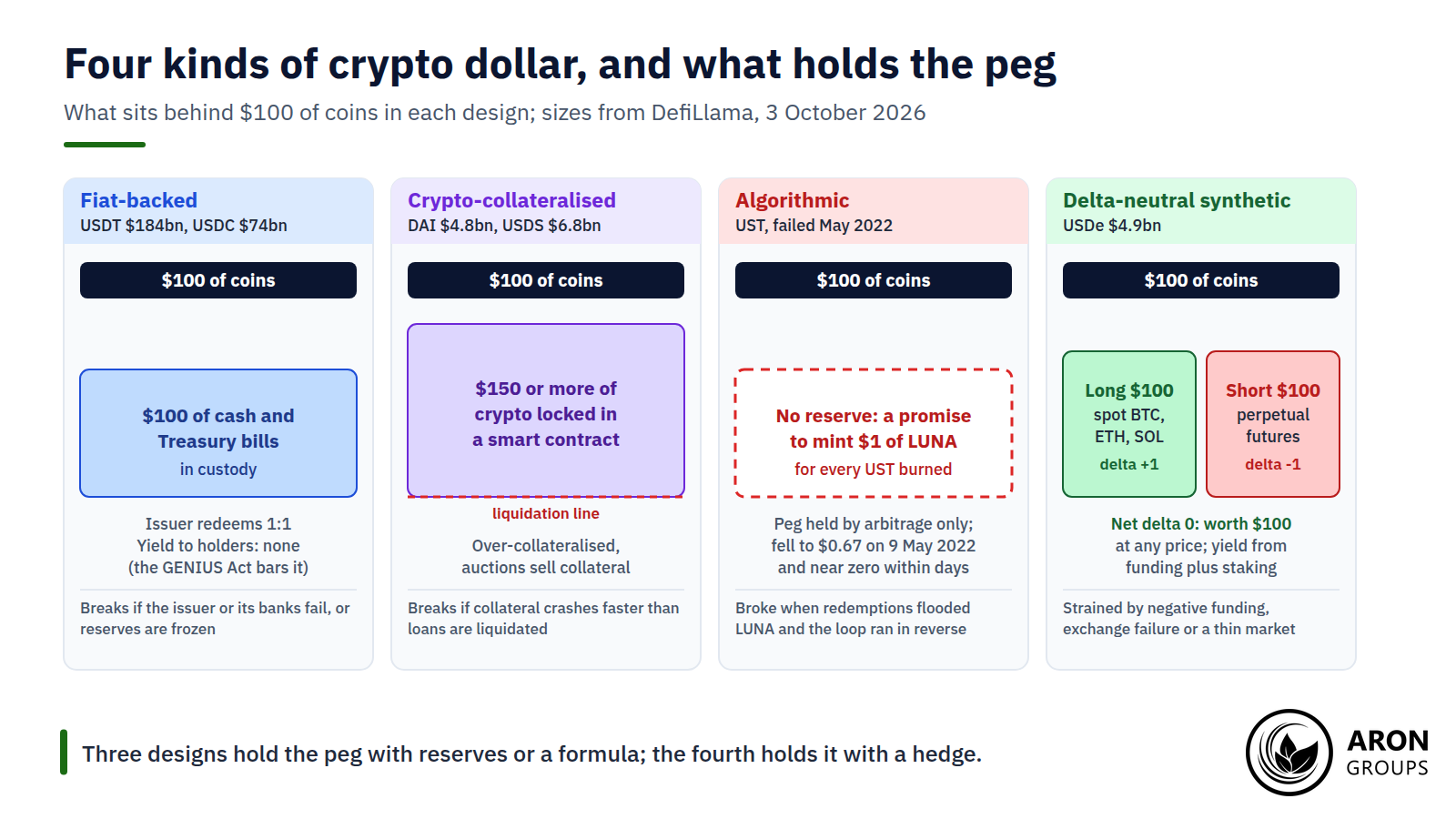
Every design must handle the moment holders want real dollars back. Fiat-backed coins such as USDT and USDC redeem from cash and bills; crypto-collateralised coins such as DAI liquidate excess collateral; algorithmic coins relied on a formula; a synthetic dollar unwinds a hedge. The split between centralised and decentralised stablecoins cuts across these categories.

CategoryExamples and size (3 Oct 2026)What backs $1Where the yield goesMain failure mode
Fiat-backedUSDT $184bn, USDC $74bnCash, bank deposits and Treasury bills held by the issuerIssuer keeps the bill interest; the GENIUS Act bars paying holdersIssuer or bank failure, frozen reserves
Crypto-collateralisedUSDS $6.8bn, DAI $4.8bnMore than $1 of crypto locked in a smart contractSavings rate from protocol fees and reservesCollateral crash faster than liquidations
AlgorithmicUST (failed May 2022)No reserve: a promise to mint $1 of LUNA for each UST burnedAnchor advertised up to 20% a yearReflexive spiral when confidence breaks
Delta-neutral syntheticUSDe $4.9bnLong spot crypto hedged with an equal short perpetual, plus liquid stablesFunding plus staking, paid to sUSDeNegative funding, exchange failure, thin markets

The four designs compared. Sizes from DefiLlama on 3 October 2026; UST facts from the SEC’s February 2023 press release.

Why USDe is not the next UST

UST failed because its only backing was a formula. The SEC describes it as an “algorithmic stablecoin” pegged “by being interchangeable” for LUNA, and records that “in May 2022, UST depegged from the U.S. dollar, and the price of it and its sister tokens plummeted to close to zero”. When holders ran, minting LUNA to pay them crushed LUNA, which made the next redemption worse: a loop with no floor.

A synthetic dollar has no such loop. Every USDe is matched by spot crypto and a short that can be unwound for real collateral, and its yield comes from a strategy funds have run for decades. USDe can still fail, but it would fail like a hedge-fund trade going wrong, not like a confidence game.

Fiat reserves, excess collateral and a formula are three answers to what holds the peg; a hedge is the fourth, and it is the only one that pays funding.

The Risks: Funding, Exchanges, De-Pegs and Code

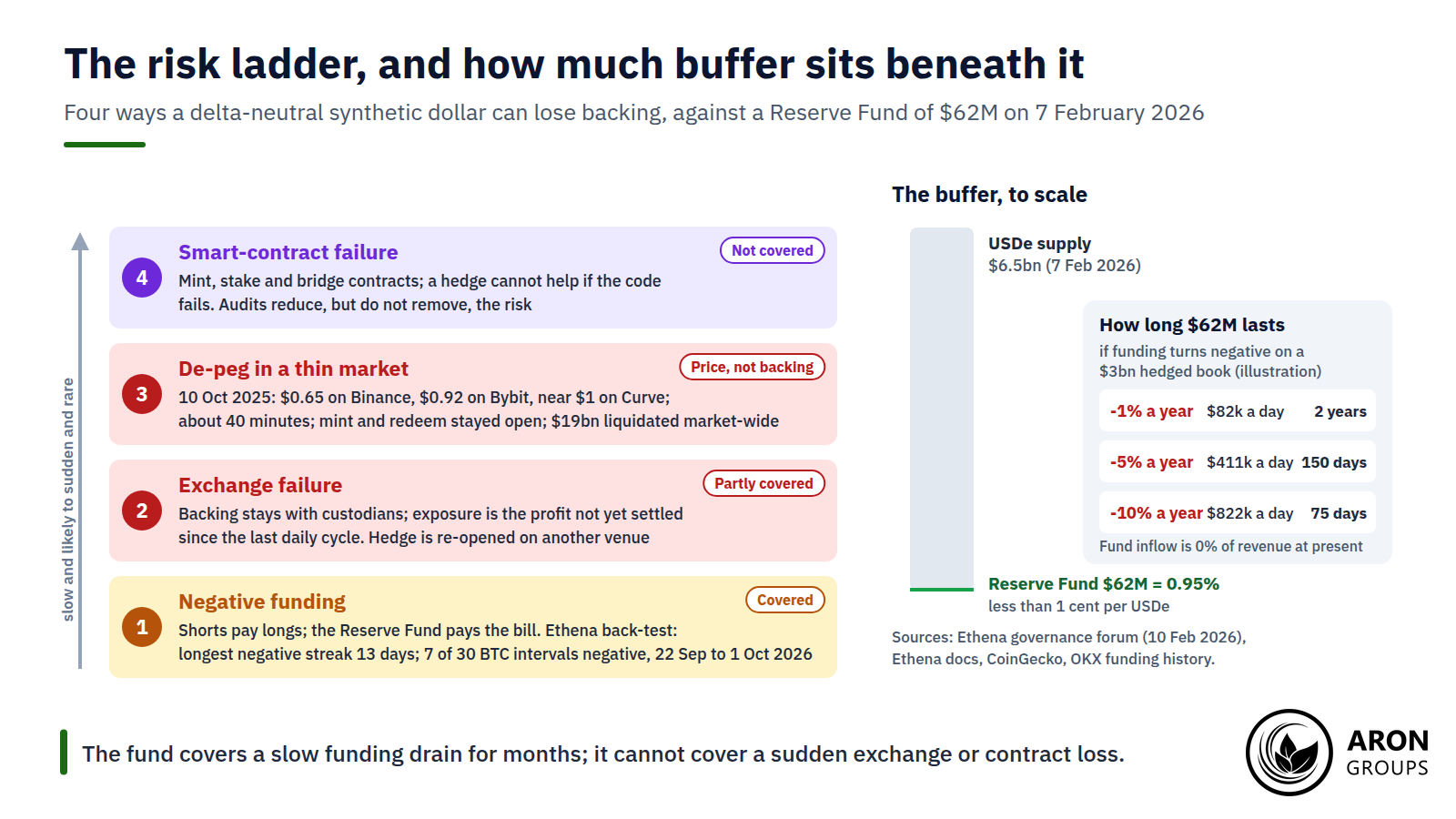
Critics call a synthetic dollar a hedge-fund trade wearing a stablecoin’s clothes. Four risks matter, in rising order of suddenness: negative funding, exchange or custodian failure, a de-peg in a thin market, and a smart-contract failure. The Reserve Fund covers the first well, the second partly and the last barely at all.

Risk 1: funding turns negative

When the market turns bearish, shorts crowd the perpetual and the funding flow reverses: the hedge pays rather than earns. Ethena’s three-year back-test found 17.5% of days negative for ETH and 15.9% for BTC, falling to 8.84% once staking income was added. The longest negative streak was 13 days, against a longest positive streak of 176. A long bear market would test those averages.

The Reserve Fund that pays that bill is small. It held $62 million on 7 February 2026 against about $6.5 billion of USDe, under 1 cent per dollar, and the share of revenue flowing into it is currently 0%. At -5% funding on a $3 billion hedged book, the drain would be about $411,000 a day and the fund would last roughly five months.

Risk 2: the shorts sit on exchanges

The hedge has to live where perpetuals trade, so the protocol runs shorts on Binance, Bybit, Bitget, Deribit and OKX. Ethena states that backing is “NEVER deposited to exchanges” and stays with off-exchange settlement custodians such as Copper, which settle profit and loss daily. An exchange failure would cost only the unsettled gains since the last cycle, but the dependence on third-party crypto exchanges remains.

Risk 3: the 10 October 2025 stress test

The sharpest test came on 10 October 2025, when a US tariff announcement set off more than $19 billion of liquidations and bitcoin fell 14.5% to $104,782. Between 21:36 and 22:15 UTC, USDe printed $0.65 on Binance while trading near $0.92 on Bybit and close to $1 on Curve. Binance later said its pricing had relied on internal order books, and it compensated users with more than $283 million.

The backing never broke; minting and redemption stayed open and the on-chain price held. What broke was liquidity on one venue, and leveraged positions using USDe as collateral were liquidated against a print that lasted about 40 minutes. Market cap still fell $2.2 billion in two days, and net outflows reached $8.3 billion within two months.

Q: Can a synthetic dollar be liquidated like a leveraged trader?
A: Not in the usual way. Ethena says it runs the hedge with no material leverage. Its analysis shows the staked-ether discount would have to reach about 65% before exchange liquidation began, against a worst case of 0.3% since Ethereum enabled unstaking. The practical danger is different: traders who borrow against USDe at high loan-to-value ratios can be liquidated when a venue prints a bad price, as happened on 10 October 2025.

The Reserve Fund of $62 million is under 1% of supply: months of cover against negative funding, but no cover against a sudden exchange or contract loss.

Risk 4: smart-contract and bridge failure

USDe lives in minting, staking and bridge contracts on more than twenty chains, 55% of it on Ethereum on 3 October 2026. A flaw in any of them can lose backing that no hedge can recover, and the Reserve Fund is far too small to make good a large exploit. Access to the platforms that mint, stake or trade synthetic dollars also varies by country, and users in restricted regions face added legal, access and custody risk.

Regulation: The GENIUS Act and the Yield Question

The GENIUS Act, signed on 18 July 2025, bars permitted payment stablecoin issuers from paying holders “any form of interest or yield” solely for holding their coin. It also requires at least one-to-one reserves in cash, deposits and short-dated Treasuries. It takes effect by 18 January 2027 at the latest, and it is written for payment stablecoins: tokens an issuer promises to redeem at a fixed value.

A synthetic dollar sits awkwardly beside that definition. Its yield is the return on a derivatives trade, not interest on reserves, and Ethena does not call USDe a stablecoin at all. That is why USDe can pay holders while USDC cannot. Whether a hedged token counts when US platforms must stop offering non-permitted payment stablecoins on 18 July 2028 is the open question.

sms-star

Key Point
Yield that exists because of a regulatory gap can disappear when the gap closes. Treat a synthetic dollar's yield as a trading return with legal uncertainty attached, not as a savings rate.


The Other Synthetic Dollar: FX Swaps

In money markets, synthetic dollar funding means something older and far larger. A European bank or Japanese insurer that needs dollars borrows euro or yen, swaps it into dollars today and agrees to swap back at a forward rate. The BIS estimates “$80 trillion-plus” of such dollar obligations in FX swaps, forwards and currency swaps, with turnover near $5 trillion a day in April 2022.

That synthetic dollar is a funding technique, recorded off balance sheet, whose risk is a rollover squeeze when dollars get scarce. The crypto synthetic dollar is a token whose value is held by a hedge, and a synthetic dollar position built from options or futures is a third thing again.

The Honest Limits of a Synthetic Dollar

A synthetic dollar is only as stable as the markets that host its hedge. Funding can stay negative for longer than any back-test shows, exchanges can halt withdrawals, and one venue can print a price that liquidates everyone who borrowed against the token. The design also scales only as far as perpetual open interest allows.

A 4.76% rate looks like a savings account, but it is the net of funding, staking and a buffer worth less than 1 cent per token. Anyone holding sUSDe is running a basis trade with a manager they do not control, on venues they cannot audit, in a legal category regulators are still defining.

Where Aron Groups Fits

Aron Groups does not issue, list or custody any stablecoin or synthetic dollar, and it does not offer perpetual futures or DeFi products. What it does offer is the raw material of the trade: crypto CFDs such as BTCUSD and ETHUSD on MetaTrader 5. The overnight swap on a CFD plays the role funding plays on a perpetual: a daily charge or credit for holding the position.

The useful lesson is how a market-neutral position behaves. Hold a long ETHUSD CFD and a short of equal size and the net value sits still while the swap line moves, the synthetic dollar’s engine in miniature. A demo account lets you test that with no capital at risk.

Conclusion

A synthetic dollar holds its peg with a hedge: long spot crypto, short an equal perpetual, delta zero. The dollar value survives any price move, and the funding paid to the short leg, plus staking, becomes the yield. That is a basis trade in a token.

The same engine explains the record. USDe reached $14.8 billion when funding was rich, shrank to $4.9 billion as funding fell towards 4%, and survived a $0.65 print on one exchange because the backing was real. The buffer against a slow drain is months; against a sudden loss, thin.

Treat the synthetic dollar as a well-built derivatives position with a dollar label. Understand funding and delta before trusting the yield, and never confuse a hedged trade with cash.

Frequently Asked Questions

Short answers to common questions about synthetic dollars.

Is a synthetic dollar a stablecoin?

It behaves like one on an exchange, but it is not backed like one. A stablecoin such as USDC holds cash and bills; a synthetic dollar such as USDe holds a hedged crypto position. Ethena uses the term synthetic dollar to flag that difference.

Is USDe safe?

Its backing held through the October 2025 crash, but safe is the wrong word. The token depends on funding staying positive on average, on five exchanges staying solvent and on contracts holding, with a Reserve Fund of $62 million in February 2026 behind $6.5 billion of supply.

How does USDe make money?

It collects the funding rate on its short perpetual positions and the staking reward on staked ether, plus bill yield on the liquid stablecoins it holds. Those flows paid sUSDe holders 4.76% a year on 28 September 2026.

What is the difference between USDe and USDT?

USDT is redeemable from reserves of cash and Treasuries held by Tether and pays holders nothing. USDe is backed by long crypto hedged with short perpetuals and passes the trade’s return to stakers. USDT was $184 billion and USDe $4.9 billion on 3 October 2026.

Continue Reading
not-found
calendar 16 October 2026
Rate this article

Leave a Reply

Your email address will not be published. Required fields are marked *

No thanks