
icon icon Home
icon icon Accounts
icon icon Quick start
icon icon Symbols

Inducement in Forex (IDM): How Smart Money Traps Retail Traders, and How to Avoid It

Author
Abe Cofnas
Abe Cofnas
calendar Last update: 27 July 2026
watch Reading time: 8 min

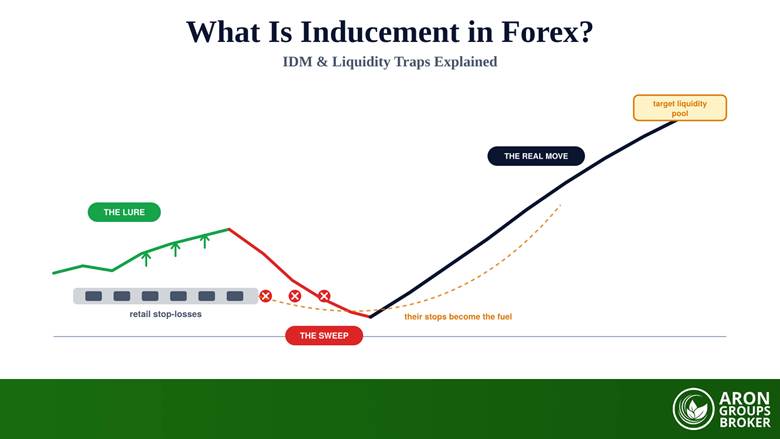
Inducement in forex, written IDM or IND in Smart Money Concepts notation, is a price move engineered to lure retail traders into the market early, so that their stop-losses become the liquidity a larger player needs. The lure is usually a small, convincing pullback or a false breakout: it looks like the start of the move, attracts entries, and stacks predictable stops just beyond it. Price then sweeps those stops before delivering the real move in the opposite direction of the trap.

The idea sits at the centre of the SMC and ICT school of price action, where markets are read as a map of resting orders rather than a chart of patterns. Large positions cannot be filled without counterparties, and clusters of retail stops are the most reliable counterparties in the book. Learning to see where those clusters form, and how price behaves around them, is one route to a genuine trading edge, provided the concept is handled with the honesty this guide insists on.

This article defines inducement precisely, separates it from the liquidity grab it precedes, maps where it forms, breaks down the four types you will actually meet, gives an identification checklist built on valid pullbacks, BOS, and CHoCH, and lays out a complete trade flow, before closing with the balanced framing most SMC content omits.

bookmark
Key Takeaways
  • Inducement is a lure: a small pullback or false breakout that attracts early entries so that the resulting stop-losses become liquidity for the real move.
  • Inducement builds the liquidity; the grab or sweep is the later move that takes it, usually at an obvious external level.
  • It forms where retail orders predictably cluster: equal highs and lows, obvious swing points, support and resistance, order blocks, and fair value gaps.
  • Identification rests on structure: a valid pullback, a break of structure (BOS), and a change of character (CHoCH), confirmed after the sweep rather than before it.
  • SMC is an interpretive lens, not a law: not every move is manipulation, and inducement must be traded probabilistically with strict risk control.

Inducement vs Liquidity Grab: The Distinction That Matters

The two terms are often used interchangeably and should not be. Inducement is the earlier, quieter event: the move that persuades traders to take positions and, in doing so, builds a pool of stops. The liquidity grab, also called a sweep or stop hunt, is the later, louder event: the spike that takes those stops out. In structural terms, inducement usually forms in internal structure, the minor swings inside a leg, while grabs target external structure, the obvious highs and lows every trader can see. If the grab is the harvest, inducement is the planting.

sms-star

Risk Disclosure

CFDs are complex instruments and come with a high risk of losing money rapidly due to leverage. You should consider whether you understand how CFDs work and whether you can afford to take the high risk of losing your money. Past performance is not indicative of future results. This content is provided for educational purposes only and does not constitute investment advice.
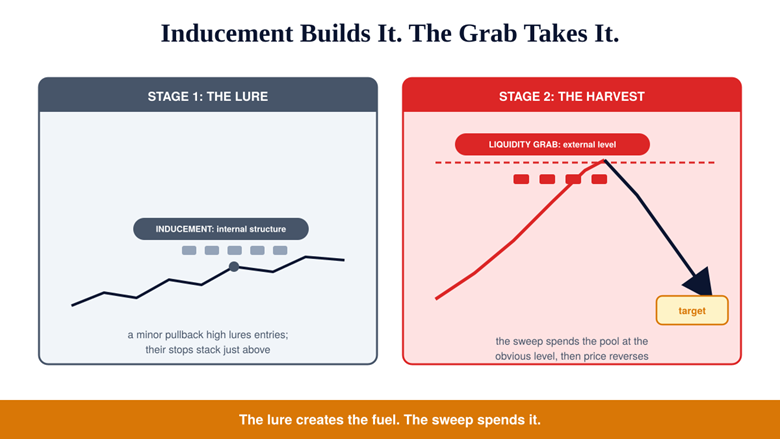
The internal-versus-external distinction is practical, not academic. External levels, yesterday’s high, the week’s low, tidy equal highs, are visible to everyone and therefore crowded; internal levels, the minor swings inside the current leg, are visible mainly to traders actively mapping structure. Inducement lives internally because that is where a lure can form without drawing the whole market’s attention, and grabs strike externally because that is where the largest pools rest. When you can name which kind of level price is interacting with, half of the classification work is already done.

Inducement vs Liquidity Grab: The Distinction That Matters
DimensionInducementLiquidity grab
Role in the trapBuilds the pool of stopsSpends the pool that was built
Where it formsInternal structure, minor swingsExternal levels, obvious highs and lows
TimingBefore the sweepThe sweep itself
What retail doesEnters the lureGets stopped out
What you doMark it and waitDemand confirmation after it

One plants and one harvests: name which event you are looking at before deciding what it means.

Q: Is a false breakout the same thing as inducement?

A: A false breakout is one common shape of inducement, the range variety, but not the whole concept. Inducement includes any engineered lure, including shallow pullbacks and minor swing breaks that never look like breakouts at all. All false breakouts are potential inducement; not all inducement is a false breakout.

Where Inducement Forms

Inducement appears wherever retail orders cluster predictably, because predictable orders are harvestable orders. The usual habitats: equal highs and equal lows, which advertise buy-side and sell-side liquidity to the whole market; obvious swing points and round numbers; classic support and resistance, where breakout traders queue; order blocks and fair value gaps, where SMC traders themselves cluster; and the edges of consolidation ranges, where a breakout strategy is most tempting to deploy naively. The common thread is visibility: the more obvious the level, the more stops rest beyond it, and the more attractive it becomes as fuel.

Reading the Chart as a Liquidity Map

The mental shift SMC asks for is from patterns to pools. Instead of asking what the chart looks like, ask where the resting orders are: every obvious level is a shelf of stops, every tidy double top is an advertisement, and every clean trendline touched three times has a queue beneath it. Drawn this way, the chart becomes a map of incentives, and inducement becomes legible as the market building inventory at one shelf before shopping at the next. Traders who annotate their charts with liquidity labels rather than pattern names find the lure easier to anticipate, because they are watching what the move is for rather than what it resembles.

The Four Types of Inducement

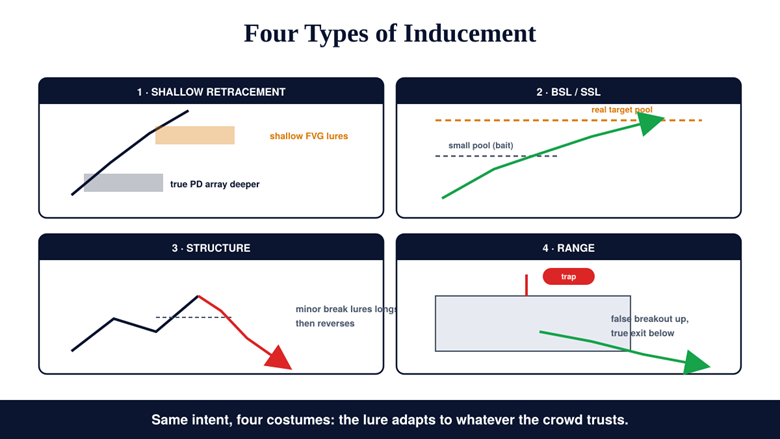
Categorising the lure makes it easier to spot in real time. Four types cover most charts:

Inducement in Forex (IDM): How Smart Money Traps Retail Traders, and How to Avoid It
  • Shallow-retracement inducement: after a strong leg, the first shallow fair value gap or minor zone tempts impatient entries, while the true point of interest sits deeper. The early zone is the lure; the deep one is the destination.
  • BSL/SSL inducement: a small, engineered pool of buy-side or sell-side liquidity, such as tidy equal highs, is swept on the way to a larger, older pool beyond it. The small pool exists to be taken.
  • Structure inducement: a minor internal swing is broken just enough to read as a break of structure, luring continuation entries, before price reverses through them toward the real level.
  • Range inducement: the classic false breakout of a consolidation, where the first move out of the box exists to collect breakout stops before the genuine move leaves the other side.

How to Identify Inducement: Valid Pullback, BOS, CHoCH

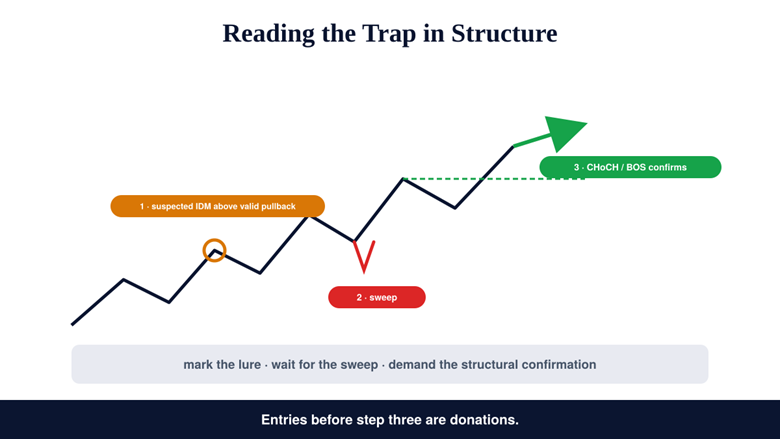
Identification is structural, not intuitive. Start with the valid pullback: in SMC terms, the first meaningful counter-move inside a leg, whose extreme becomes the reference. The suspected inducement is typically the first minor high or low that forms above or below that pullback, the level most likely to lure early entries. Then let the market speak. A sweep through the suspected inducement, followed by a break of structure (BOS) in the intended direction, or a change of character (CHoCH) against the prior trend, is the confirmation sequence. The discipline is in the waiting: the trap is only readable after it has sprung, which is why systematic traders backtest the sequence rather than trusting their eye on live charts, exactly as out-of-sample backtesting doctrine recommends.

How to Identify Inducement: Valid Pullback, BOS, CHoCH
sms-star

Rule: If your entry reason is that a level looks like inducement, you are early. If your entry reason is that the level was swept and structure then broke, you are trading the concept. The difference is one candle and most of the losses.
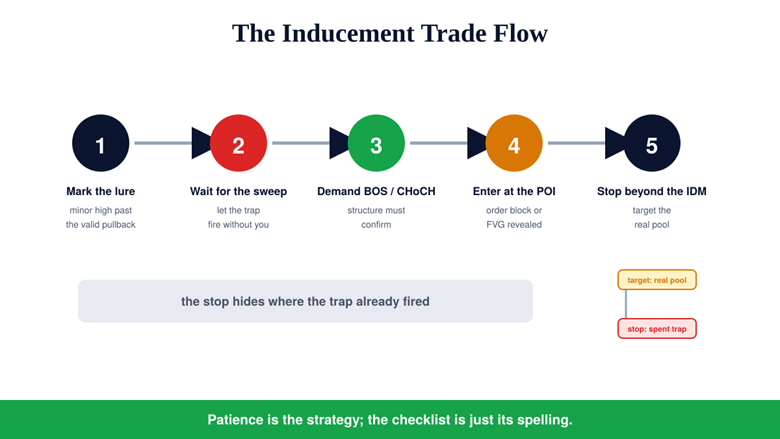
The Trade Flow, Start to Finish

The full sequence, executed patiently: mark the suspected inducement in advance; wait for the sweep to take it; demand a confirming BOS or CHoCH; enter at the valid point of interest the confirmation reveals, typically an order block or fair value gap; place the stop beyond the inducement extreme, because a level that has already been harvested is less likely to be revisited; and target the real liquidity pool or the next structural level. Position size comes from the stop distance and a fixed risk-to-reward ratio, never from conviction, and session context sharpens everything: inducement is cleanest during the London and New York killzones, and maps naturally onto the manipulation phase of the ICT Power of 3, where the session’s first move exists to mislead.

The Trade Flow, Start to Finish

Session Context: Killzones and the Power of 3

Timing filters the concept as much as structure does. Inducement is sharpest during the London and New York killzones, the windows when institutional participation actually arrives, because a lure needs an audience and a harvester in the same room. The ICT Power of 3 gives the day a narrative shape: accumulation through the quiet session builds the range, manipulation opens the active session by running one side of it, and distribution delivers the true directional leg. Inducement is the signature of the manipulation phase, which is why the first decisive move after a session open deserves suspicion rather than a market order, and why Asian-range extremes so often serve as the day’s bait.

Mini Example: A London Killzone Sequence

EURUSD consolidates through the Asian session under equal highs. Early London, price pokes above a minor pre-session high, the suspected inducement, drawing breakout longs, then sweeps hard through the Asian equal lows, collecting the other side too.

A sharp CHoCH follows: the minor bearish structure breaks upward. The trader enters at the fair value gap left by the confirming leg, stop below the sweep low, target the untouched equal highs from yesterday’s New York session. Whether it wins or loses, every decision was made after the market showed its hand, none during the lure.

The Honest Framing: A Lens, Not a Law

Now the part most SMC content leaves out. Smart Money Concepts is an interpretive lens laid over price, not a proven mechanism, and inducement narratives are especially vulnerable to hindsight bias: after any reversal, some earlier move can always be relabelled as the trap. Not every move is manipulation, not every breakout is fake, and much of what reads as deliberate trapping is simply the by-product of large institutions meeting their liquidity needs where orders happen to rest. Research into market microstructure describes dealers managing inventory and liquidity across a fragmented market; it does not describe a villain hunting your stop in particular. Treat inducement as a probabilistic pattern to be backtested and risk-managed, and remember the base rates: European regulators found the large majority of retail accounts lose money on leveraged products, and US investor-education guidance on leveraged strategies warns that amplified exposure amplifies every mistake, including misread traps.

A simple test keeps the lens honest: write the call before the outcome. If you can mark the suspected inducement, the level it should sweep, and the confirmation you require, in advance and in writing, you are trading a hypothesis. If the labels only ever appear after the reversal, you are narrating, and narration feels identical to skill right up until it is sized. A journal of forward-marked charts, reviewed monthly, settles within a quarter whether the concept pays you or merely entertains you.

sms-star

Risk Warning: Be wary of paid IDM courses, indicators, and expert advisors marketed through Telegram and social channels. The concept in this article is the whole concept, and it is free. Anyone selling certainty about traps is running one.

Where Aron Groups Fits

Concepts earn trust through repetitions, not screenshots. Free inducement and CHoCH/BOS indicators exist for both TradingView and MetaTrader 5, and marking structures by hand teaches more than any of them. Rehearse the full sequence with strict risk management on a small account, where micro volumes keep tuition cheap.

Then hold your results to the same standard as any strategy: a stable equity curve across many trades, not a highlight reel. The patient, process-first approach of a professional trader is what converts a compelling narrative into a durable method, and our guide on how to trade forex covers the foundations the narrative sits on.

Conclusion

Inducement is the market’s oldest trick written in modern notation: create a reason to enter early, harvest the stops that early entries leave behind, then make the real move with the fuel collected. Learning its four shapes, and the sweep-then-confirm sequence that validates it, moves a trader from being the liquidity to reading it.

Keep the lens honest. Demand structural confirmation after the sweep, hide stops beyond spent traps, size by rule, and protect capital preservation above any single setup, because the concept’s edge, where it exists, is thin and probabilistic. The traders who profit from inducement are, almost by definition, the ones who stopped needing every move to be a conspiracy.

Frequently Asked Questions

Quick answers to the questions traders ask most about inducement, for the reader who arrived here with one of them.

What is inducement in forex trading?

Inducement, or IDM, is a price move designed to lure retail traders into early positions so that their stop-losses build a pool of liquidity. Price sweeps that pool before making the real move, which is why the lure so often forms just before a reversal.

What is the difference between inducement and a liquidity grab?

Inducement is the lure that builds the liquidity, usually in minor internal structure; the liquidity grab or sweep is the later move that takes it, usually at an obvious external level. One plants, the other harvests.

How do I identify inducement on a chart?

Mark the first minor high or low that forms beyond a valid pullback, the likeliest lure, then wait. A sweep through that level followed by a break of structure or a change of character is the confirmation; entering before the sequence completes is entering the trap.

Is Smart Money Concepts a proven strategy?

It is a popular interpretive framework, not a proven law, and it is vulnerable to hindsight bias. Some traders extract a real edge from it through strict rules and backtesting; treated as certainty, it performs no better than any other narrative. Test it like any strategy before trusting it.

Continue Reading
not-found
calendar 27 July 2026
Rate this article

Leave a Reply

Your email address will not be published. Required fields are marked *

No thanks