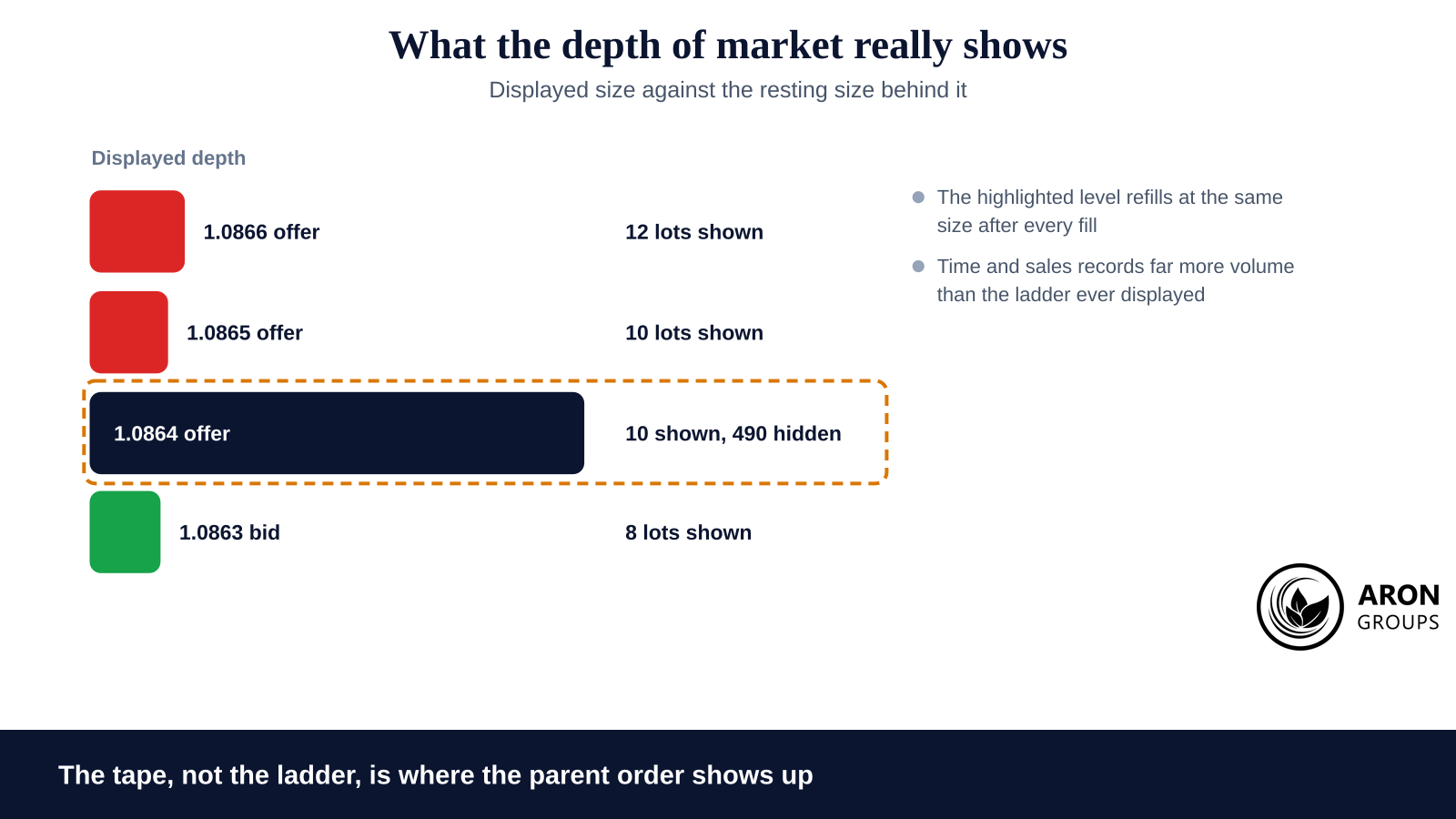
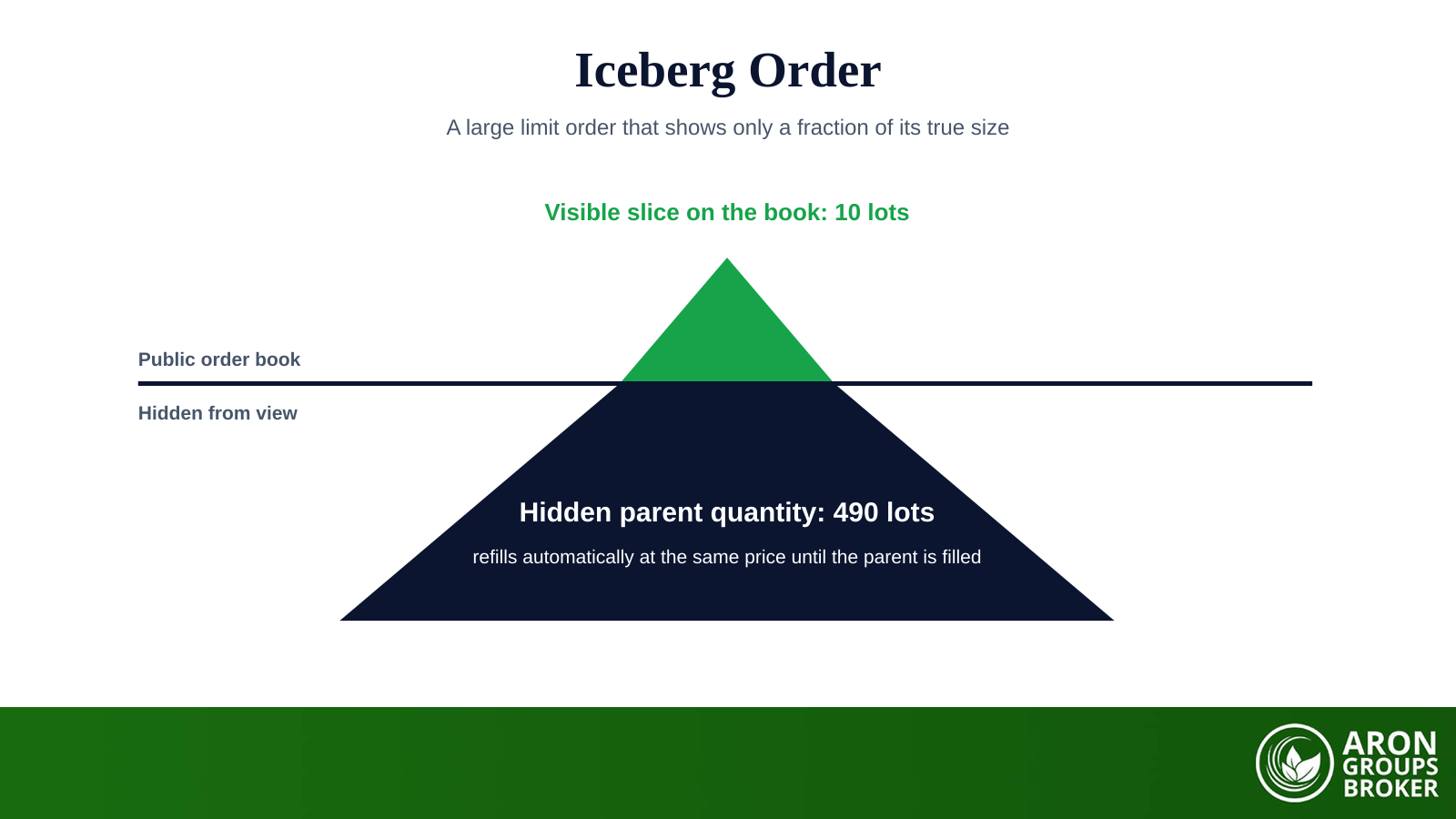

An iceberg order is a large limit order that displays only a small slice of its true size. The rest stays hidden, and refreshes automatically as each visible slice fills. The name is literal: the market sees the tip, and the mass sits below the surface. Exchanges also call it a reserve order, and the visible portion is called the peak or the display quantity.
Most traders read the depth of market as though it were a complete inventory of supply and demand. It is not. On any venue that supports hidden size, the ladder shows what participants have chosen to reveal, which is a different thing entirely. A level holding four visible lots may be backed by four hundred. A trader who sizes a position against the visible number alone is working from a partial picture.
This guide explains what an iceberg order is and how the refill mechanic works. It covers why institutions accept a queue priority penalty to use one, and how order flow traders infer hidden liquidity from repeated absorption. It also covers what an iceberg is not, because confusing a legitimate execution tool with market manipulation is a costly mistake.
- An iceberg order splits one large limit order into visible slices, showing only the peak at any moment.
- Each time the visible slice fills, the venue posts the next one at the same price, behind the existing queue.
- Institutions use icebergs to cut market impact, reduce slippage, stay anonymous and avoid being front run.
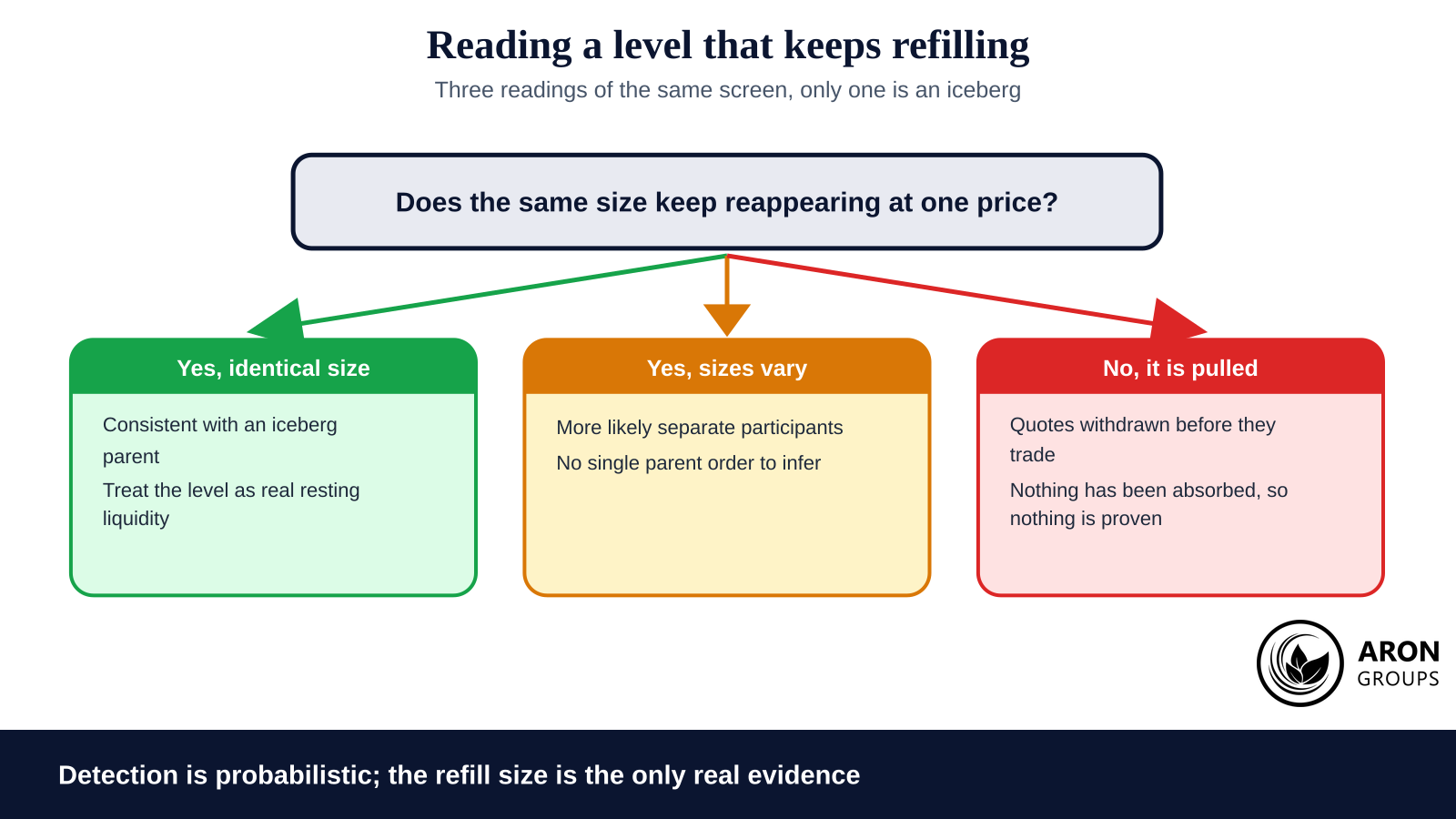
- Detection is probabilistic: repeated identical refills at one level suggest a parent order, they do not prove it.
- Spot forex is decentralised, so a retail trader sees only a broker's partial flow, never a global book.
What an iceberg order actually is
An iceberg order is a single large limit order that a venue releases to the public book in small, repeated instalments. The trader submits two numbers rather than one. The first is the total quantity to be worked, the second is the display quantity allowed on screen. The venue shows the display quantity and holds the rest in reserve. Other participants therefore see a modest resting order where a very large one exists.
Risk Disclosure
Trading forex and CFDs carries a high level of risk and can result in the loss of all your capital. This content is educational and is not investment advice. Never risk money you cannot afford to lose.
The two quantities that define it
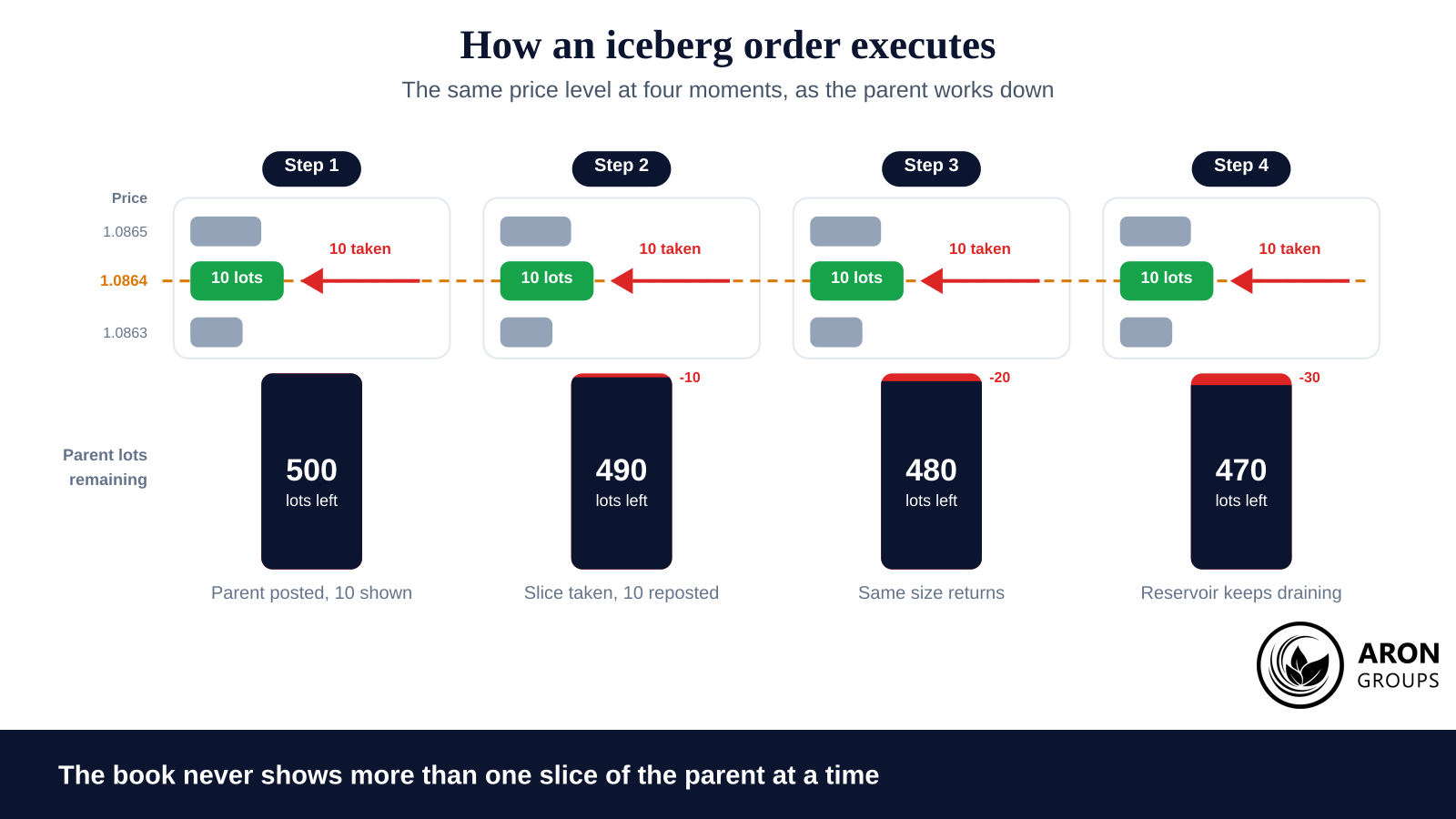
The total quantity is the parent order, the real commitment. The display quantity, often called the peak, is the slice the market is allowed to see. A 500 lot parent with a 10 lot peak appears as a 10 lot order and refreshes forty nine more times. Set the peak too small and the order takes a long time to work, because each refill rejoins the queue at the back. Set it too large and the concealment stops doing its job.
Where the order type is available
Iceberg orders originated on centralised equity exchanges and are standard on futures venues. Several large cryptocurrency exchanges now expose the same functionality to retail accounts. Spot forex is the exception, for a structural rather than a technical reason: there is no single consolidated book to hide inside. Keep that in mind before you go looking for icebergs on a retail platform.
How the refill mechanic works
The sequence is mechanical and identical on every venue that supports it. Understanding it matters because the refill step, not the hiding step, is what makes an iceberg detectable at all. Each refill is a fresh order at the same price, and a fresh order joins the queue behind everything already resting there.
That queue penalty is the hidden cost of the order type. A displayed 500 lot order would hold its place in the queue from the moment it arrived. The iceberg surrenders that place fifty times over, so it trades more slowly than an equivalent visible order would. Institutions accept the trade because slow and quiet beats fast and expensive once the size is large enough to move price against them.
Key Point
An iceberg does not hide size from the market for free. It pays for concealment with queue priority, and that is the whole economic bargain of the order type.
Why institutions use iceberg orders
There are four separate motives, and they are worth separating because they call for different peak sizes. Reducing market impact is the first. A visible order large enough to clear several price levels tells everyone what is coming, and the book thins out ahead of it. Reducing slippage is the second, and follows from the first. Anonymity is the third, since a resting block advertises both size and intention. Avoiding front running by fast systematic participants is the fourth.
The wider context matters. Foreign exchange is an enormous and highly concentrated market, in which a handful of dealers intermediate most of the flow. Execution quality there is measured in fractions of a pip. Hiding size is not exotic in that setting; it is ordinary execution hygiene for an order the visible book cannot absorb in one go.
How large the hidden share can be
Academic work gives a sense of scale. A study of one hundred Euronext Paris stocks found that hidden orders made up forty four per cent of the sample order volume. Eighteen per cent of incoming orders carried some hidden size. A separate working paper looked at Nasdaq market maker quotes. It put non displayed size at roughly a quarter of the dollar depth at the national best bid and offer. Both samples are old and both are equity markets, but the point holds: hidden depth is an ordinary part of a modern book. Treat the displayed ladder as a sample of resting interest rather than a census of it.
Iceberg, hidden and dark: the distinctions that matter
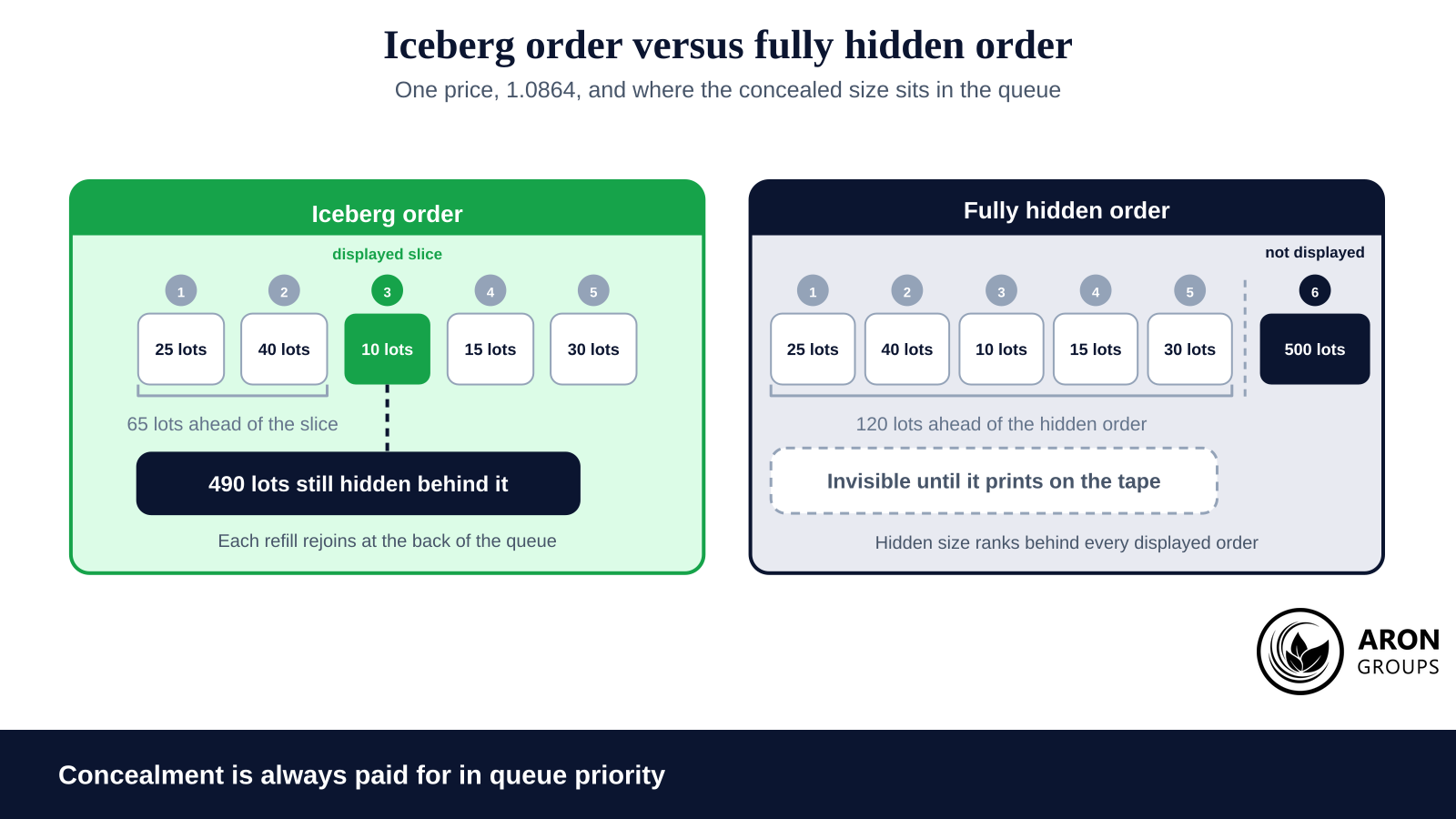
Three order types get conflated constantly, and the differences are practical rather than academic. An iceberg shows a slice. A fully hidden order shows nothing and typically ranks behind displayed orders at the same price. A dark venue removes the order from the lit book altogether and matches it under the venue’s own rules.
| Order type | Shown on the book | Queue priority | Typical user |
|---|---|---|---|
| Iceberg | One slice at a time | Held on the visible slice only | Institutional execution desk |
| Fully hidden | Nothing | Usually behind displayed size | Institutional execution desk |
| Dark venue order | Nothing on the lit book | Set by venue matching rules | Block trading desk |
| Plain limit | Full size | Full, from time of arrival | Most retail orders |
Concealment and queue priority sit at opposite ends of the same trade off.
A basket order belongs in none of these categories, despite often appearing in the same lists. A basket is several different instruments executed together as a portfolio, not one order divided into slices. The two get grouped because both involve size, but the mechanics share nothing.
How traders try to spot an iceberg
Detection rests on one observation: a price level that keeps absorbing trades and keeps refilling, without a large visible order ever sitting there. Order flow traders watch the ladder alongside time and sales. They look for a run of prints at one price, each followed by the same modest quantity reappearing.
The practical reading is that the level is real resting liquidity rather than a thin quote. Traders treat a hidden bid showing absorption as a reference point to buy near, and a hidden offer the same way in reverse. Confirmation from delta or imbalance beats the refill pattern alone. Position sizing still has to assume the read is wrong some of the time.
Mini Example: reading absorption on a round number
A pair grinds up into a round number and stalls. The offer at that price shows ten lots. It trades, and ten lots reappear. Over twenty minutes the tape prints several hundred lots through that single price while the ladder never displays more than ten.
The inference is that a seller is working a large parent order there. The trade that follows is not a prediction of reversal. It is a decision to stop buying into known supply, and to wait for the level to clear or for price to reject it. The evidence supports caution, not a target. A level that has absorbed real volume deserves respect until it clears.
Q: Can I estimate the full size of an iceberg?
A: Only loosely, and only after the fact. You can count the volume that has traded through the level, which gives a floor for how much has already been absorbed. You cannot see what remains, so any estimate of the parent order’s total size is a guess that improves as more refills appear.
What an iceberg is not
An iceberg order is a legitimate execution tool. The hidden portion is a real commitment that the trader intends to fill. Spoofing is a different activity, and an illegal one. It means placing large orders with no intention of executing them, purely to mislead others, then cancelling. The distinction is intent, and it is the difference between an execution algorithm and market abuse.
It is also not the same as slippage, and it is not a signal. A refilling level tells you where liquidity is, not which way price will go. Large resting supply can absorb buyers for an hour and then vanish. The market is then free to run straight through the level that looked so solid.
The honest limits of iceberg detection
Detection is probabilistic and the evidence is always circumstantial. Repeated refills of the same size are consistent with an iceberg. They are equally consistent with several participants quoting similar size, or with an algorithm slicing an order. Nothing on a retail screen separates these cases with certainty.
The constraint is sharper in spot foreign exchange. The market is decentralised, so there is no consolidated order book anywhere. A retail platform displays a partial view of one liquidity provider’s flow, and you cannot observe global icebergs from that seat. The concept still buys you a better model of why price stalls at some levels and slides through others. It also buys a healthy scepticism about reading intention off a ladder.
Practical filter
If a level has not absorbed real volume, there is nothing to infer. Quotes that are pulled before they trade prove nothing at all.

Where Aron Groups fits
Order flow reading of this kind sits on top of a platform, not inside a strategy. Aron Groups runs on MetaTrader 5. Market execution fills at the next available price with no requotes, and spreads float with the underlying market. That matters here, because the depth window you read reflects available liquidity rather than a fixed dealing desk price.
The Nano account is the sensible place to practise reading absorption. It is commission free with the cost carried in the spread, and it supports micro volumes from 0.0001 lots. Test any rule you build with out of sample validation rather than a handful of screenshots. Keep the position size small enough that a wrong read costs you nothing you will remember.
Conclusion
An iceberg order is a simple idea with an important consequence. The idea is that a large order can be shown to the market in slices, with the remainder held in reserve and refreshed automatically. The consequence is that the visible book is a curated document rather than a complete one. Any method that treats displayed depth as the full picture is working from bad data.
For a retail trader the practical value is not detection, which is unreliable, but humility. Levels hold for reasons you cannot see, and they break for the same reason. Build that uncertainty into risk management rather than trying to resolve it with a ladder you can only partly read. Leveraged trading is unforgiving of confident inferences, and regulators have documented how consistently retail accounts lose money on these products.
Frequently asked questions
Four questions come up repeatedly once traders start looking for hidden liquidity.
Are iceberg orders legal?
Yes. They are a standard order type offered by exchanges and the hidden portion is a genuine order intended to execute. What is illegal is spoofing, which means entering orders you plan to cancel in order to create a false impression of supply or demand.
Can I place an iceberg order on a forex broker?
Usually not as a native order type, because spot forex has no central limit order book to conceal size within. Traders who want a similar effect split the order manually, or automate the splitting with an expert advisor. That is a different mechanism, with different costs.
How is an iceberg order different from a hidden order?
An iceberg always displays a small slice, which keeps it in the visible queue at its price. A fully hidden order displays nothing and normally ranks behind displayed orders at the same level. It trades later, in exchange for complete invisibility.
Does spotting an iceberg give me an edge?
Not on its own. It tells you where meaningful resting liquidity probably sits, which is context rather than a trigger. Traders who use it well combine it with structure and a defined risk plan. They also accept that a fair share of their reads will be wrong.