
icon icon Home
icon icon Accounts
icon icon Quick start
icon icon Symbols

Fat Finger Errors in Trading: How a Single Keystroke Causes Costly Trades, and How to Avoid Them

Author
Abe Cofnas
Abe Cofnas
calendar Last update: 3 October 2026
watch Reading time: 9 min

A fat finger error is a mistaken trade caused by an input slip. The trader enters the wrong quantity, price, symbol or side, and the order reaches the market as typed. The name describes a clumsy finger landing on the wrong key. It is an accident, not a strategy, and the loss depends on the field that was mis-keyed.

The public record is dominated by institutional cases, which misleads a retail reader. The same slip on a leveraged account rarely moves a market, but it can empty the account in minutes. Careful position sizing counts for nothing if the volume field is wrong.

This guide sets out the five fields where these errors happen, and separates a fat finger from spoofing, slippage and a deployment failure. It then covers what the largest cases cost, the prevention routine that matters, and what no control layer catches.

bookmark
Key Takeaways
  • A fat finger error is a mistaken order caused by an input slip in the quantity, price, symbol, side or account field.
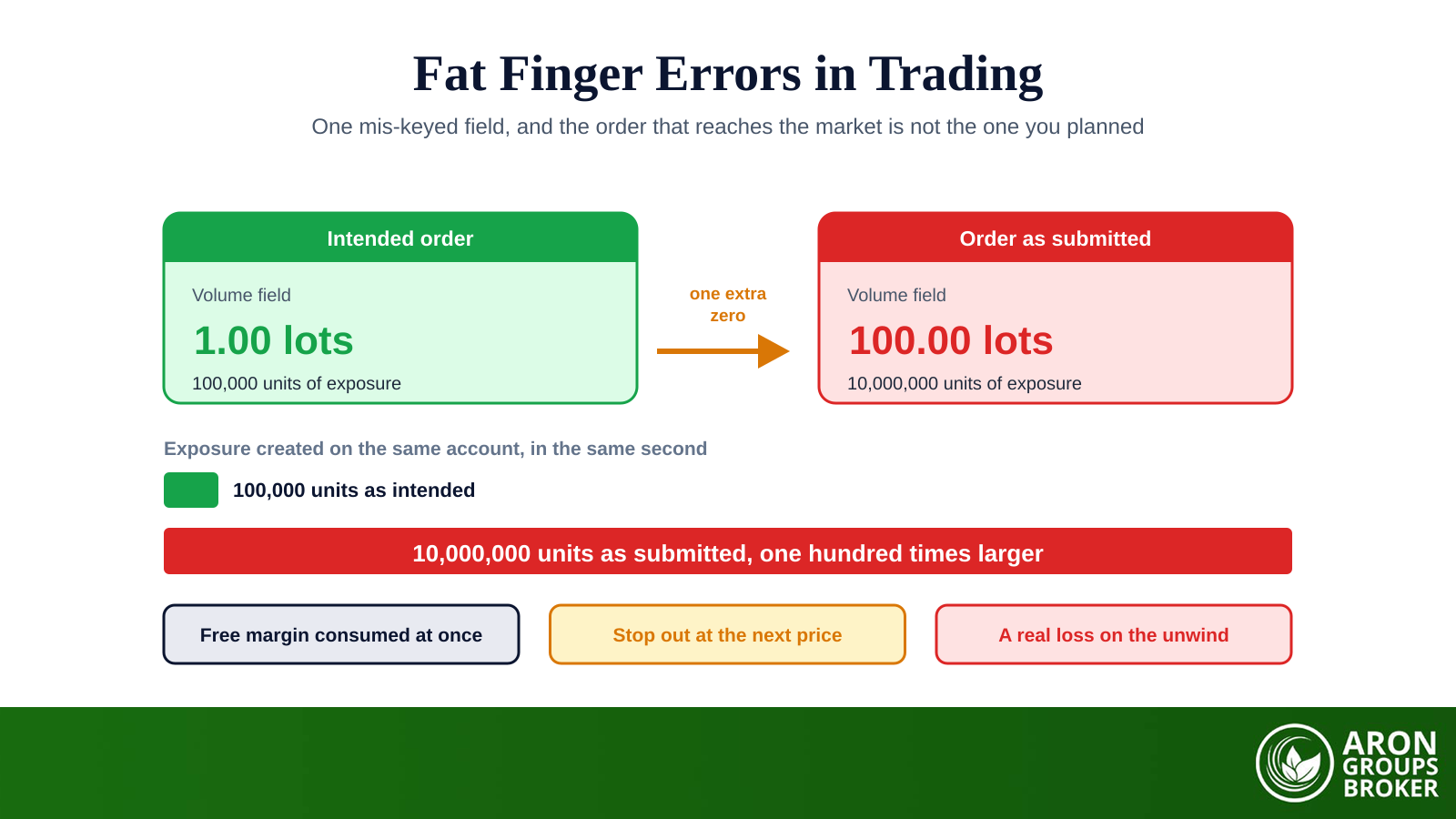
  • Quantity errors do the most damage, because an extra zero multiplies the position rather than nudging it.
  • Institutional errors can move a market for minutes, while retail errors usually end in a margin call or a stop out.
  • Knight Capital in 2012 was a deployment failure, not a keystroke, and almost every article files it wrongly.
  • An order confirmation dialogue, a maximum order size and a deliberate pause are the defences that actually work.

What a fat finger error is

A fat finger error is an order that reaches the market carrying a value the trader never intended. The mistake sits in the input, not in the judgement. A trader can hold a sound view and still send an order a hundred times too large. The term covers price and side errors as well as quantity.

sms-star

Risk Disclosure
Trading forex and CFDs carries a high level of risk and can result in the loss of all your capital. This content is educational and is not investment advice. Never risk money you cannot afford to lose.
Where the name comes from

The name is literal and it predates electronic trading. It entered trading floor language when clerks keyed orders by hand. Today the error is a figure pasted into the wrong field, or a default lot size nobody checked.

Why leverage changes the stakes

Leverage turns a keying error into a solvency event, because margin is a fraction of face value. A retail account can accept an order many times larger than its balance. European rules cap retail leverage and require margin close out and negative balance protection. The cap limits the damage; it does not prevent the order.

The five inputs that go wrong

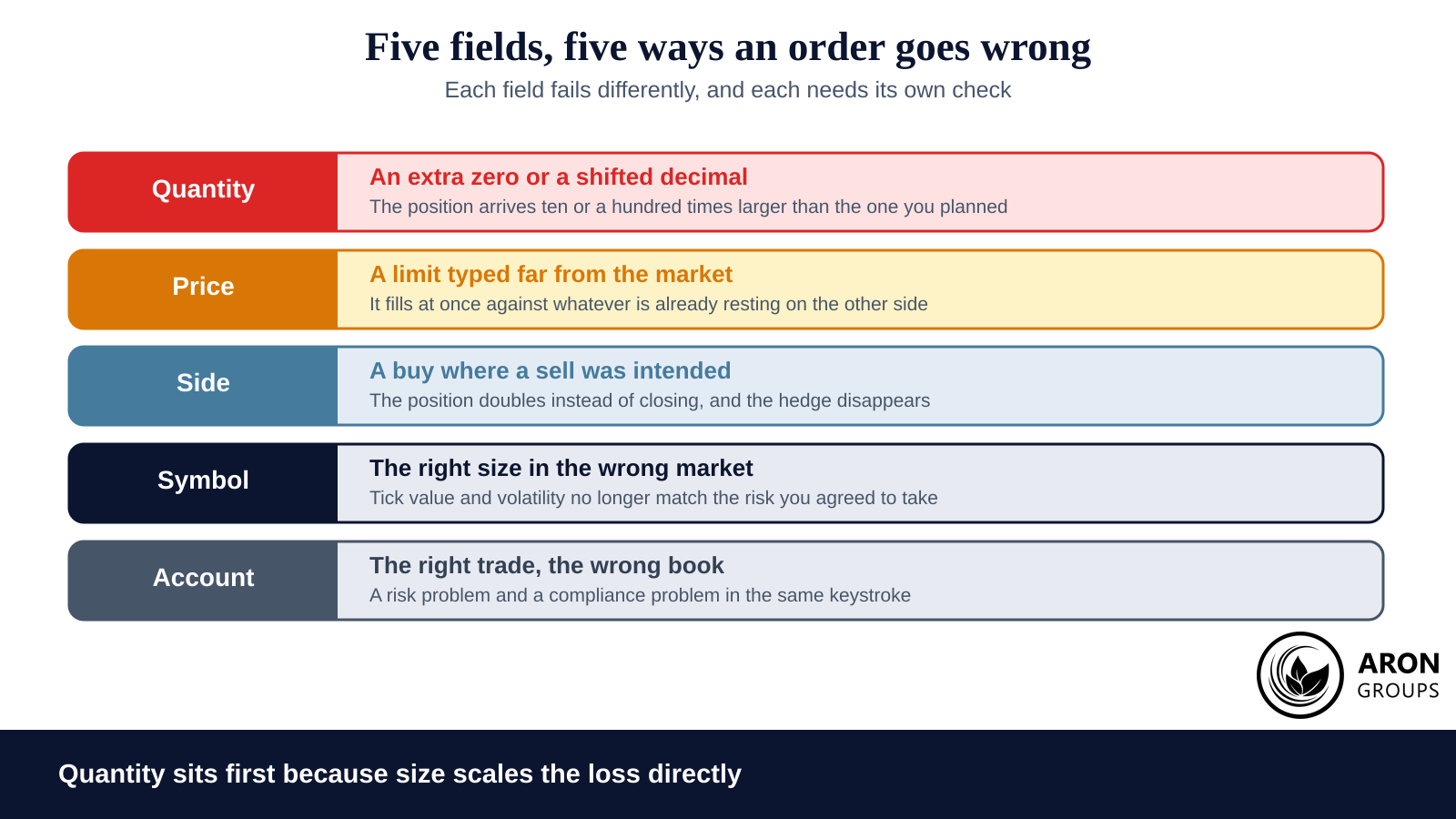
Five fields on an order ticket account for almost every fat finger error, and quantity is the most dangerous. The other four are price, side, symbol and account, and each needs its own check.

Quantity scales the loss directly; the other four change what you own, not how much.

The ranking below runs from the most expensive field down.

· Quantity: an extra zero multiplies the position by ten or a hundred.

· Price: a limit typed far from the market fills at once against resting orders.

· Side: a buy where a sell was intended doubles the exposure instead of closing it.

· Symbol: the right size in the wrong instrument, with a different tick value.

· Account: the right trade in the wrong book, a compliance problem too.

The decimal error recurs in every asset class. On 11 December 2021 a Bored Ape Yacht Club token was listed on OpenSea at 0.75 ether instead of 75 ether. A bot took it for about 3,015 dollars before the seller could cancel.

sms-star

Did You Know
The gap between a mistaken order and a filled order is measured in milliseconds. Cancellation is a race, and the trader usually loses it.
Same mistake, different blast radius

The same error produces two very different outcomes depending on who makes it. An institution with direct market access can move a price for minutes. A retail trader mostly destroys their own equity.

A large erroneous order consumes resting liquidity at every level it touches. In a thin market it can clear the book several levels deep, which is one recognised route into a flash crash.

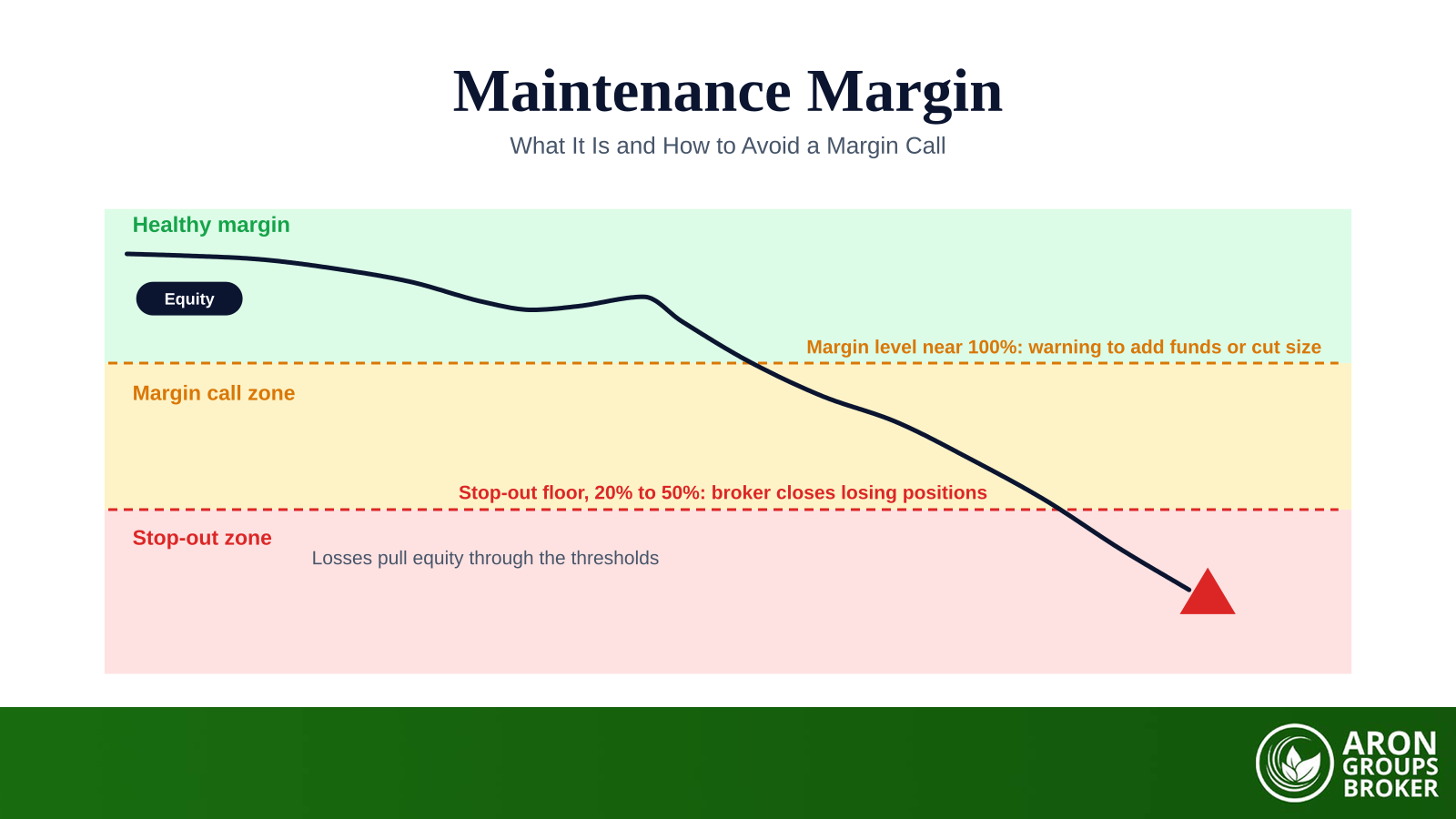
For a retail account the sequence is shorter. An oversized position consumes free margin at once. The platform issues a margin call and the stop out closes positions at whatever price is available. The drawdown has nothing to do with the strategy behind it.

Regulators treat retail foreign currency trading as high risk before any input error is added. An accidental position carries the same leverage as a deliberate one.

What a fat finger error is not

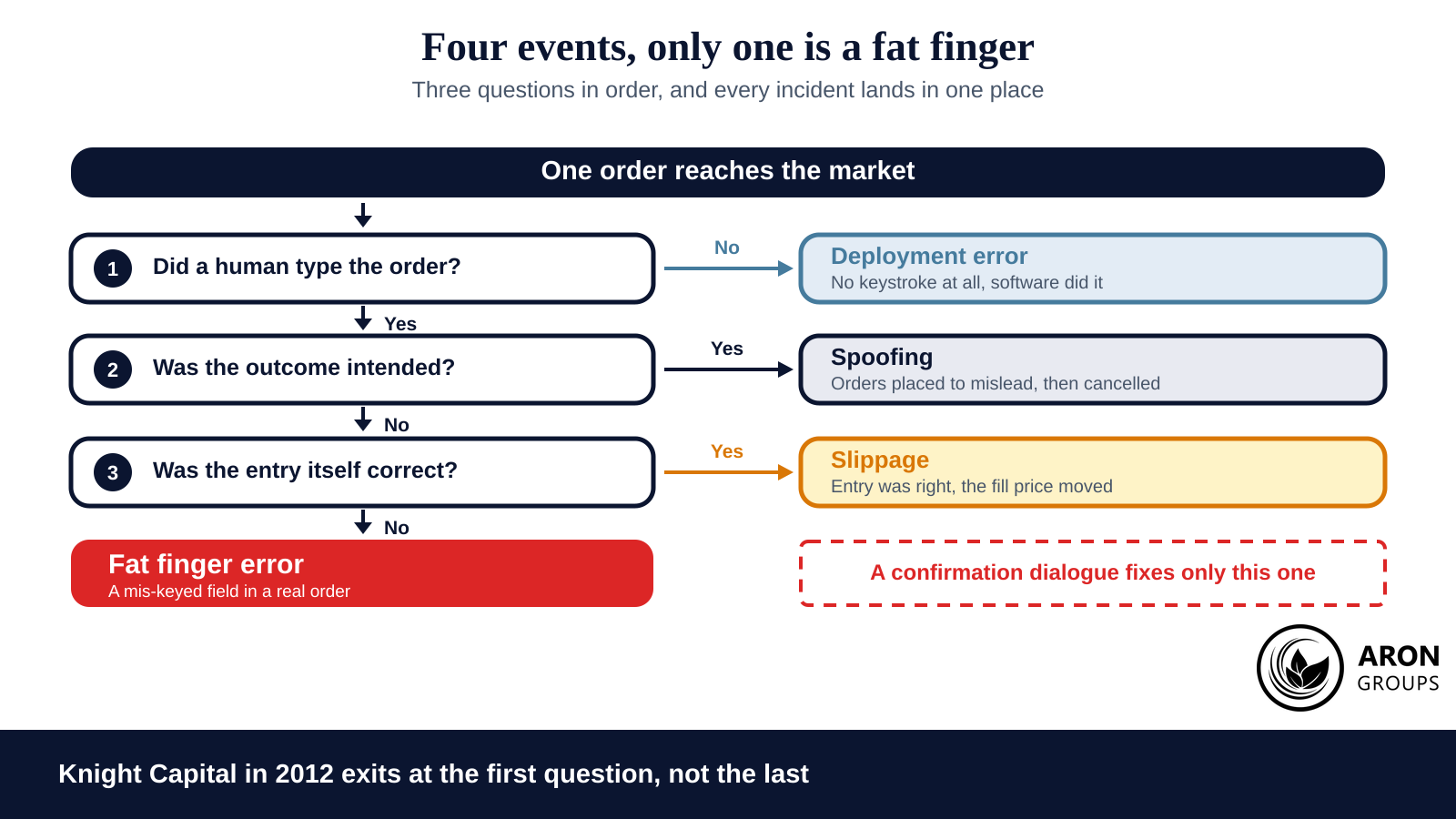
Three other events get filed under the same label and none is a typing mistake. Spoofing is deliberate, slippage is ordinary execution, and a deployment error is software doing exactly what it was told.

The remedy follows the branch, so mislabelling an event means fixing the wrong thing.
EventHuman inputIntentWhat fixes it
Fat finger errorA mis-keyed fieldAccidentalConfirmation and size limits
SpoofingDeliberate ordersManipulative and illegalSurveillance and enforcement
SlippageOrder entered correctlyNeither, it is executionOrder type and liquidity
Deployment errorNo keystroke at allAccidental, in softwareRelease process and testing

Only the first row is a typing mistake, and only the second is done on purpose.

Spoofing is the one with legal consequences: orders entered with no intention of executing them, then cancelled to mislead others. Slippage is different, because the order was correct and only the fill moved.

Knight Capital was a deployment failure, not a keystroke

No human typed an order at Knight Capital on 1 August 2012. A technician failed to copy new code to one of eight order router servers. The deployment reused a flag that switched on dormant legacy code from 2003. About four million executions followed in 154 stocks, more than 397 million shares, in roughly forty five minutes.

Knight’s press release of 2 August 2012 reported a pre-tax loss of approximately 440 million dollars. The SEC order of October 2013 put the loss at over 460 million dollars, with a 12 million dollar penalty. The lesson belongs to release management and to anyone running an automated strategy.

Four incidents that show the true scale

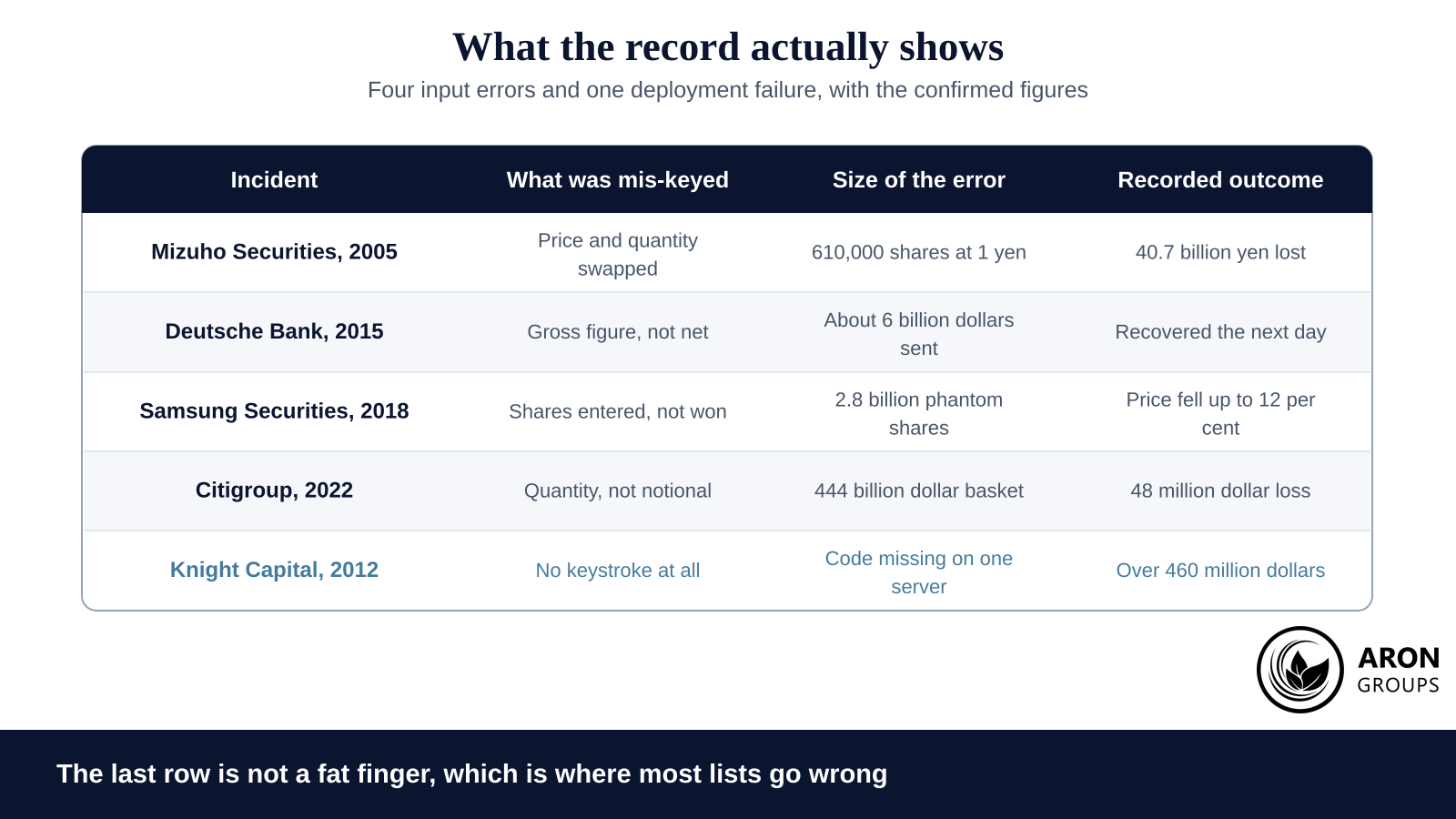
Four cases define the public record, and each failed at a different field. The figures below are the confirmed ones, which in two cases are not the numbers usually quoted.

Two of these five figures are routinely misreported, and the bottom row is not a fat finger.

Mizuho Securities and the order that could not be cancelled

On 8 December 2005 a Mizuho Securities trader meant to sell one J-Com share at 610,000 yen. The order entered was a sale of 610,000 shares at 1 yen, with price and quantity transposed. The confirmed loss was 40.7 billion yen, about 340 million dollars.

Mizuho tried to pull the order within about ninety seconds and the exchange system rejected it. In December 2009 the Tokyo District Court held the Tokyo Stock Exchange seventy per cent liable. The Supreme Court dismissed both appeals in September 2015.

Deutsche Bank’s June 2015 error was a settlement instruction, not a trade. A junior trader on the London foreign exchange desk processed a gross figure instead of a net value while his supervisor was away. About 6 billion dollars went to a United States hedge fund, came back the next day, and the bank reported itself to regulators.

Samsung Securities shows what happens when the unit itself is wrong. On Friday 6 April 2018 an employee entered shares in the field where won belonged. The dividend was 1,000 won per share held, so the system issued 1,000 shares. About 2.8 billion shares appeared against 89.3 million outstanding, thirty one times the share count.

The notional value was 112.6 trillion won, about 105 billion dollars, against an intended payment near 2.81 billion won, or 2.6 million dollars. Sixteen employees sold about 5.01 million phantom shares in the thirty seven minutes before trading was blocked. The price fell as much as about twelve per cent intraday.

Q: Why can a firm not simply cancel a mistaken order?
A: Because a cancellation is a request rather than a right. It travels to the venue behind every order already queued, and the venue can reject it, as the Tokyo Stock Exchange did in 2005. In a fast market the fills are done before the cancel message arrives.

Citigroup and the basket that was only partly blocked

On 2 May 2022 a Citigroup Global Markets trader in London entered a basket value in the unit quantity field, not the notional field. It was a United Kingdom bank holiday, the order went in at 08:56, and liquidity was thin. The intended trade was 58 million dollars; the basket built instead was 444 billion dollars across 349 stocks in thirteen European countries.

The controls then did part of their job: they blocked 255 billion dollars, 189 billion reached the execution algorithm, and 1.4 billion actually traded. A European equity index fell just over four per cent within five minutes. Sweden’s OMX Stockholm 30 fell as much as about eight per cent before closing down 1.9 per cent.

Citigroup’s own loss was 48 million dollars. On 22 May 2024 the FCA fined the firm 27,766,200 pounds and the PRA 33,880,000 pounds, about 61.6 million pounds in total. The FCA’s criticism was that no hard block would have rejected the erroneous basket in its entirety.

How to prevent a fat finger error

Prevention is a routine rather than a feature. Confirm before submitting, check the three fields that matter, cap the maximum order size, and slow down when speed feels essential.

The order confirmation dialogue is the highest value setting on a retail platform. It costs a second and shows volume, direction and instrument before anything is sent. Most traders switch it off within a week, which is exactly the wrong trade.

The checklist below is short, because a long one gets skipped.

· Enable the order confirmation dialogue and leave it enabled.

· Check three things on every ticket: volume, direction and instrument.

· Set a maximum order size that a normal trade never approaches.

· Type the volume rather than holding an increment arrow that repeats.

· Stop entering orders by hand when you are rushed, tired or chasing a move.

Institutions formalise the same ideas in software, and systematic desks depend on them. Pre-trade risk checks reject an order whose quantity or notional value sits outside a set band. A kill switch cuts a desk’s entire order flow.

Mini Example: a two second check that costs nothing

A trader means to add 0.20 lots and types 2.00 instead. The dialogue shows a volume ten times the usual size. The margin figure does not fit the plan.

The check compares one number on the screen against one in the plan. It costs four seconds, and the alternative was a position ten times too large.

sms-star

Trading Tip
Set the platform default volume to the smallest size you ever trade. A default of one lot is an accident waiting for a distracted afternoon.
This is where trading discipline becomes measurable. A hard ceiling is easier to keep than a promise to concentrate. Set it once, in line with your drawdown limits.

Q: Does an order confirmation dialogue slow trading down too much?
A: It adds about a second. That matters for a scalper working inside a few seconds of price movement, and for almost nobody else. Traders who genuinely cannot afford the delay need an automated execution path rather than a faster hand.

The honest limits of order entry controls

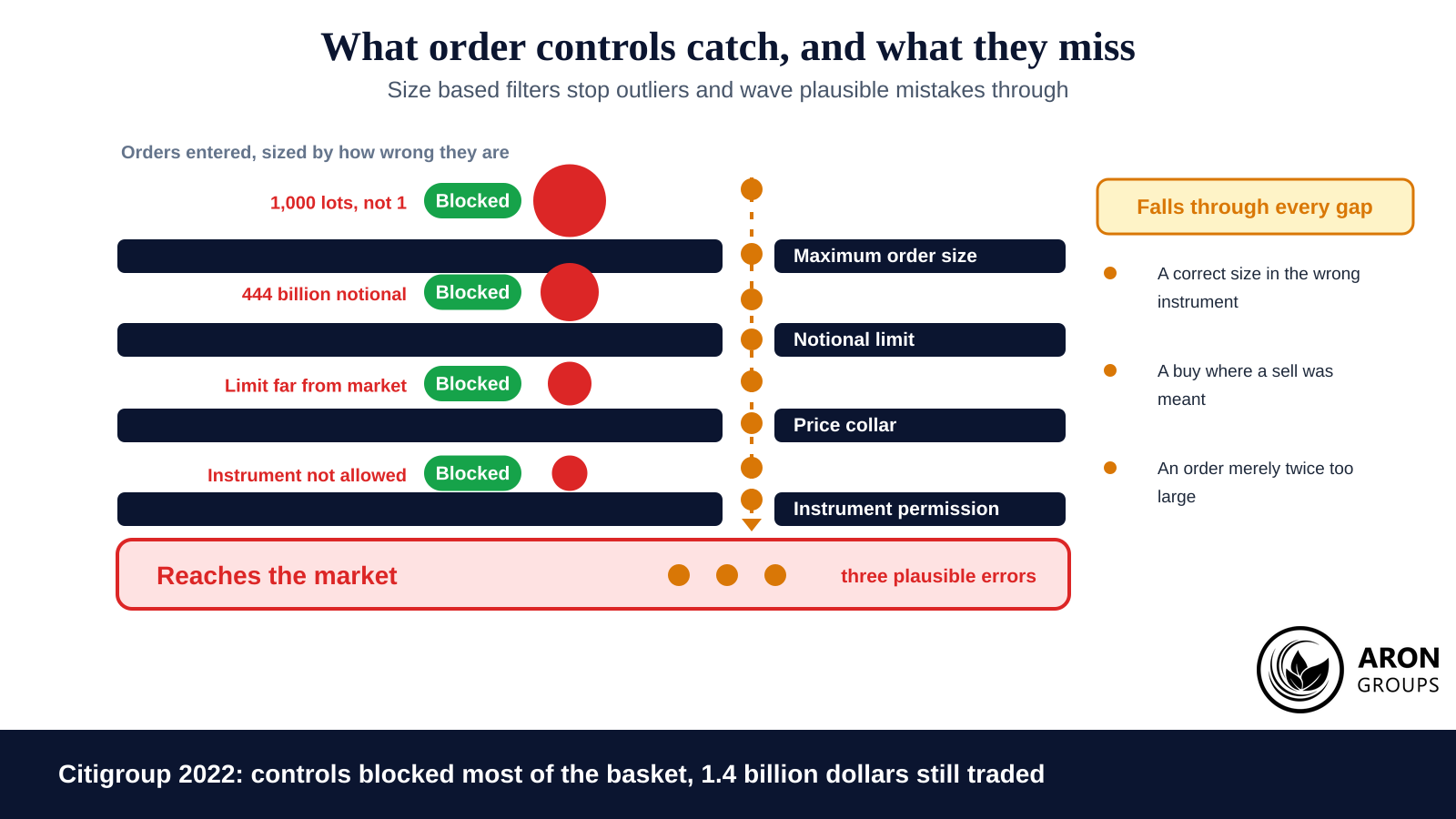
Controls are calibrated on size, so they catch outliers and pass plausible errors. An order twice as large as intended looks normal to a check built to stop one a thousand times too large.

Each filter is calibrated on size, so the errors small enough to look normal reach the market.

The Citigroup case is the clearest evidence. Controls blocked more than half the basket and 1.4 billion dollars still traded. The criticism was not that controls were absent, but that none rejected the basket outright.

A confirmation dialogue only works if the trader reads it. Anyone clicking through fifty confirmations a day has stopped reading by the tenth.

sms-star

Practical filter
If a control has never rejected one of your orders, it is either well calibrated or set far too wide. It is worth knowing which.


The popular claim that fat finger errors cause flash crashes is partial. They are one recognised trigger among several, and most episodes have more than one cause. Treating every sharp fall as a typing mistake is a viewpoint, not a fact.

Retail leveraged products carry structural risk before any of this is added. The United Kingdom regulator consulted on restricting retail access to contracts for difference. Risk management has to assume a wrong order will eventually be sent.

Where Aron Groups fits

Order entry discipline is a platform habit before it is a trading skill. Aron Groups runs on MetaTrader 5, where market execution fills at the next available price with no requotes and floating spreads. The platform’s own confirmation and volume settings are where this becomes practical. Set the default volume low and read the ticket.

To build the habit without an oversized position teaching you the lesson, the Nano account is the sensible place. It is commission free with the cost carried in the spread, and supports micro volumes from 0.0001 lots. Aron Groups offers spot and CFD instruments only, so the cases above are context, not trades to place here. Keep size conservative while the routine is new, since capital preservation is what makes an error survivable.

Conclusion

A fat finger error is the cheapest loss to prevent and one of the most expensive to suffer. The field that fails is almost always quantity, and the fix is a confirmation step and a ceiling on size.

The institutional cases are instructive for another reason. In every one the control layer existed and worked partially, and the loss came through the gap it left. A retail trader has fewer controls and more leverage, so the routine matters more.

Frequently asked questions

Four questions come up whenever an order goes in at the wrong size. Account specifics sit in the Aron Groups FAQ.

What is the most common fat finger error?

A wrong quantity, usually an extra zero or a misplaced decimal. The volume field is where one character changes the answer by a factor of ten. Price and side errors rarely scale the loss that way.

Can a fat finger trade be cancelled?

Sometimes, and never reliably. A cancellation queues behind orders already sent, and the venue can reject it. Mizuho tried within about ninety seconds in 2005 and was refused.

Is a fat finger error the same as spoofing?

No. A fat finger is an accident, while spoofing is deliberate manipulation and illegal. Orders may look alike on a screen, but intent is the whole distinction.

How do I reduce the risk on a retail platform?

Turn on the order confirmation step, set a low default volume, and agree a maximum order size. Then check volume, direction and instrument on every ticket. That is the defence that holds when you are rushed.

Continue Reading
not-found
calendar 3 October 2026
Rate this article

Leave a Reply

Your email address will not be published. Required fields are marked *

No thanks