





The relationship between CPI and gold is one of the most watched dynamics in financial markets. Every month, when the US Bureau of Labor Statistics publishes the latest inflation data, gold traders around the world brace for volatility in XAUUSD. In 2024–2025, US headline inflation moved from its June 2022 peak above 9% back toward the federal reserve’s 2% target, while gold traded repeatedly above $2,000 per ounce. By May 2026, headline CPI climbed again to roughly 4.2% year-over-year, reigniting debate about how cpi affects gold prices in both the short term and the long term.
This article breaks down how the consumer price index cpi drives moves in the gold market – covering CPI basics, the inflation hedge debate, real interest rates, monetary policy, trading strategies, and practical tips. If you trade XAUUSD or gold CFDs with Aron Groups Broker, this is the macro framework you need.

- The consumer price index is the primary US inflation gauge and a key driver of short-term gold price volatility around monthly releases.
- Gold prices react not just to CPI itself, but to how CPI changes expectations for federal reserve interest rates and real yields.
- Over the long term, gold can preserve purchasing power, but CPI and gold do not always move together month by month - changes in CPI account for only 16% of gold price fluctuations since 1971.
- Traders at Aron Groups Broker can speculate on CPI-driven gold moves via CFDs, using risk management and technical analysis on MT5.
Understanding the Consumer Price Index (CPI)
The consumer price index measures the average change in prices paid by urban consumers for a fixed market basket of consumer goods and services. Published monthly by the Bureau of Labor Statistics (part of the US Department of Labor Statistics), CPI tracks categories including shelter, food, energy, transportation, and medical services.
Reports typically drop around the 10th–15th of each month at 8:30 a.m. ET – a moment when gold investors and forex traders are glued to their screens. A rising consumer price index indicates higher inflation and decreased purchasing power of the dollar.
Two readings matter most:
- Headline CPI: Includes all items, including volatile food and energy.
- Core CPI: Excludes food and energy to capture underlying inflation trends.
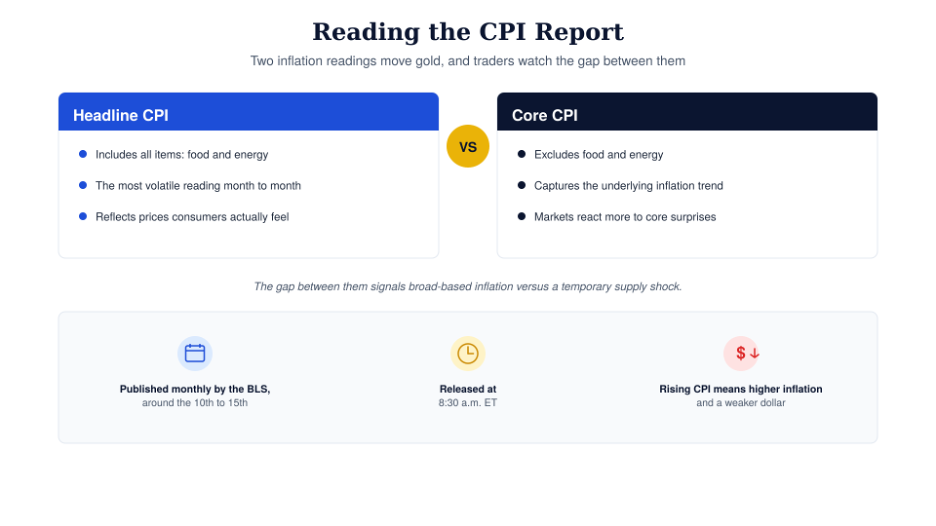
Both headline inflation and core cpi can move gold markets differently. Economists and analysts watch the gap between them to assess whether inflation is broad-based or driven by temporary supply shocks. CPI feeds directly into monetary policy decisions, wage indexation, and inflation expectations – making it a central macro indicator for anyone trading the yellow metal.
Gold’s Role: Inflation Hedge or Unstable Companion?
The traditional view holds that gold serves as an inflation hedge and a store of real value during periods of rising consumer prices and currency devaluation. Historically, gold prices typically rise during periods of high inflation. Gold demand tends to rise with increasing inflation as investors seek to preserve wealth.
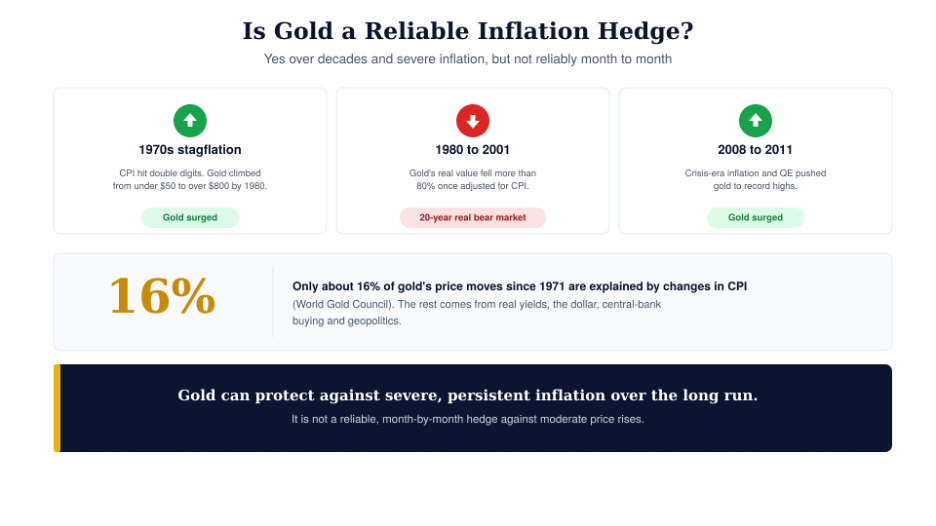
The 1970s US stagflation era is the textbook example: CPI surged into double digits, and gold rose from under $50 per ounce to over $800 by 1980. Similarly, during the 2008–2011 financial crisis, elevated cpi inflation and quantitative easing pushed gold to then-record highs.
But the story has a sharp counterpoint. From 1980 to 2001, gold’s price decreased over 80% adjusted for CPI – a brutal two-decade bear market in real terms. Gold’s real price eventually recovered, reaching almost $740 per ounce in April 2024, but that long drawdown illustrates a critical nuance.
Research from the World Gold Council shows that changes in CPI account for only 16% of gold price fluctuations since 1971. Gold’s relationship with inflation is unstable and variable over time. The bottom line: gold may protect against severe, persistent high inflation over the long term, but it is not a reliable month-by-month hedge against moderate price rises
Learn about the Terminal Federal Funds Rate.
How CPI Affects Gold Prices: Main Transmission Mechanisms
CPI data influences gold prices through several interconnected channels: inflation expectations, real interest rates, opportunity cost, and US dollar moves. Because gold is quoted in USD globally, any CPI surprise that shifts expectations for the dollar and US yields can trigger an immediate reaction in the gold market.
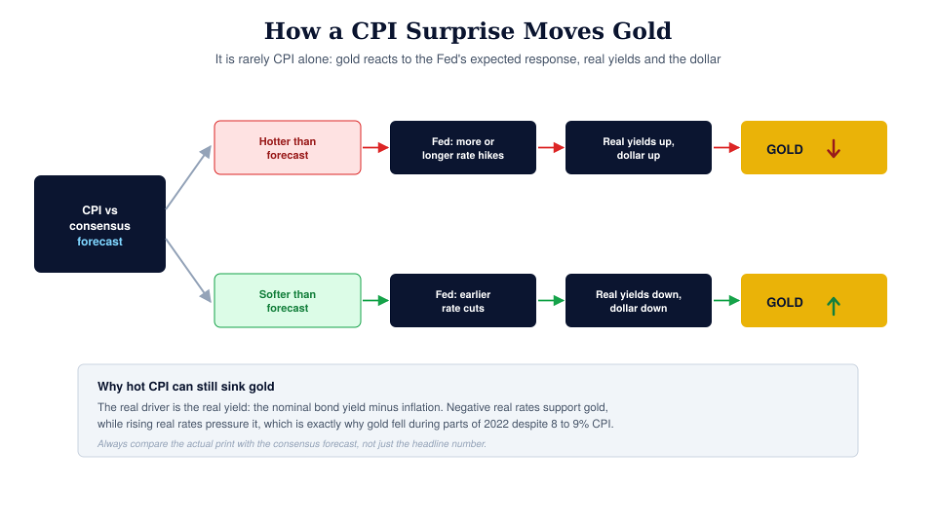
Traders should watch not only the CPI number but how it compares with consensus forecasts. High consumer price index data often correlates with a weakening currency, which can support safe haven demand for gold. But the relationship runs through the federal reserve’s expected response – not through CPI alone. Understanding the most important factors affecting the gold market means tracking multiple variables simultaneously.
Inflation Hedge Theory and Market Psychology
When CPI rises faster than nominal interest on cash or savings, real purchasing power erodes. This pushes some investors toward safe haven assets like gold to protect their wealth. If CPI prints significantly above expectations – for example, 0.6% month-over-month versus a 0.3% forecast – the initial knee-jerk reaction often assumes stronger demand for gold as a hedge.
During the COVID-19 pandemic in 2020–2021, fears of high future CPI coincided with gold reaching then-record highs above $2,050 per ounce. However, this relationship is not linear. Moderate CPI increases are sometimes ignored by gold markets when investors are focused more on interest rates and growth data.
Real Interest Rates: The Primary Link Between CPI and Gold
Gold prices correlate most strongly with real interest rates – defined as the nominal yield on assets like 10-year US Treasuries minus CPI inflation or expected inflation. When CPI is high and nominal yields lag behind, real rates turn low or negative. In a negative real-rate environment, demand for gold typically surges because bonds offer returns below inflation.
In 2020–2021, real US yields fell well below zero, coinciding with strong gold prices and repeated tests of $2,000 per ounce. Conversely, if CPI surprises to the upside but bond yields rise even more due to expectations of aggressive raising rates, real yields can increase and actually pressure gold lower – exactly what happened during parts of 2022.
Traders using Aron Groups Broker should monitor both CPI releases and benchmark yields together rather than treating inflation data in isolation.
Opportunity Cost and the Federal Reserve’s Reaction
Gold has no yield. Its relative attractiveness depends entirely on the opportunity cost versus interest-bearing assets influenced by monetary policy. The sequence is straightforward:
- Higher-than-expected CPI → markets price in more rate hikes
- Higher short-term interest rates → greater cost of holding gold
- Potential gold sell-off despite elevated inflation
The opportunity cost of holding gold increases when interest rates rise. In early 2024, sticky US CPI readings led traders to push out expectations for rate cuts, causing temporary pullbacks in gold. When CPI comes in softer than expected, the reverse happens: markets anticipate earlier rate cuts, the dollar weakens, and gold prices often rise.
The Federal Reserve, Monetary Policy, and the Gold Market
In many cases, the Fed’s response to CPI matters more for gold than the CPI number itself. Higher inflation can prompt central banks to raise interest rates, which strengthens the dollar and lifts yields – typically bearish for gold. Dovish policy (rate cuts, QE) does the opposite, supporting gold by depressing real rates and money market returns.
Key policy shifts shaped gold’s trajectory: post-2008 QE fueled a gold rally, the aggressive 2022–2023 hiking cycle created headwinds, and the ongoing 2025–2026 debate over when to cut rates keeps uncertainty elevated. Traders in gold CFDs often position ahead of FOMC meetings based on how CPI data may influence Fed projections.
Short-Term Trading: CPI Releases and Gold Volatility
Gold prices can swing 1-2% after CPI announcements within minutes, creating both opportunity and risk. Short-term reactions to CPI reports can be erratic and short-lived, so preparation matters.
Before each release:
- Track the economic calendar and know exact CPI release times
- Pre-define support and resistance levels on your chart
- Use pending orders rather than market orders to avoid slippage
- Set stop-loss and take-profit before the data drops
Explore Forex Signals and their usage.
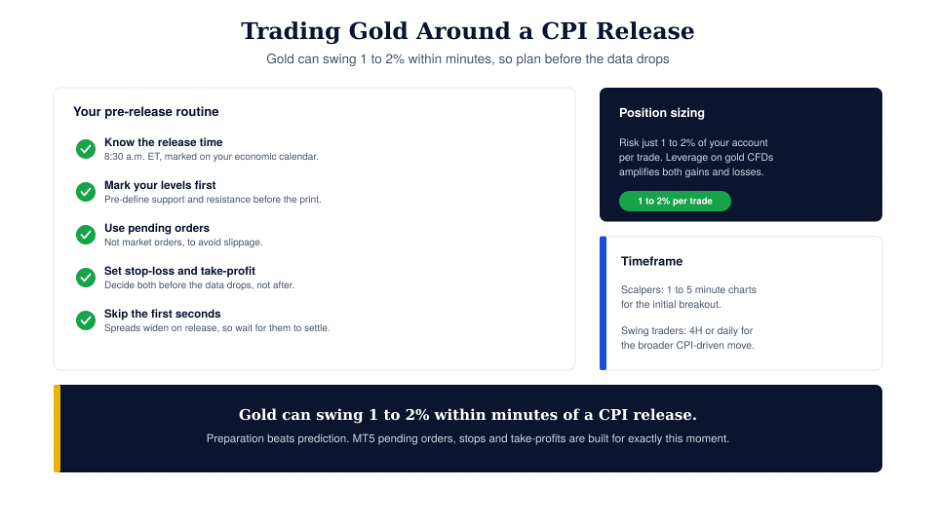
For scalpers, 1–5 minute charts around the release capture the initial breakout. Swing traders may use 4H or daily timeframes. A proven gold scalping strategy combined with CPI analysis can sharpen entries considerably. Spreads widen in the first seconds after release on most brokers, so avoid entering trades in that narrow window.
Long-Term Perspective: CPI, Gold, and Portfolio Strategy
Over multi-decade periods, long-term gold has maintained its purchasing power with inflation – but with deep interim drawdowns. The 1980–2001 collapse in gold’s real value shows that waiting decades for gold to “work” as a hedge is realistic.
CPI changes explain only a portion of long-run gold moves. Central bank buying, geopolitical risk, and currency regimes also drive the market. Some gold investors use gold or gold CFDs as a strategic hedge against tail risks: very high inflation, currency crises, or loss of confidence in fiat money. Aron Groups Broker clients might combine gold exposure with forex and index types of CFDs to build diversified strategies reflecting their outlook on inflation and monetary policy.
Practical Tips for Trading CPI and Gold with Aron Groups Broker
Here’s actionable guidance for Aron Groups Broker users trading XAUUSD and related instruments:
- Build a macro calendar: Include US CPI, PCE, nonfarm payrolls, and Fed meetings. Review weekly before placing gold trades.
- Choose your timeframe: Scalpers focus on 1–5 minute charts; swing traders use 4H or daily to capture broader CPI-driven trends.
- Use MT5 tools: MetaTrader 5 supports pending orders, stop-loss, and take-profit – essential for managing the 8:30 a.m. ET CPI volatility spike.
- Size positions carefully: Use a position size calculator and limit risk to 1–2% of account balance per trade. Leverage on gold CFDs amplifies both gains and losses.
- Explore copy trading: If you prefer to follow experienced CPI and gold traders, Aron Groups Broker offers copy trading and prop trading programs.
FAQ
These questions address common CPI and gold issues not fully covered above, aimed at both beginning and intermediate traders.
Does gold always go up when CPI is high?
No. Gold’s reaction depends on expectations, real interest rates, and the federal reserve’s perceived response. In 2022, CPI was above 8–9% but gold declined during periods when markets anticipated aggressive raising rates that pushed real yields higher. Always compare actual CPI to forecasts and monitor bond yields and the dollar alongside XAUUSD.
Which CPI release matters most for gold traders?
The monthly US CPI report from the Bureau of Labor Statistics is the primary driver, especially headline and core year-over-year readings. Markets often react more to surprises in core CPI because it strips out volatile food and energy components. Track both metrics in economic calendars on your trading platform.
How can I manage risk when trading gold around CPI with CFDs?
Pre-define maximum risk per trade (1–2% of account balance) and set stop-loss orders before the CPI release. Reduce position size or leverage given potential 1–2% intraday swings. Avoid entering trades in the final seconds before release when spreads widen. Performing security verification on your account settings and ensuring verification successful status before volatile sessions helps avoid access issues. Note that security service protections and measures against malicious bots may temporarily require you to respond ray id prompts – a site verifies your connection is legitimate before granting access.
Is gold a good long-term inflation hedge for retail traders?
Historically, gold has helped preserve purchasing power over multi-decade periods, but with long stretches of underperformance compared to CPI. Gold is best viewed as one component of a diversified strategy rather than a perfect one-for-one measure against the consumer price index. Consider your time horizon, risk tolerance, and access to other instruments when sizing gold exposure.
What other indicators besides CPI should I watch when trading gold?
Key factors include PCE inflation, US nonfarm payrolls, unemployment rate, ISM PMIs, and Fed policy statements – all influence interest rates and the dollar. Geopolitical news (wars, sanctions, political crises) can sometimes overshadow CPI effects and become the dominant driver. Build a simple watchlist and observe how gold reacts to each type of data over time to refine your positive edge in the economy.
Learn more about the KST Indicator.