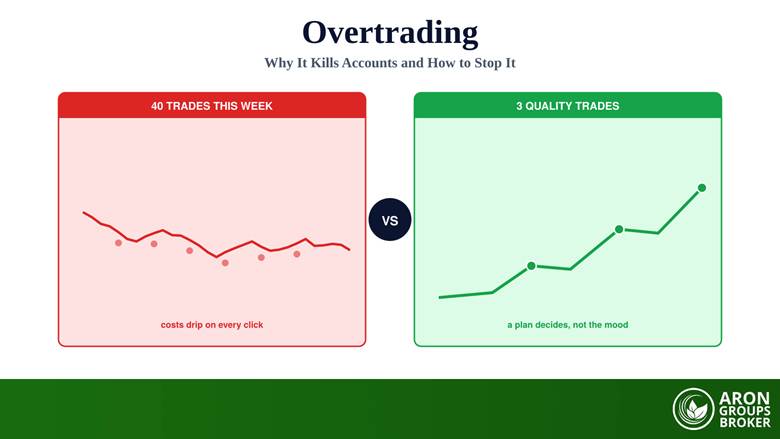

Overtrading is trading too frequently, or in positions too large for your plan and account, driven by emotion rather than a valid setup. It is more activity, not more profit: opening positions you cannot justify, holding them longer than the plan allows, and clicking because being flat feels wrong. The definition matters because the cure follows from it, and the cure is behavioural, not technical.
That is the core framing this guide insists on: overtrading is a psychological issue, not a strategy flaw. Traders hunt for a better indicator when the problem is an unmanaged impulse, which is why the fix looks less like analysis and more like the disciplined structure of a professional trader: a written plan, hard numbers, and rules that fire without a vote.
Below: the four emotional drivers, the hidden cost bill that drains accounts even on break-even trading, a self-diagnosis checklist, the prop-firm pressure that manufactures overtrading, the rule-based plan that stops it, the Pareto arithmetic behind trading less, and one precision note most articles blur.
- Overtrading means trading too often or too large for your plan, driven by FOMO, revenge, boredom, or greed rather than by a setup you can name.
- It is a psychological pattern, not a strategy flaw: more trades do not mean more profit, and the cure is rules, not indicators.
- The hidden bill is death by a thousand cuts: spreads, commissions, and slippage stack up on every click and are paid win or lose.
- Concrete numbers stop it: fixed percentage risk, a daily loss limit, a maximum number of trades, and sessions you actually trade well.
- Most profit comes from a few quality trades, so adding volume usually dilutes results rather than improving them.
What Is Overtrading?
Overtrading is excessive trading activity relative to your plan, your account, and your edge: too many positions, too large, too often, or held too long, with the excess supplied by emotion. It wears two faces that look different and are the same mistake. Frequency overtrading is dozens of small, impulsive entries with no nameable setup. Size overtrading, its close cousin overleveraging, is fewer trades carrying more risk than the plan permits, and both are measured against the same yardstick: what your written rules and sensible risk management actually authorised.
Risk Disclosure
CFDs are complex instruments and come with a high risk of losing money rapidly due to leverage. You should consider whether you understand how CFDs work and whether you can afford to take the high risk of losing your money. Past performance is not indicative of future results. This content is provided for educational purposes only and does not constitute investment advice.
A Psychological Problem Wearing a Technical Mask
No strategy causes overtrading, and no strategy fixes it, because the behaviour begins after the analysis ends. A trader with a profitable, backtested system can still destroy it by taking the system’s three signals plus seventeen improvised ones. Studies of retail day traders found only a small minority consistently profitable, and excessive activity, not weak analysis, is one of the recurring reasons; the market rewards selectivity and bills activity.
The Four Drivers: FOMO, Revenge, Boredom, Greed
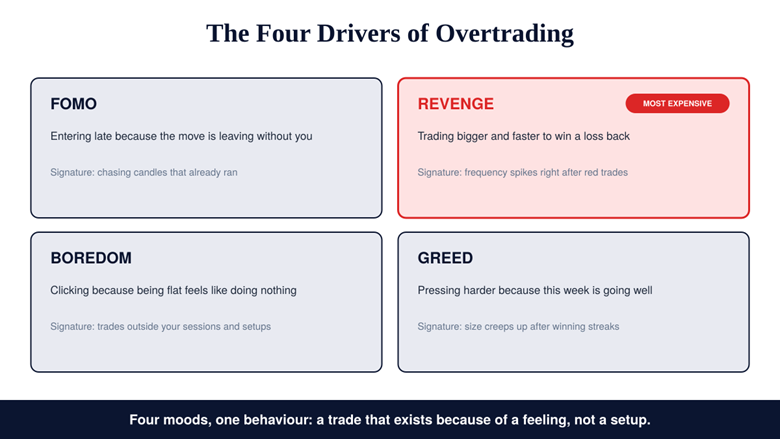
Overtrading is one behaviour with four fuels, and naming the one running you is half the fix. FOMO enters late because the move is leaving; revenge trades bigger and faster to win a loss back from the market that took it; boredom clicks because being flat feels like doing nothing; and greed presses harder because the week is going well and surely deserves more. Social media amplifies the first, and prop-firm challenge culture amplifies all four.
Four moods, one behaviour: each driver leaves a different fingerprint in your trade history.
| Driver | Fingerprint in your history | The rule that stops it |
|---|---|---|
| FOMO | Chasing candles that already ran | Enter only on alerts at planned levels |
| Revenge | Frequency spikes right after losses | Daily loss limit that closes the platform |
| Boredom | Trades outside your sessions and setups | Best sessions only; flat otherwise |
| Greed | Size creeps up after winning streaks | Fixed fractional risk, never adjusted mid-week |
Each fuel has a signature and a countermeasure; the journal tells you which row is yours.
Q: What is the difference between overtrading and overleveraging?
A: Overtrading is too many trades or too much activity; overleveraging is too much size on the trades you take. They travel together, because the same emotions drive both, but the remedies differ: a trade-count limit caps the first, while fixed fractional position sizing caps the second.
The Hidden Costs: Death by a Thousand Cuts
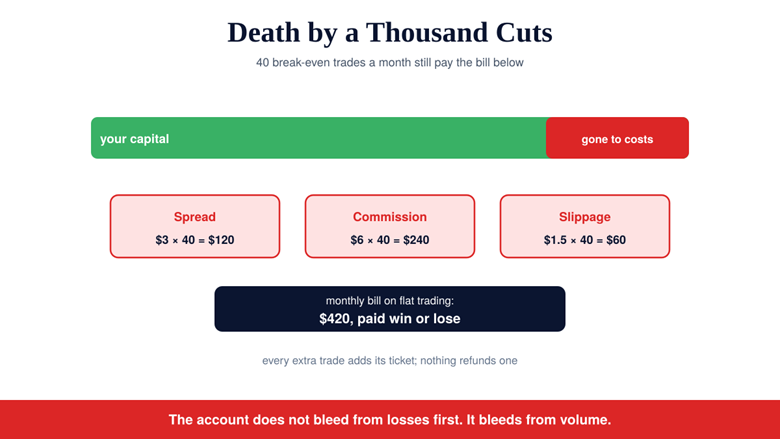
The visible damage of overtrading is losing trades; the invisible damage is the bill attached to every trade, winning or losing. Each click pays the spread, any commission, and often a little slippage, and the amounts are individually trivial, which is exactly why they work. Forty break-even trades a month can quietly transfer hundreds of dollars from your account to transaction costs while your trade log insists nothing went wrong, a slow leak that capital preservation arithmetic makes brutally visible once you total a month of tickets.
Mini Example: The Break-Even Month That Was Not
A trader takes 40 gold trades in a month and finishes exactly flat on price. Average spread cost $3 per trade, commission $6, average slippage $1.50: the month’s bill is $420 on trading that felt free.
The same trader’s plan authorised 12 trades. At identical per-trade costs, the authorised month costs $126. The difference, $294, bought nothing: not edge, not information, only activity. Over a year that is more than $3,500 of pure friction.
Signs You Are Overtrading
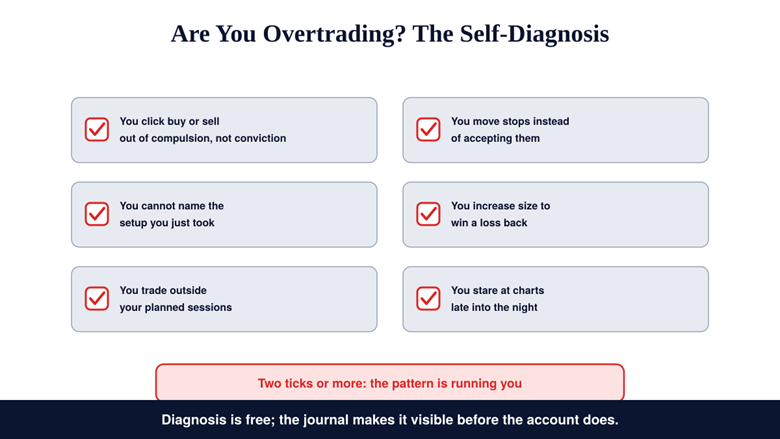
Self-diagnosis is uncomfortable and cheap, and the checklist below is the honest mirror. Tick what applied in the last two weeks: you clicked buy or sell out of compulsion rather than conviction; you cannot name the setup behind your last three trades; you traded outside your planned sessions; you moved stops instead of accepting them; you increased size to win a loss back; you stared at charts late into the night looking for a reason to click. Two ticks or more and the pattern is running you, not the reverse.
The Prop-Firm Pressure Cooker
Evaluation culture deserves its own paragraph, because challenge targets and time limits actively manufacture overtrading: a profit target with a deadline whispers that every flat hour is wasted, and traders sprint into dozens of forced trades that no plan authorised. The fix is treating a challenge as rule-bound risk arithmetic rather than an emotional race: a daily loss cap, a maximum trade count, and position sizes computed from the drawdown limit, rehearsed before any fee is paid. A free evaluation such as the No Deposit PROP Challenge exists precisely for that rehearsal, and a drawdown calculator turns the percentage rules into daily dollar budgets you can actually obey.
One more piece of challenge hygiene: know every cost before the sprint starts. Evaluation fees, reset fees, and the per-trade bill all reward the patient plan over the frantic one, and the CFTC’s advisory on off-exchange forex trading makes the general point that understanding exactly what you are paying, and to whom, is the first defence any retail trader has.
How to Stop Overtrading: Rules With Numbers In Them
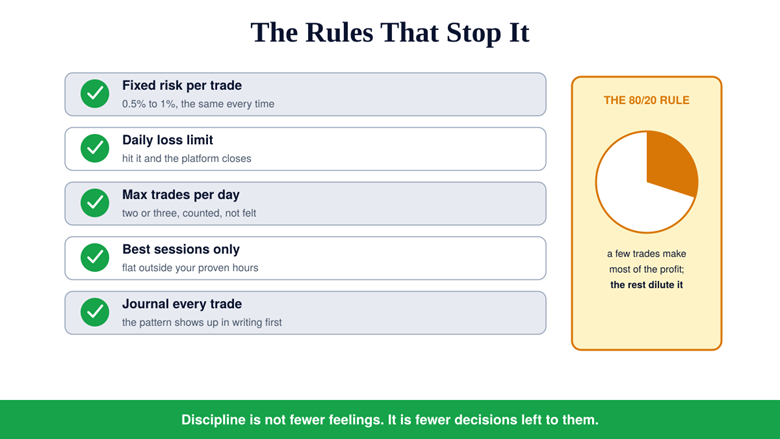
Vows fail; numbers hold. The plan that stops overtrading is written, and every line contains a figure. Exact entry criteria you can point at on a chart. A fixed percentage risk per trade, commonly 0.5% to 1%, applied through deliberate position sizing rather than mood. A daily loss limit that closes the platform when hit, not a suggestion but a circuit breaker. A maximum number of trades per day, two or three for most intraday styles, counted rather than felt.
Two structural habits complete it. Trade only your best sessions, the hours your journal proves you trade well, and close the platform outside them, because availability is not opportunity. And keep the journal itself, logging every trade with its named setup and its feeling, since the overtrading pattern appears in writing weeks before it appears in the equity curve. Traders who want the pattern gone fastest sometimes adopt a weekly limit of two or three trades for a month: drastic, temporary, and remarkably clarifying about which trades were ever necessary.
Rule: Make the rules mechanical: a fixed risk-to-reward requirement before entry, alerts instead of watching, and a trade counter on the desk. Every decision moved out of the moment is a trade the mood cannot take. |

The Overcorrection: Undertrading
The cure has a failure mode of its own. Undertrading is skipping valid setups your plan authorised, usually out of fear after a losing streak or perfectionism dressed as patience, and it costs expectancy just as surely as overtrading costs friction. The target is not fewer trades for their own sake; it is every trade the plan authorises and none it does not. The journal diagnoses both directions with the same two columns: authorised trades skipped, and unauthorised trades taken. A disciplined month scores near zero on each.
The Pareto Reminder: Less Is the Edge
Audit any honest trading journal and a version of the 80/20 rule appears: the large majority of profit comes from a small minority of trades, the clean setups where everything aligned. Adding trades beyond those does not add more of them; it dilutes focus, spends the cost bill, and drags the average down, which is why a systematic, quantitative process treats trade selection, not trade generation, as the scarce skill. European regulators found the large majority of retail accounts lose money on leveraged products, and the overactive account is overrepresented in that majority.
Run the audit once and the argument ends. Sort last quarter’s closed trades by profit and cover the top five with your hand: for most overactive accounts, what remains is flat or negative. Then count how many of those top five would have survived a two-trades-a-day limit. Almost always, all of them. The limit does not cost you the good trades; it costs you the crowd around them.
Q: Is overtrading the same as churning?
A: No, and the distinction matters. Overtrading is your own behaviour: you trading your account too much. Churning is a broker or manager excessively trading a client’s account to generate commissions, which is misconduct regulators pursue. Many articles blur the two; keep them separate, because one is fixed by discipline and the other by reporting it.
Practising the Discipline With Aron Groups
Structure is easier to build where mistakes are cheap. A demo account lets you practise the two-trades-a-day rhythm with zero stakes, and the MetaTrader 5 platform enforces the mechanics: hard stops on every order, alerts at planned levels instead of screen-watching, and fixed lot defaults that do not drift with mood.
When the habit holds, a small account with micro volumes keeps early live lessons affordable while the rules bed in, and a transparent ECN cost structure has one underrated virtue for recovering overtraders: the spread and commission on every ticket are visible, so the thousand cuts stop being hidden and start being a line you can read, total, and shrink. The mechanics of entries and exits live in our guide on how to trade forex; this article is about taking fewer of them.
Conclusion
Overtrading is the silent account killer because nothing about it looks like a mistake in the moment: every extra trade arrives dressed as an opportunity, and the bill is collected quietly in spreads, commissions, slippage, and diluted focus. It is a psychological pattern with four fuels, FOMO, revenge, boredom, and greed, and no indicator retires any of them.
Rules with numbers do. A written plan, fixed fractional risk, a daily loss limit with teeth, a counted maximum of trades, your best sessions only, and a journal that names every setup: build that structure and the urge to click meets a system with no slot for it. Trade less, on a defined risk-to-reward basis, and let the few trades that deserve your capital carry the month, because they were always the ones doing the carrying.
Frequently Asked Questions
Quick answers to the questions traders ask most about overtrading and how to stop it.
What is overtrading in forex?
Overtrading is trading too frequently or with positions too large for your plan and account, driven by emotions such as FOMO, revenge, boredom, or greed rather than by valid setups. It shows up as impulsive clicks, unnameable setups, and trades outside your planned sessions.
Why do I overtrade?
Usually one of four fuels: fear of missing a move, the urge to win a loss back, the discomfort of being flat, or overconfidence after wins. Prop-firm targets, deadlines, and social media amplify all of them. Identifying your dominant fuel tells you which rule you need most.
How do I stop overtrading?
Replace willpower with numbers: a written plan with exact entry criteria, fixed percentage risk per trade, a daily loss limit that closes the platform, a maximum of two or three trades per day, your best sessions only, and a journal. Some traders reset the habit with a strict weekly limit for a month.
Does overtrading cost money even if my trades break even?
Yes. Every trade pays the spread, any commission, and often slippage, win or lose. Dozens of low-quality trades can drain hundreds of dollars a month from an account that finished flat on price, which is why the cost bill is called death by a thousand cuts.