
icon icon Home
icon icon Accounts
icon icon Quick start
icon icon Symbols

Raw Spread vs Zero Spread Accounts: How They Differ and Which Costs Less

Author
Abe Cofnas
Abe Cofnas
calendar Last update: 21 July 2026
watch Reading time: 8 min

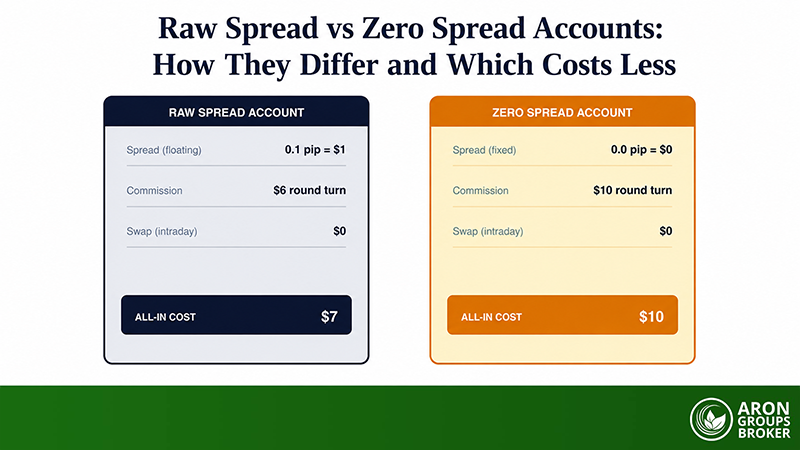
Raw spread and zero spread accounts price the same trade in two different ways. A raw spread account passes you the market’s own bid-ask spread, floating and often near 0.0 pips in liquid hours, and charges a fixed commission per lot on top. A zero spread account fixes the spread at 0.0 on a list of selected pairs and recovers the cost through a higher commission. Neither is free, and neither is always cheaper; the honest answer lives in one line of arithmetic covered below.

The comparison matters because spread pricing is where broker marketing works hardest. Zero is a powerful word, and raw sounds institutional, but both labels describe where the cost sits, not whether it exists. Understanding the mechanics is part of learning how to trade forex at all, and it is the difference between choosing an account and being sold one.

This guide explains how each account type is built, why the same broker can offer both honestly, how volatility treats them differently, what the structures hint about a broker’s execution model, and the total-cost formula that settles the question for your own trading, with a worked example on gold.

bookmark
Key Takeaways
  • Raw spread accounts pass through the liquidity providers' floating spread, from around 0.0 pips, plus a fixed commission per lot.
  • Zero spread accounts fix the spread at 0.0 on selected pairs and charge a higher commission to recover the cost.
  • Volatility is the real divider: raw spreads widen sharply at news, while a fixed zero spread holds, making the choice style-dependent.
  • The only fair comparison is total cost per trade: spread cost plus commission plus swap, computed with your instruments and your frequency.
  • Commission-free accounts are not free either; the cost moves into the spread, which suits lower trade frequencies.

What Is a Raw Spread Account?

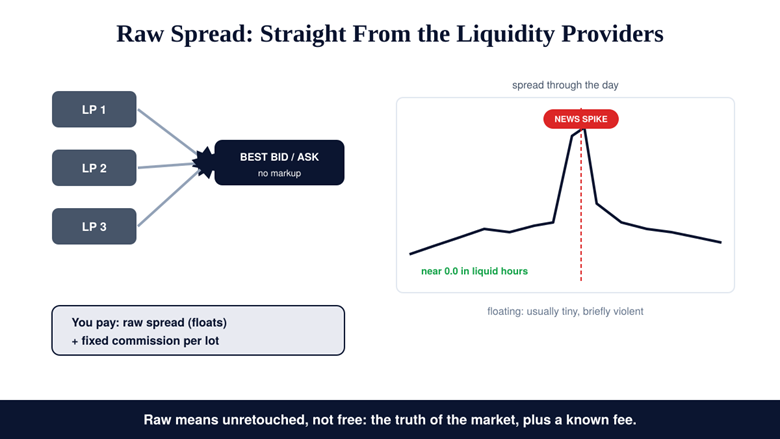
A raw spread account, sometimes labelled ECN or pure spread, streams prices assembled from the broker’s liquidity providers with no markup added. In deep sessions on major pairs the resulting spread sits near 0.0 to 0.1 pips, and because the broker adds nothing to the price, it earns its revenue as a fixed, disclosed commission per lot, commonly in the range of a few dollars per round turn. The global FX market‘s scale is what makes this possible: the deepest pairs are so heavily traded that the raw spread between the best bid and ask is often barely measurable.

The word raw cuts both ways. You receive the market’s truth, and the market’s truth is not always kind: in thin hours, at rollover, and above all around news releases, the underlying spread widens instantly, and a raw account passes the widening straight to you. The commission stays fixed, but the spread component of your cost floats with conditions.

sms-star

Risk Disclosure

CFDs are complex instruments and come with a high risk of losing money rapidly due to leverage. You should consider whether you understand how CFDs work and whether you can afford to take the high risk of losing your money. Past performance is not indicative of future results. This content is provided for educational purposes only and does not constitute investment advice.
What Is a Raw Spread Account?

Who Is the Raw Account Best Suited For?

Raw pricing rewards traders who transact often, in liquid hours, with tight targets: scalpers, high-frequency intraday styles, and automated strategies whose expectancy is measured in fractions of a pip. For them, paying the market’s true spread of nearly nothing plus a moderate fee beats any fixed arrangement, and the per-lot commission becomes a precise input to position sizing rather than a nuisance. The trade-off is discipline around the calendar: a raw-account scalper who wanders into a news release has volunteered for the one moment the account type is expensive.

What Is a Zero Spread Account?

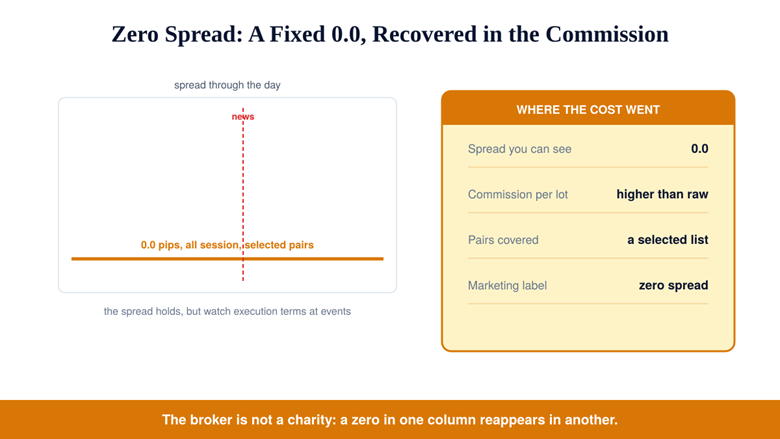
A zero spread account fixes the spread at 0.0 pips on a defined list of instruments, usually the major pairs and a few popular metals, and charges a higher commission per lot than a raw account does. The broker is not performing charity; it is repackaging. The cost that would have appeared as a floating spread reappears as a predictable fee, which is genuinely valuable to traders who need identical, plannable costs on every trade, and less valuable to anyone who mostly trades the quiet hours when raw spreads are near zero anyway.

What Is a Zero Spread Account?

Who Is the Zero Account Best Suited For?

Fixed pricing suits traders who need the cost column of their journal to be a constant: news traders who are active precisely when floating spreads explode, strategy testers who want live results comparable to backtests without spread noise, and anyone whose edge is thin enough that a surprise two-pip spread converts a winner into a loser. The higher commission is the insurance premium, and like any premium it is only worth paying if you actually trade the moments it insures.

sms-star

Risk Warning: Read the instrument list before opening a zero spread account. The 0.0 usually applies to selected symbols only; everything outside the list trades on ordinary pricing, and assuming otherwise is an expensive surprise.

Q: If both accounts charge commission, what is actually different?

A: The variable part. On a raw account the spread floats with the market while the commission is fixed; on a zero spread account both parts are fixed on covered pairs. You are choosing between a usually cheaper cost that can spike, and a slightly higher cost that cannot.

Volatility: Where the Two Accounts Truly Part Ways

In calm, liquid conditions the two structures converge, and the raw account is often marginally cheaper. The divergence appears exactly when trading gets interesting. At a CPI print or a central bank decision, raw spreads on even the deepest pairs can jump from a tenth of a pip to several pips for a few seconds, precisely when news traders are active. A fixed zero spread holds through the event on covered pairs, which is why event-driven styles gravitate toward it, though execution quality and slippage at extreme moments remain their own subject, and regulators’ advisories on retail forex trading are blunt about how leverage amplifies those moments. Whatever the account label, sound risk management decides whether volatility is an opportunity or a bill.

What the Pricing Model Hints About Your Broker

Account structures also whisper about execution models. Raw spread plus commission is the natural shape of A-book, agency-style execution: the broker profits from the disclosed fee and passes your flow toward liquidity providers, so its revenue does not depend on your losses. Artificially fixed pricing, by contrast, is easiest to run when the broker internalises flow, B-book style, and prices against its own book. These are hints, not verdicts; hybrid models are common and legitimate, and European regulators’ product intervention rules, leverage caps, margin close-out, and negative balance protection, exist precisely because the retail CFD market mixes models. The practical test is disclosure: a broker that explains where its prices come from and publishes its fees per account has answered the question that matters.

Three questions extract most of the signal. Ask where the account’s prices are sourced and whether flow is passed to external liquidity. Ask for the full fee schedule, spread, commission, and swap, per account type in writing. And ask what happens to execution during major news: requotes, widened stops distance, or unchanged terms. Brokers with clean answers tend to have clean models, whatever mix of books sits behind them.

Raw vs Zero vs Standard: The Three-Way Choice

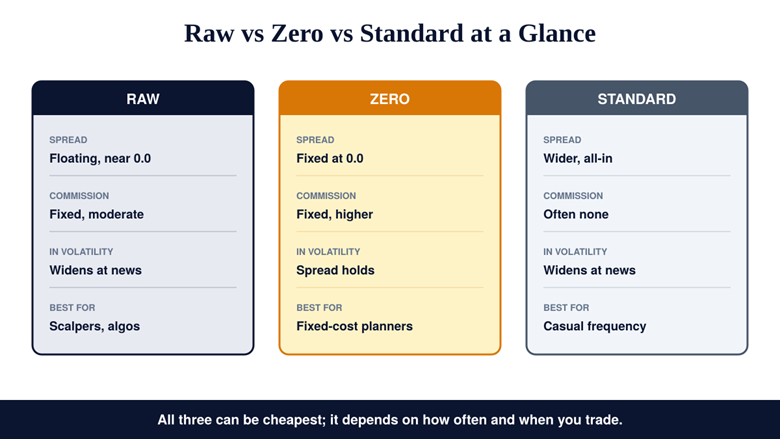
Most brokers offer a third shape as well: the standard account, where there is often no separate commission and the whole cost lives inside a wider spread. Standard pricing suits lower trade frequencies, where simplicity beats a per-lot fee. The table puts the three side by side.

Raw vs Zero vs Standard: The Three-Way Choice
DimensionRaw spreadZero spreadStandard
SpreadFloating, from ~0.0 pipsFixed 0.0 on selected pairsWider, all-in
CommissionFixed, moderateFixed, higherOften none
Behaviour at newsSpread widens sharplySpread holds on covered pairsSpread widens
Cost predictabilityMediumHighestLowest
Typical fitScalpers, algos, high frequencyFixed-cost planners, news stylesOccasional traders

No column wins outright: frequency, timing, and instruments decide which shape is cheapest for you.

The Total-Cost Formula That Settles It

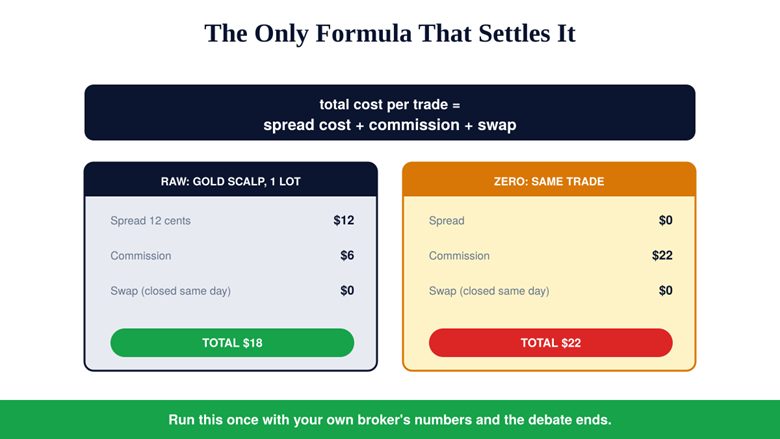
Every account comparison reduces to one line: total cost per trade equals spread cost plus commission plus swap. Spread cost is the spread in price terms multiplied by your position size; commission is the broker’s published per-lot fee; swap applies only if you hold overnight. Compute it for the instruments you actually trade, at the times you actually trade them, and multiply by your monthly trade count. High-frequency styles feel commissions keenly, position traders barely notice them, and a systematic trader can fold the figure directly into expectancy alongside the risk-to-reward ratio.

Scale is what makes the formula decisive. A difference of $4 per trade reads as trivial until it is multiplied by two hundred trades a month, at which point it is $800, and very few strategies have enough monthly edge to donate $800 to the wrong pricing model. The same multiplication runs in reverse for occasional traders: at six trades a month, a $4 difference is $24, and convenience or swap terms may legitimately outweigh it. The formula does not only pick an account; it tells you how much the choice is worth.

One multiplication per component: run it with your own numbers and the marketing stops mattering.

Mini Example: Gold Scalp, Two Receipts (text-only scenario)

A scalper trades 1 lot of gold and captures a quick move. On a raw account the spread is 12 cents, costing $12 on 100 ounces, plus a $6 commission: $18 all-in. On a zero spread account the spread costs $0 and the commission is $22: $22 all-in. The raw account wins this trade by $4.

Now rerun the same trade at a news release, when the raw spread touches 60 cents for a moment: $60 plus $6 against a fixed $22. The zero account wins by $44. Same trader, same instrument; the clock decided the winner, which is why the formula must be run on your schedule, not a brochure’s.

Q: Are commission-free accounts cheaper than both?

A: They remove the line item, not the cost, which moves into a wider spread. For a few trades a month that trade-off is often genuinely better, because simplicity is worth more than a fraction of a pip. For high frequencies, the widened spread compounds into the largest bill of the three.

Where Aron Groups Fits

Aron Groups‘ account line-up is a live illustration of everything above, and worth reading with the formula in hand. The Nano account is commission-free on all symbols, with the cost carried in the spread and micro volumes from 0.0001 lots, which makes it the natural place to measure real costs with real money at minimal stakes. The Islamic ECN account is also commission-free as well as swap-free. The Standard and VIP ECN accounts charge commissions in the classic ECN shape, with special symbols that periodically waive commission and swap under published conditions. The full, current numbers per account live on the trading accounts page, and comparing them with the worksheet from this article, on the Aron Groups MetaTrader 5 platform, takes about ten minutes.

Conclusion

Raw spread and zero spread are two arrangements of the same bill. Raw gives you the market’s floating truth plus a moderate fixed fee, and is usually cheapest in liquid hours; zero gives you a fixed 0.0 on selected pairs plus a higher fee, and is at its best exactly when raw pricing is at its worst. Standard accounts fold everything into the spread and win on simplicity at low frequencies.

The deciding vote belongs to the formula: spread plus commission plus swap, computed on your instruments, your hours, and your monthly volume. Run it honestly and the account choice makes itself, protecting both your capital preservation and the smoothness of the equity curve your strategy is trying to draw. A professional trader knows the label on the account matters far less than the number on the receipt.

Frequently Asked Questions

What is the difference between raw spread and zero spread?

A raw spread account passes through the floating market spread, from about 0.0 pips, plus a moderate fixed commission. A zero spread account fixes the spread at 0.0 on selected pairs and charges a higher commission. The difference is which cost component floats.

Is a zero spread account really zero cost?

No. The spread is genuinely 0.0 on covered instruments, but the cost is recovered through a higher per-lot commission, and instruments outside the covered list trade on ordinary pricing. Zero describes the spread column, never the receipt total.

Which account is best for scalping?

Usually raw spread: scalpers trade the liquid hours where raw spreads are near zero, so the moderate commission produces the lowest all-in cost per trade. Scalpers who focus on news releases are the exception, because fixed 0.0 pricing protects them from event-time spread spikes.

Do raw spread accounts have hidden fees?

A well-run raw account has exactly two visible costs, the floating spread and the published commission, plus swap on overnight positions. What surprises traders is not a hidden fee but the honest one: the raw spread widening sharply in thin or volatile moments. 

Continue Reading
not-found
calendar 21 July 2026
Rate this article

Leave a Reply

Your email address will not be published. Required fields are marked *

No thanks