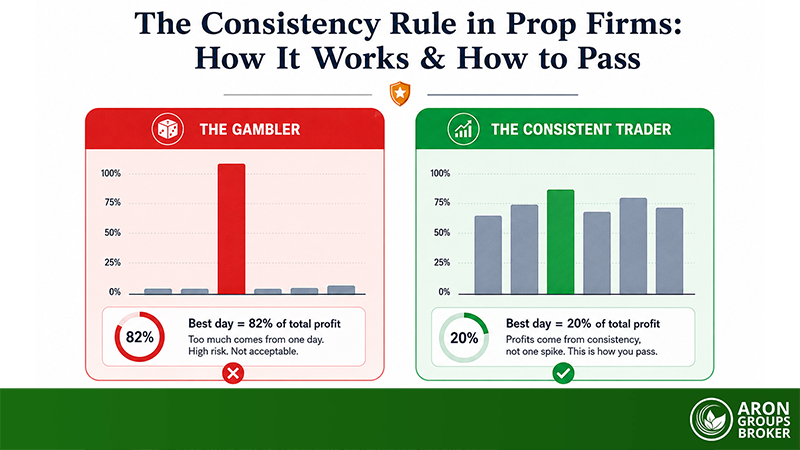

The consistency rule is a prop-firm risk rule that caps how much of your total profit can come from your single best trading day. If your best day makes up more than a set percentage of everything you have earned, usually somewhere between 20% and 50%, the firm treats the result as luck rather than skill, and your payout or your pass is put on hold until the numbers say otherwise.
The rule exists because prop firm evaluations are easy to beat once, by accident. One oversized position on one news candle can hit a profit target in an afternoon, and a firm that funded every lucky spike would be paying gamblers. The consistency rule forces the thing firms actually want to buy: steady, repeatable performance under sensible risk.
This guide defines the rule, shows the exact calculation with a worked example, explains what really happens when you breach it, maps where and when it applies, exposes the hidden trap that catches careful traders, and finishes with a playbook for passing it without changing your trading style.
- The consistency rule limits how much of your total profit can come from a single trading day, with common thresholds between 20% and 50%, most often 30% to 40%.
- The maths is simple: best-day profit divided by total profit must stay at or below the threshold, so your daily cap equals target multiplied by threshold.
- Breaching it usually pauses your payout or raises the challenge target rather than failing the account; you fix it by trading more normal days.
- Losing days are the hidden trap: they shrink your total, which raises your best day's percentage without any new trading.
- A higher percentage is more lenient, and the friendliest setups apply no rule at all, or only during the challenge phase.
What Is the Consistency Rule?
The consistency rule, sometimes called the consistency score or profit distribution rule, measures your best trading day as a percentage of your total profit and requires that percentage to stay at or below a stated threshold. On a 40% rule, no single day may contribute more than 40% of everything you have made. The test usually runs continuously, so every new trading day changes the ratio, and it applies whether the big day came from one large trade or many small ones that happened to land together.
Risk Disclosure
CFDs are complex instruments and come with a high risk of losing money rapidly due to leverage. You should consider whether you understand how CFDs work and whether you can afford to take the high risk of losing your money. Past performance is not indicative of future results. This content is provided for educational purposes only and does not constitute investment advice.
Why Firms Use It, Honestly
The generous reading is real: the rule filters out gambling, rewards genuine risk management, and protects the firm’s capital from traders whose entire edge is one oversized bet. Regulators make the same point from the other side, warning that leveraged speculation rewards discipline poorly applied with fast losses. The critical reading is also real: a rule that pauses payouts also helps firms delay or reduce them, and it can penalise legitimate styles, such as news traders whose profits naturally cluster on event days. Both readings are true at once, which is why the transparency of the rulebook matters more than the rule itself. The backdrop makes the filter understandable: European regulators found that the large majority of retail accounts lose money on leveraged products, so a firm paying winners from its own revenue has every reason to check that a winner is not merely a survivor of variance.
How the Consistency Rule Is Calculated
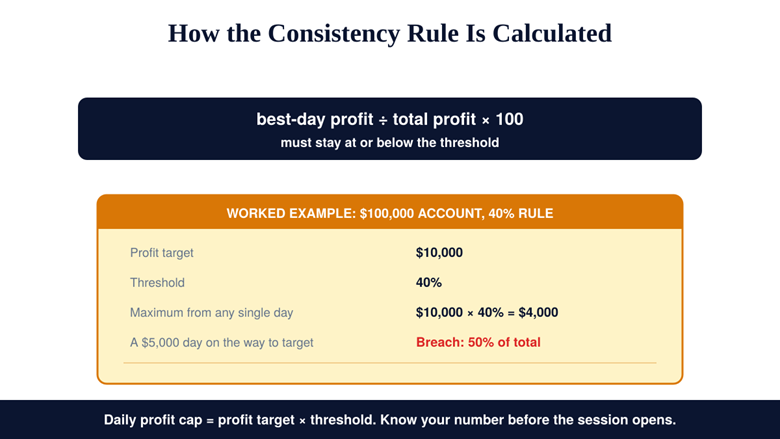
The formula is best-day profit divided by total profit, multiplied by 100, and the result must stay at or below the threshold. Because the threshold is fixed, you can convert it into a practical daily ceiling before you ever trade: your daily profit cap equals the profit target multiplied by the threshold. That single multiplication is the most useful number in the whole topic.
Mini Example: The $4,000 Ceiling (text-only scenario)
Take a $100,000 evaluation with a $10,000 profit target and a 40% consistency rule. The daily cap is $10,000 multiplied by 40%, which is $4,000. As long as no single day exceeds $4,000, you can reach the target with a best-day ratio at or below the threshold.
Now suppose an excellent session runs to $5,000. If you finish the challenge on $10,000 total, your best day is 50% of the total, and the rule is breached even though you hit the target. To restore the ratio you would need to grow the total to $12,500, because $5,000 divided by $12,500 is exactly 40%.
Rule: Work out your daily cap before the session opens: cap equals target multiplied by threshold. When a day approaches the cap, stop trading. The best day you can have is one that ends slightly under it. |
Q: Is a higher consistency percentage stricter or more lenient?
A: More lenient. A 50% rule lets one day carry half of your total profit, while a 20% rule forces your profit to be spread across at least five meaningful days. When comparing firms, a higher percentage is easier to live with, and no rule at all is the easiest of all.
A Consistency Calculator You Can Run in Your Head
Competitor pages offer web calculators, but the arithmetic is light enough to carry with you. Keep two running numbers after every session: your best day and your total. Divide the first by the second; if the answer is over the threshold, the gap tells you how much more total you need, because the required total equals the best day divided by the threshold. A $3,600 best day under a 30% rule needs a $12,000 total before the ratio clears. Write both numbers in your journal daily and the rule can never surprise you at payout time.
What Happens If You Breach It
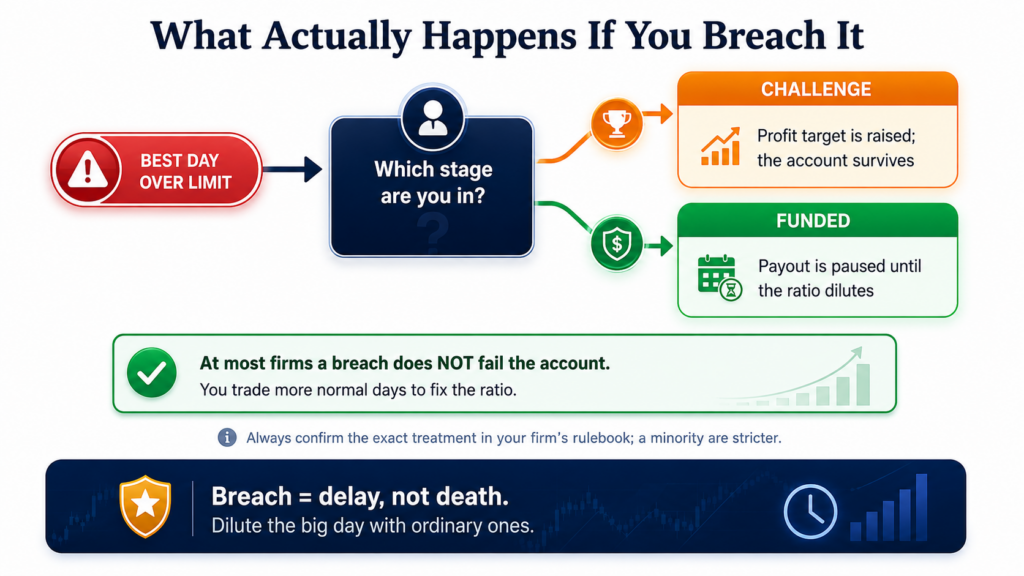
Here is the nuance most traders miss: at the large majority of firms, breaching the consistency rule does not fail your account. In a challenge, the usual consequence is that your effective profit target rises, because you must keep trading until the big day shrinks below the threshold as a share of the growing total. In a funded account, the usual consequence is that your payout is paused until the ratio dilutes. The account survives in both cases, and the cure is the same: more ordinary days. That said, a minority of firms are stricter, so read the rulebook, the same way you would check how a firm calculates drawdown before trusting a headline number.
Treat a breach as a scheduling problem rather than a crisis. Count the sessions you realistically need to dilute the ratio at your normal daily pace, then trade exactly those sessions at exactly your normal size. The traders who turn a breach into a blown account are almost always the ones who try to fix a percentage in a hurry, doubling size to grow the total faster, which risks the drawdown limit to satisfy a statistic that was never account-threatening in the first place.
When It Applies, and the Variants You Will Meet
Firms attach the rule to different stages: some enforce it only during the evaluation, some only on funded accounts at payout time, and some in both. The friendliest setups, in order, are no rule at all, a rule only in the challenge, or a rule with a high percentage. Beyond the classic best-day version, four variants appear often enough to know by sight:
- Best-day percentage: the standard form described in this article, and the one calculators are built for.
- Profit-per-single-trade: outlier trades are flagged, so one enormous winner can trigger review even inside a normal day.
- Position-sizing consistency: your lot sizes must stay within a defined band, so doubling size after losses stands out.
- Minimum trading days: often five or more, which is a consistency rule expressed in time rather than percentage.
A firm that states these terms plainly before you pay is behaving well; one that reveals them after you pass is not. Vague or shifting consistency terms belong on the same red-flag list we cover in our guide to spotting questionable prop firms. The habit of reading terms closely is one regulators keep recommending to retail traders generally; the CFTC’s advisory on off-exchange forex trading makes the same point about any firm that stands between you and your money.
The Hidden Trap: Losing Days Raise Your Ratio
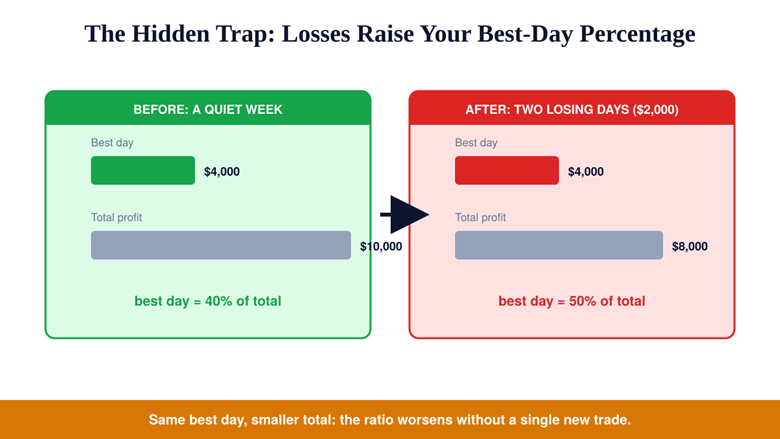
The consistency ratio has a numerator and a denominator, and traders watch the wrong one. Your best day is fixed history, but your total profit moves every session, and losing days shrink it. Lose $2,000 after a $4,000 best day on a $10,000 total and your ratio jumps from 40% to 50% without a single new winning trade. This is why capital preservation is doubly valuable under a consistency rule: small losses protect the denominator as well as the account. The trap has a second jaw, too. Traders who force extra trades, or shrink their size to “balance” the distribution, usually add losing days, which makes the ratio worse, not better.
Risk Warning: Never trade badly on purpose to fix a ratio. Reducing your best day by giving profits back is the one move that is always wrong: it lowers the numerator and the denominator together and destroys real money to repair a statistic. |
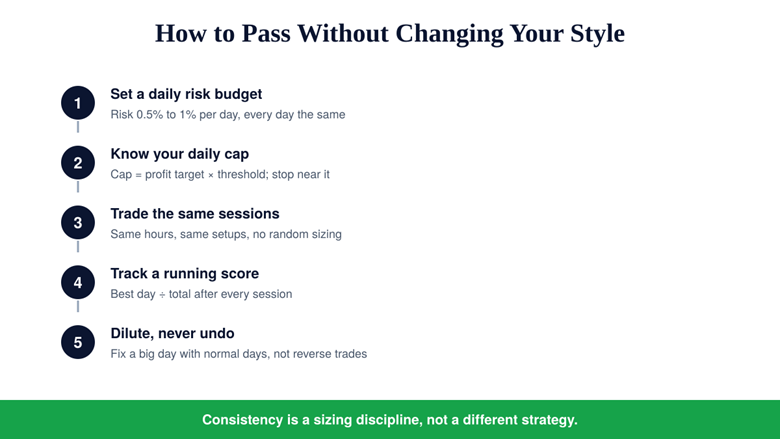
How to Pass the Consistency Rule Without Changing Your Style
The rule looks like a strategy constraint but is really a sizing discipline, and it yields to five habits. First, set a daily risk budget of roughly 0.5% to 1% and hold it constant, using deliberate position sizing rather than mood. Second, compute your daily cap, target multiplied by threshold, and wind the session down as you approach it. Third, trade the same sessions with the same setups, because a stable risk-to-reward ratio across similar days is what a flat profit distribution actually is. Fourth, keep a running consistency score after every session, exactly as you would track an equity curve. Fifth, when a monster day happens anyway, dilute it with normal days rather than undoing it.
One habit ties the five together: measure yourself before the firm does. Backtest your strategy over past months and compute the consistency score it would have produced; if your historical best day routinely exceeds a firm’s threshold, the mismatch is structural, and the fix is choosing a different firm rather than distorting a working edge to please a percentage.
| Threshold | Threshold | Practical meaning on a $10,000 target |
|---|---|---|
| 50% | 50% | One day may earn up to $5,000 |
| 40% | 40% | Daily cap $4,000; three good days pass |
| 30% | 30% | Daily cap $3,000; four good days pass |
| 20% | 20% | Daily cap $2,000; five or more meaningful days |
Q: Does the consistency rule punish news traders?
A: It can. Styles whose profits naturally cluster on event days, such as trading CPI or central bank releases, produce spiky distributions that a best-day rule reads as inconsistency. If that is your edge, favour firms with a high threshold, a challenge-only rule, or no consistency rule at all.
Where Aron Groups Fits
The habits that satisfy a consistency rule are worth building before any firm is watching. The Aron Groups No Deposit PROP Challenge is a free, demo-based evaluation with a real profit target and drawdown limit, which makes it a costless place to practise trading to a daily cap and tracking your own best-day ratio. Aron Prop, the broker’s paid prop programme on forex, gold, oil, and indices, publishes its rules upfront, and you can rehearse the whole routine on the MetaTrader 5 platform, using a drawdown calculator to translate percentage limits into daily dollar budgets before you risk an evaluation fee.
Conclusion
The consistency rule asks one question: is your profit a distribution or a spike? Everything else, the formula, the thresholds, the breach mechanics, follows from that. Firms use it to separate a repeatable process from a lucky afternoon, and, less charitably, to slow payouts, which is why the percentage and the stage it applies to belong on your checklist before you pay for any evaluation.
The good news is that passing it requires no new strategy, only the systematic discipline of a professional trader: a fixed daily risk budget, a known daily cap, and the patience to let ordinary days do the arithmetic. Trade like that and the consistency rule stops being an obstacle; it becomes a description of what you already do.
Frequently Asked Questions
What is the consistency rule in prop trading?
It is a rule that caps how much of your total profit can come from your single best trading day, usually between 20% and 50% of the total. It exists to prove your results come from a repeatable process rather than one lucky trade.
How do I calculate my consistency score?
Divide your best day’s profit by your total profit and multiply by 100. If the result is at or below the firm’s threshold, you pass. Your daily cap is the profit target multiplied by the threshold.
Does breaching the consistency rule fail my account?
Usually not. Most firms respond by raising the effective target in a challenge or pausing the payout on a funded account until more normal trading days dilute the ratio. A minority are stricter, so always confirm in the firm’s own rulebook.
Which consistency rule is best for my style?
Steady intraday traders fit almost any threshold. Traders whose profits cluster on news days should prefer a high percentage, a challenge-only rule, or a firm with no consistency rule, because spiky profit distributions are penalised by tight thresholds.