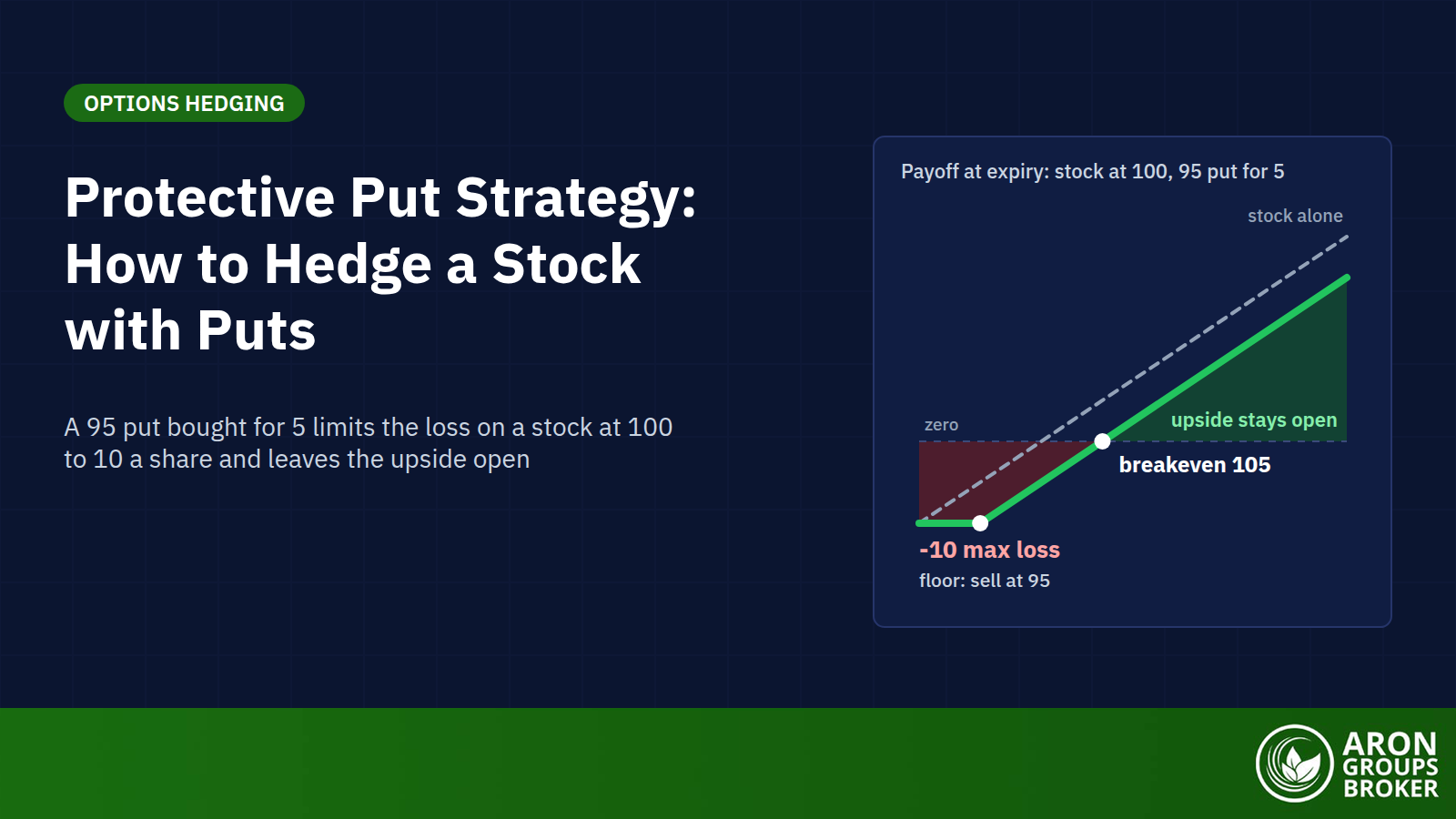

A protective put is an options strategy in which you buy a put option on a stock you already own. The put gives you the right to sell at its strike price, so the strike becomes a floor under the position. You keep the upside and pay a premium for the cover.
With stocks near records, a hedge is topical. The S&P 500 closed at 7,811.54 on 9 October 2026, up 14.1% for the year. That was 0.1% below its record close of 7,818.93 on 6 October. The VIX, the market’s gauge of implied volatility, was 14.84 against a long-run average near 19, so protection was cheaper than usual but not free.
This guide works through the protective put strategy on a 95 put bought for 5, then prices a $500,000 SPY hedge. It covers the Greeks, a collar, a stop-loss and a covered call, and ends with the honest limits.
- A protective put is long stock plus a long put: the strike is the floor, the premium is the cost and the upside stays open. At expiry, profit or loss is max(S, K) - (S0 + premium).
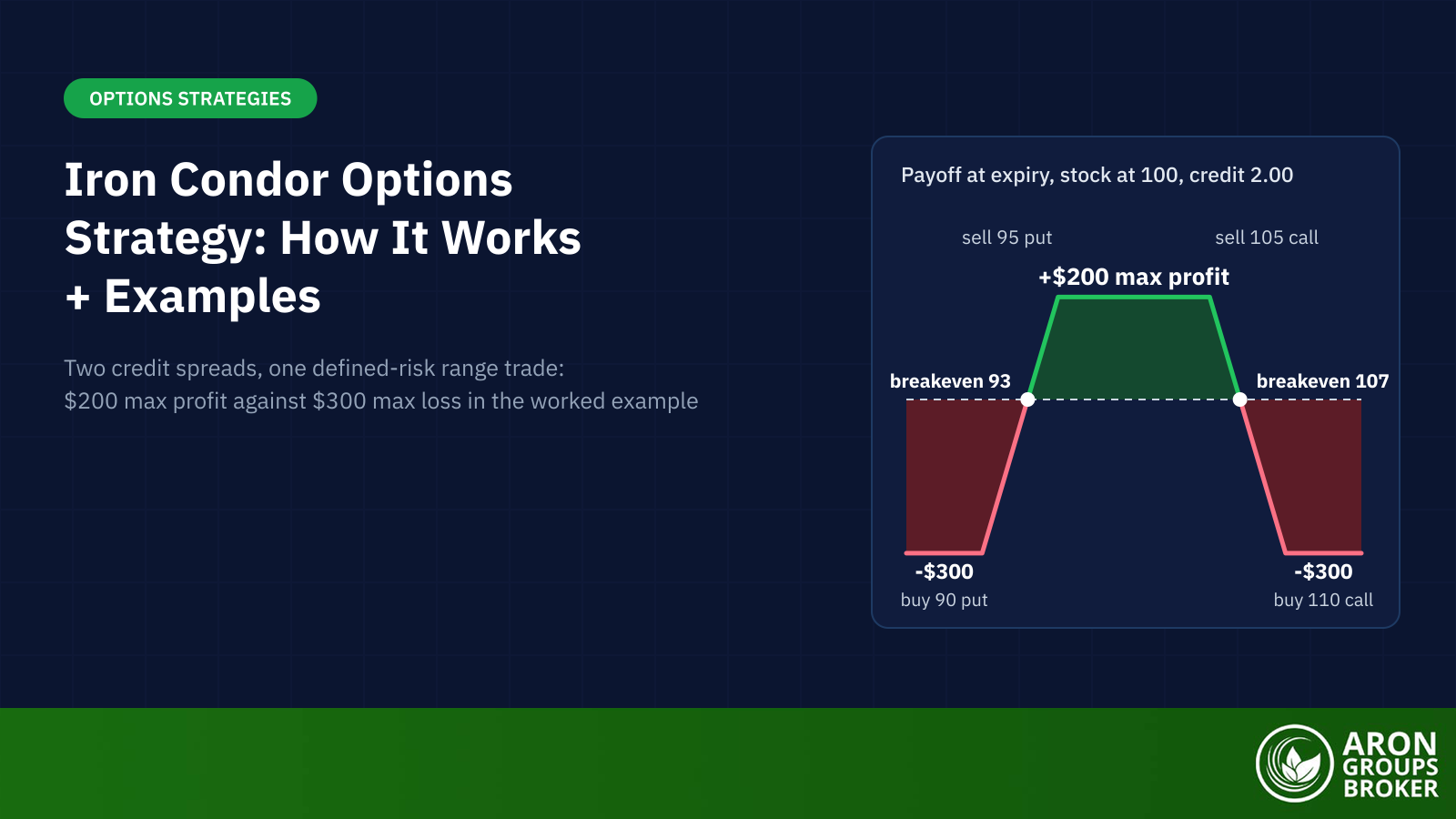
- Worked example: stock at 100 and a 95 put bought for 5 give a floor of 95, a maximum loss of 10 a share ($1,000 a contract) and a breakeven of 105. A stock bought at 60 still locks in +30 a share.
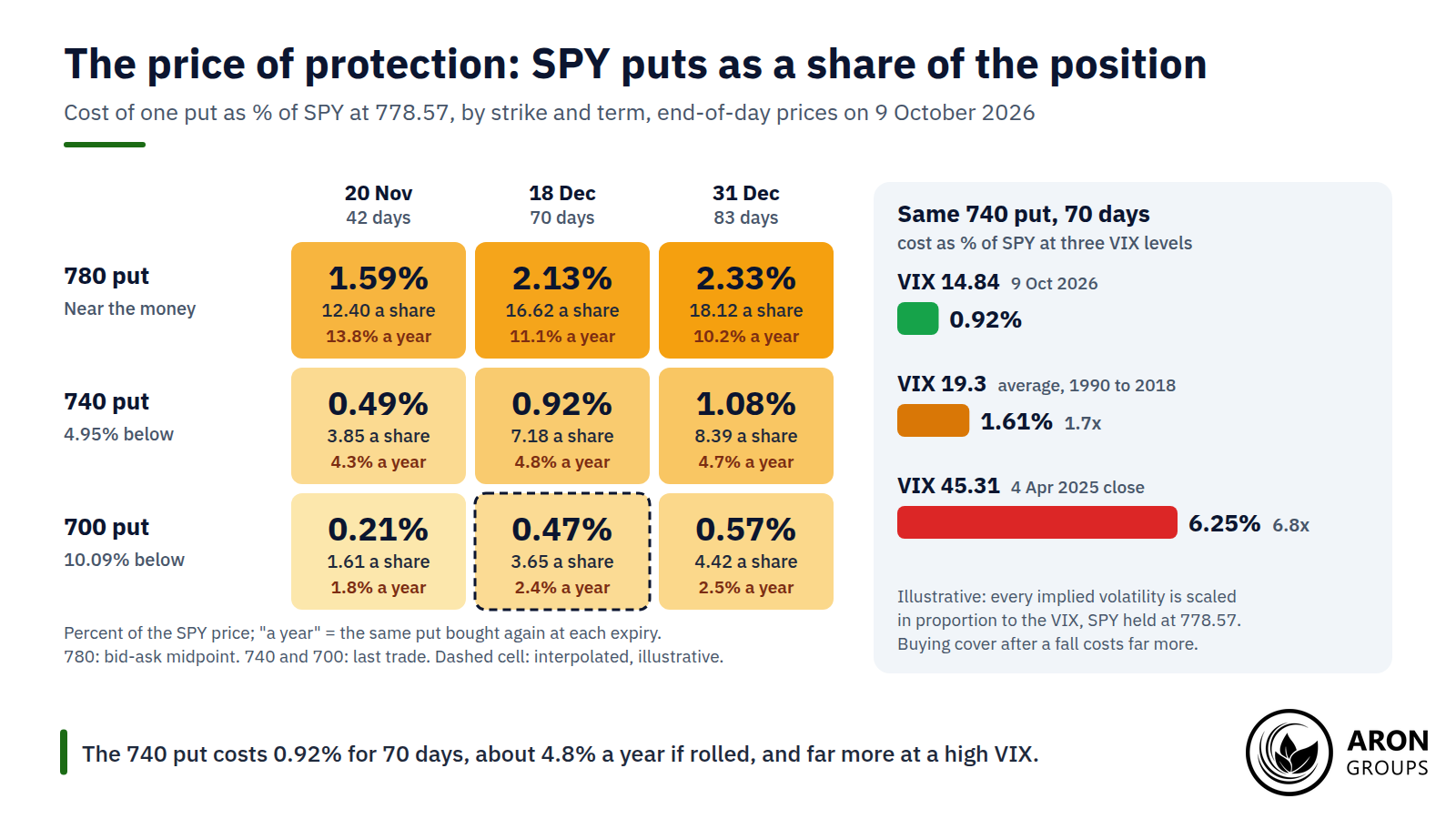
- On 9 October 2026 the SPY 740 put expiring 18 December last traded at 7.18, or 0.92% of the 778.57 price, for 70 days. Rolled, that is about 4.8% a year.
- A collar sells a call to fund the put, but put skew keeps the cap close: the 810 call, 4.04% above the price, paid for all but 0.62 of the 7.18 put, 4.95% below it.
- A stop-loss is free but becomes a market order that can fill far below its price. In a Cboe-supported back-test, a 5% put-protection index (PPUT) returned 6.64% a year against 9.80% for the S&P 500 from 1986 to 2018: insurance, not a profit engine.
What Is a Protective Put?
A protective put works like insurance on your shares: the strike is the floor, the premium is the cost, expiry is the policy term. The gap from today’s price to the strike is the deductible; exercising the put is the claim, and with no claim the premium is gone. The SEC’s investor bulletin on options defines a put as the right to sell at the strike and says a contract generally covers 100 shares.
Risk Disclosure
Trading forex and CFDs carries a high level of risk and can result in the loss of all your capital. This content is educational and is not investment advice. Never risk money you cannot afford to lose.
Protective Put vs Married Put
The payoff is identical. A married put is a protective put option bought together with the stock; a protective put can be added later to shares you hold. Here the term means the options strategy, not the W-4 or married-filing tax question.
Under section 1233 of the Internal Revenue Code, buying a put later can restart the holding period of shares held a year or less. A same-day married put is treated differently; IRS Publication 550 covers puts and calls. This is not tax advice, and rules vary by country.
How the Payoff Works: Floor, Cost and Breakeven
At expiry, profit or loss per share is max(S, K) – (S0 + premium). Here S0 is the price you paid and max(S, K) is the higher of the stock price and the strike. The put is worth its intrinsic value: the strike minus the price, or zero.
Key Point
Maximum loss = price paid - strike + premium. Breakeven = price paid + premium. If the put is added later, the price on the day the hedge starts replaces the price paid.
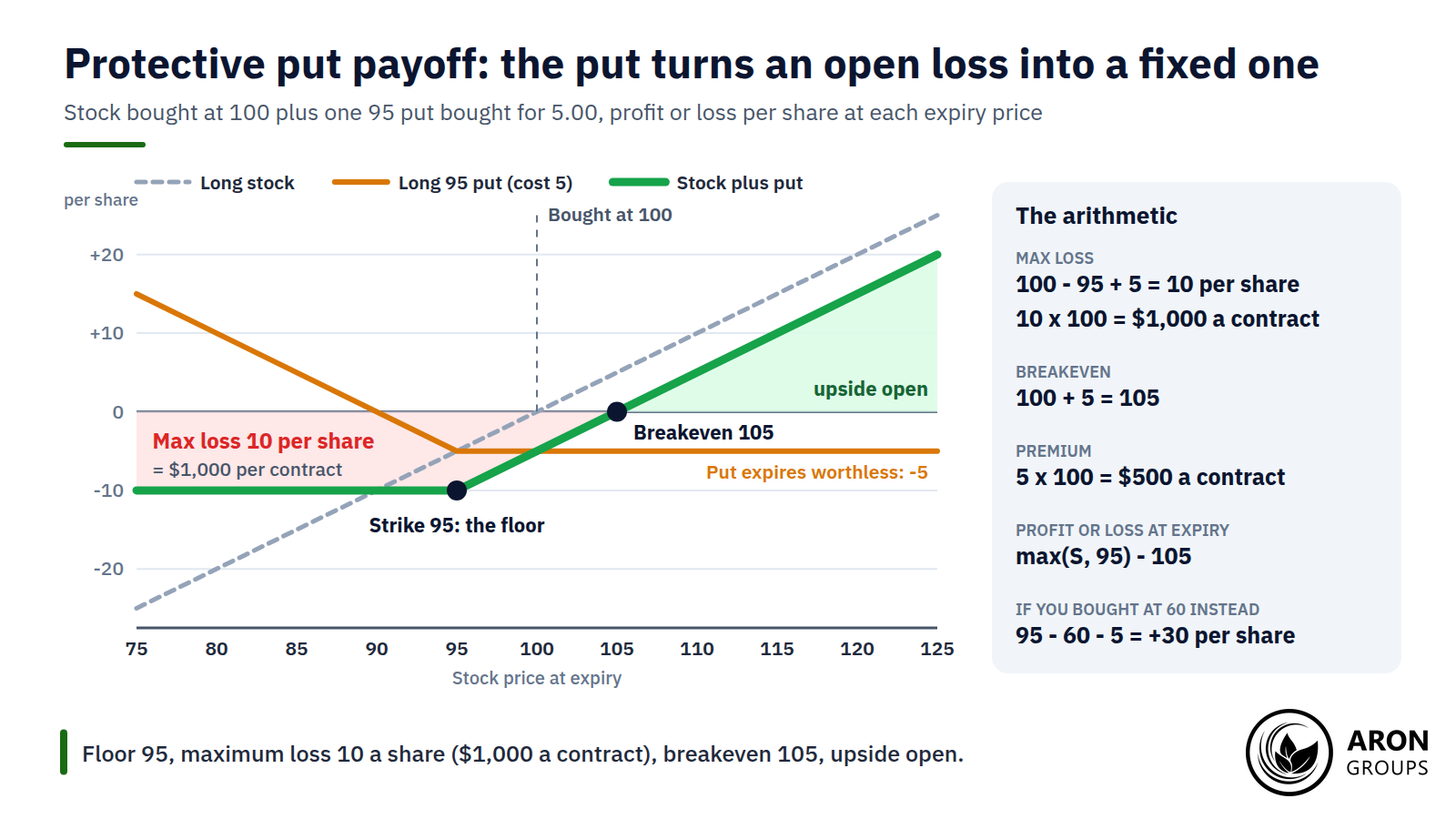
Below the strike, every extra dollar lost on the shares is repaid by the put, so the loss stops at its maximum. If the stock rises, the put expires worthless and the premium is the only cost; above breakeven the gain has no cap. The payoff diagram plots the stock, the put net of its cost and the combined position.
Mini Example: A Protective Put on a Stock at 100, Step by Step
In this protective put example you buy 100 shares at 100 and one 95 put for 5.00. The floor is 95, because you can always sell at 95 until expiry. The shares cost $10,000 and the premium $500, so you lay out $10,500 per contract. Treat the 5.00 as a clean teaching number; in the SPY example below, a put 5% out of the money cost far less.
Maximum loss is 100 – 95 + 5 = 10 a share, or $1,000 a contract. Breakeven is 100 + 5 = 105. Maximum gain is unlimited, less the 5 premium.
Test three expiry prices. At 80 the shares lose 20, the put pays 15 and the premium costs 5: net -10. At 105 the shares gain 5, the put expires worthless and the premium costs 5: net 0. At 120 the shares gain 20 and the premium costs 5: net +15.
Locking In an Unrealised Gain Without Selling
Suppose you bought a stock at 60, it reached 100 and you added the same 95 put for 5. Measured from 100, the worst case is the usual loss of 10. Measured from your cost, it is a sale at 95: 95 – 60 – 5 = +30 a share before costs.
You keep the shares, the upside stays open and no sale realises the gain. Other common uses are a long-term bull who fears a short-term drop, a concentrated position and an earnings date.
Put-Call Parity: Why a Stock Plus a Put Behaves Like a Call
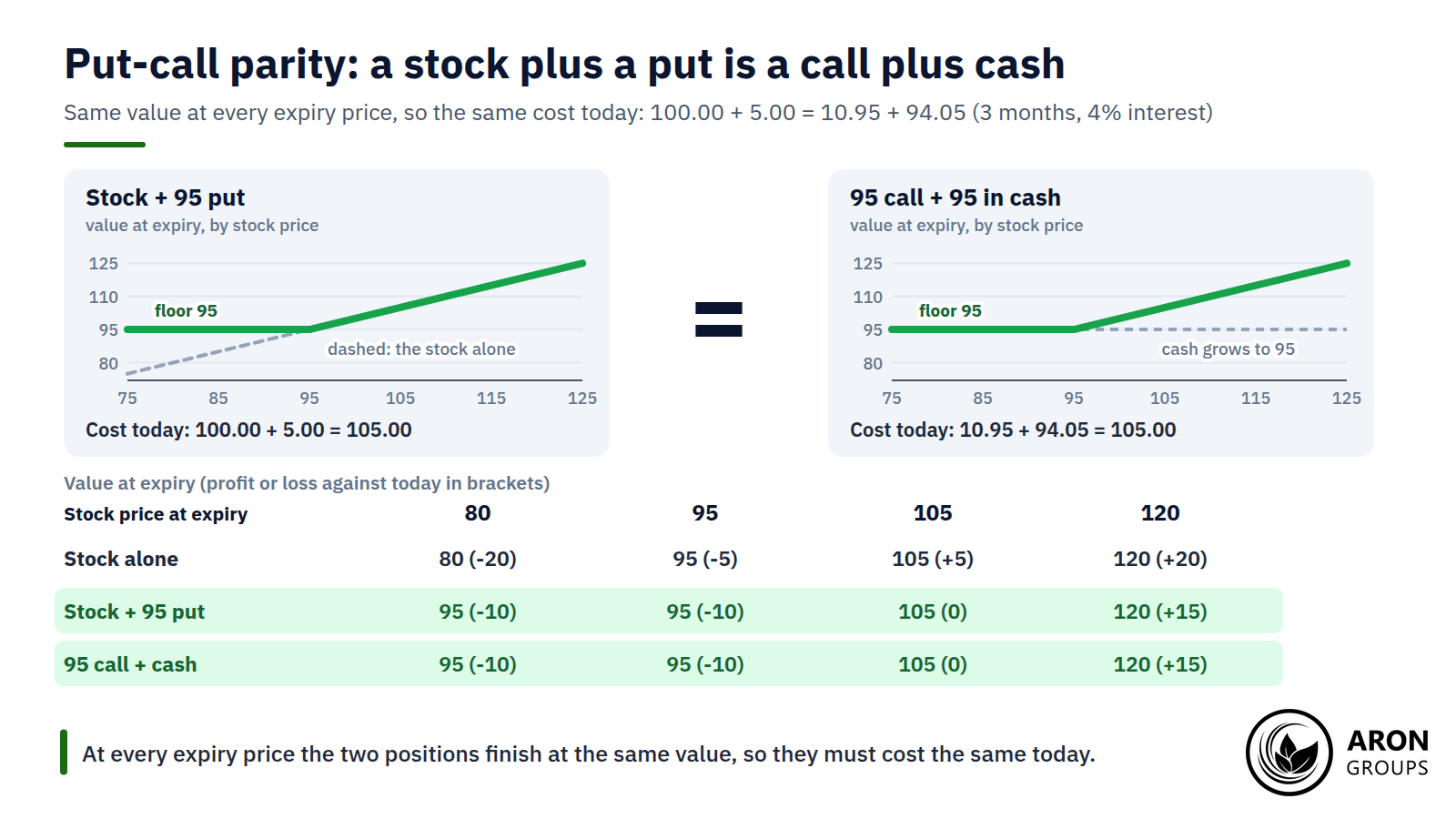
Put-call parity says a stock plus a put equals a call plus cash: S + P = C + PV(K), with PV(K) the discounted strike. It holds exactly for European options on a stock paying no dividend, and approximately for American ones. With three months and 4% interest, 95 discounts to 94.05, so the 95 call must cost 100.00 + 5.00 – 94.05 = 10.95.
Both positions pay the same at every expiry price. At 80, 95, 105 and 120 both are worth 95, 95, 105 and 120, which is -10, -10, 0 and +15 on the 105 outlay. A protective put is therefore a synthetic call, with the payoff shape of a long call.
The match is in payoff, not in practice. The call costs about 11 against 105 for the stock and put, with the other 94 held in cash. Shares pay dividends and carry votes, American options can be exercised early, and tax treatment differs. Parity is a pricing link, not free money.
What Protection Costs: A Real-Scale SPY Example
On 9 October 2026, cover for 70 days on a $500,000 S&P 500 position would have cost $4,308, or 0.86%, at last-trade prices. The puts were about 5% out of the money.
SPY is an S&P 500 exchange-traded fund. A portfolio with a beta of 1, meaning it moves with the index, needs 642.2 SPY shares, or 6.42 contracts, rounded down to six. Six contracts cover $467,142, a 93.4% hedge ratio; seven would be 109%.
The 740 put expiring 18 December, 70 days out and 4.95% below the price, last traded at 7.18 in Optionistics’ end-of-day data for 9 October. Six contracts cost $4,308, which is 0.92% of the $467,142 insured. The deductible is the 4.95% gap, $23,142, so the maximum loss on the hedged shares is $27,450.
Distance from the price drives the cost most. At 42 days the 780 put, near the money, costs 1.59% of the price, the 740 put 0.49% and the 700 put, 10.09% below, 0.21%. Time adds to it: the 740 put costs 0.49% for 42 days, 0.92% for 70 and 1.08% for 83. Rolled every 70 days, 5.21 times a year, 0.92% becomes about 4.8% a year.
Implied volatility sets the rest. Cboe puts the average VIX at 19.3 for 1990 to 2018, so 14.84 is low, but cover remains a running cost. Scaled with the VIX, in an illustrative what-if, the same put costs 1.61% at 19.3 and 6.25% at the 45.31 close of 4 April 2025. One grid cell, the 700 put for 18 December, is interpolated, and every price is an end-of-day figure, not a live quote.
Q: Is a low VIX a good time to buy a protective put?
A: A low VIX makes cover cheaper, but it is not a timing signal. At 14.84 the 740 put cost 0.92% for 70 days; in the what-if above, a VIX of 19.3 lifts it to 1.61%. Protection is usually bought for a specific risk, such as an event or a gain worth keeping, and a low price is a bonus.
The Greeks of the Hedge: Delta, Gamma, Theta and Vega
Delta measures how much of the stock’s move the put offsets today. Fitting Black-Scholes to the 7.18 last trade gives the 740 put a delta of about -0.21, so six contracts offset about 127 of 600 shares. The offset is partial and grows as the price falls towards the strike. Gamma is long: each $1 fall in SPY adds about 3 shares of offset, the force gamma scalpers trade.
Theta is the cost of waiting: about 0.11 a share a day, or $64 on six contracts, if nothing else changes. Vega is long, about +0.99 a share per volatility point, or $593 on six contracts. Markets tend to fall as implied volatility rises, so the put can gain more than its intrinsic value suggests.
Events change what you pay. A put bought before earnings pays for elevated implied volatility, which usually collapses afterwards: the IV crush. A stock can hold its price and still cost you premium. Third-quarter earnings season began in the week of 12 October 2026, so the premium has to be weighed against the move being insured.
Protective Put vs Collar, Stop-Loss and Covered Call
Of these four tools, only the protective put combines a guaranteed exit price with an open upside, and the premium is the price of that. A collar adds a covered call to help pay for the put. On the same 18 December expiry the 810 call, 4.04% above the price, last traded at 6.56 against 7.18 for the 740 put. The net cost is 0.62 a share, or $372 on six contracts, with a floor 4.95% below the price and a cap 4.04% above.
The call has to sit closer than the put because of skew, the extra volatility the market charges for downside. Fitted to last trades, the 740 put implies a volatility of about 16.8% and the 800 to 815 calls 11.9% to 12.5%. Interpolating the call prices, a zero-cost call would sit near 808, 3.8% above the price, against a put 4.95% below. A collared stock pays off like a bull call spread plus cash.
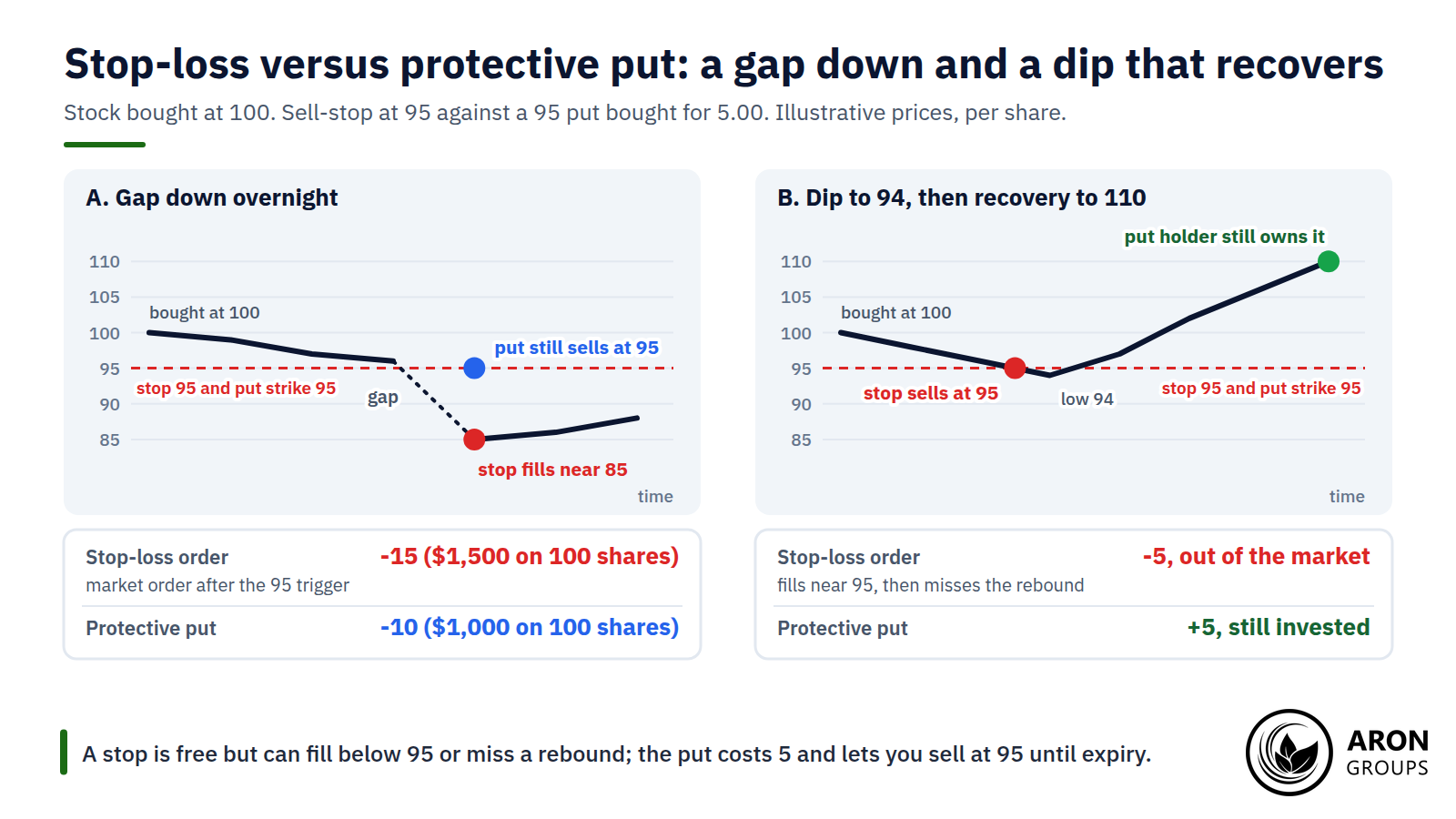
A stop-loss costs nothing to place, but when its price is reached it becomes a market order. An investor.gov bulletin warns that the stop price is not the guaranteed execution price. The SEC staff’s analysis of 24 August 2015 found SPY opened 5.2% below its previous close. Now take a stock at 100 with a stop at 95.
A gap to 85 fills near 85, a loss of 15; the put still sells at 95, a net loss of 10. If the stock dips to 94 and recovers to 110, the stop sold at 95 for a loss of 5 and missed the rebound. The put holder ends 5 ahead. Neither tool is worse: they solve different problems.
Covered call vs protective put comes down to earning a premium or paying one. A covered call collects a premium, 0.84% for the 810 call, but caps the upside and cushions a fall only by that much. A protective put pays a premium and leaves the upside uncapped. The table sets all four side by side.
| Feature | Protective put | Stop-loss | Collar | Covered call |
|---|---|---|---|---|
| Cost | 0.92% of the price for 70 days (740 put); about 4.8% a year if rolled | Free to place; slippage and missed rebounds are the cost | Net 0.62 a share (0.08%) for the 740 put and 810 call | Earns 6.56 a share (0.84%) from the 810 call |
| Protection | Floor at the strike after a 4.95% deductible | Exit near the stop price if the market trades through it | Floor at the put strike, 4.95% below the price | Only the premium collected, 0.84% |
| Upside | Open, less the premium | Open until the stop triggers, then none | Capped at the call strike, 4.04% above | Capped at the call strike plus the premium |
| Certainty of exit on a gap | Yes: sells at the strike until expiry | No: a market order can fill far below the stop | Yes, at the put strike | No: nothing fixes an exit price |
| Best used when | You are bullish but fear a drop, hold a big gain or face an event | You want free, simple discipline in a liquid market | You want a floor without paying cash and accept a cap | You expect a flat or slowly rising price and would sell at the strike |
SPY example, 9 October 2026: a 740 put and 810 call expiring 18 December; last trades, illustrative.
The Honest Limits of the Protective Put
Protection is a running cost. Rolling the 740 put every 70 days at the same price would cost about $22,500 a year, 4.8% of the $467,142 insured. The Cboe S&P 500 5% Put Protection Index (PPUT) buys a monthly 5% out-of-the-money put on an S&P 500 portfolio.
A Wilshire Analytics study, financially supported by Cboe, reported back-tested PPUT returns of 6.64% a year from June 1986 to December 2018. The S&P 500 returned 9.80%. The index launched in August 2015, so most of that record is hypothetical, and past performance is not predictive. PPUT was less volatile, 12.1% against 14.9%, and its maximum drawdown was 38.92% against 50.95%. The give-up of about 3.2 points a year shows why a put is insurance, not a profit engine.
Cover ends at expiry, so it has to be rolled, and the new price depends on that day’s volatility. An index put leaves basis risk if you protect one stock: the two can diverge. Single-stock options often have thin open interest and wide bid-ask spreads. Spreads widen in stress. BIS Bulletin 95 records the VIX rising 180% to almost 66 pre-market on 5 August 2024, helped by wider put bid-ask spreads.
FINRA notes that American-style stock options can be exercised on any trading day, so early exercise is possible. A put protects only against a price below the strike during its term, not inflation or currency moves, and the whole premium can be lost.
Your broker must approve you for options, and investor.gov says it generally offers five levels. It must also supply the OCC’s Characteristics and Risks of Standardized Options. Access to US-listed options also varies by country, and users in restricted regions face added legal, access and custody risk.
Where Aron Groups Fits
Aron Groups offers no options, so you cannot buy a protective put there. The problem a put solves, downside risk on a position, applies to index and gold CFDs on MetaTrader 5, such as SPXUSD, NDXUSD and XAUUSD. The tools are a stop-loss and position size, but a stop is not a put. Aron’s FAQ says it may execute orders at the first available price in high volatility and price gaps. Slippage can therefore carry the fill beyond the stop.
A CFD has no built-in maximum loss, and a short index CFD against a stock portfolio hedges the downside but removes the upside too. That makes it a hedge, not insurance. Aron’s glossary describes a hedge as a position opened to protect the profit of an existing one, and as not a money-making strategy. Aron applies a margin call at 100% margin level and a stop-out at 50%, or 40% on Islamic and VIP accounts, so position sizing matters. A demo account or a Nano account, from 0.01 nano lots, lets you rehearse stops and sizes first.
Conclusion
A protective put is a floor you rent: you keep the upside and pay a premium for the cover. In the worked example the floor is 95, the maximum loss 10 a share and the breakeven 105. On SPY, 70 days of cover cost 0.92%.
It suits a specific risk, such as a gain worth keeping, a concentrated holding or an event, and the cost is worth pricing first. A protective put turns an unknown downside into a known maximum loss.
Frequently Asked Questions
Short answers to common protective put questions.
How much does a protective put cost?
It depends on the strike, the term and implied volatility. On 9 October 2026 the SPY 740 put expiring 18 December last traded at 7.18, or 0.92% of the price, for 70 days. Rolled continuously that is about 4.8% a year.
How do you choose the strike price and expiry?
Traders usually set the strike by the loss they can absorb: the gap is the deductible, and closer strikes cost more. The expiry is matched to the risk, such as an earnings date, because every extra week is paid for.
Is a protective put the same as a covered call?
No. A covered call sells a call for income and caps the upside. A protective put buys a put for a floor and keeps the upside. A covered call cushions a fall only by the premium collected, 0.84% in the SPY example.
Can a protective put lose more than the premium?
The put itself can lose only its premium, but the position can lose more: the premium plus the fall to the strike. In the 95 example that is 5 plus 5, a maximum of 10 a share. Below the strike the put repays every further dollar until expiry.