
An iron condor is a defined-risk, neutral options strategy built from four options with the same expiration date. It pairs a bull put spread below the market with a bear call spread above it. You collect a net credit up front and keep it all if the underlying finishes between the two short strikes at expiration.
It matters now because zero-day (0DTE) contracts reached a record 66.2% of SPX volume in July 2026, by Cboe’s count. SPX open interest stood at 23.5 million contracts on 9 October 2026, with the VIX at 14.84. A low VIX means thin credit, so the arithmetic matters more than usual.
This guide builds the condor leg by leg, works two examples and covers timing, the Greeks, management, margin, assignment and the limits most guides skip.
- An iron condor combines a bull put spread and a bear call spread with the same expiry; the two short strikes form the body and the two long strikes are the wings that cap the loss.
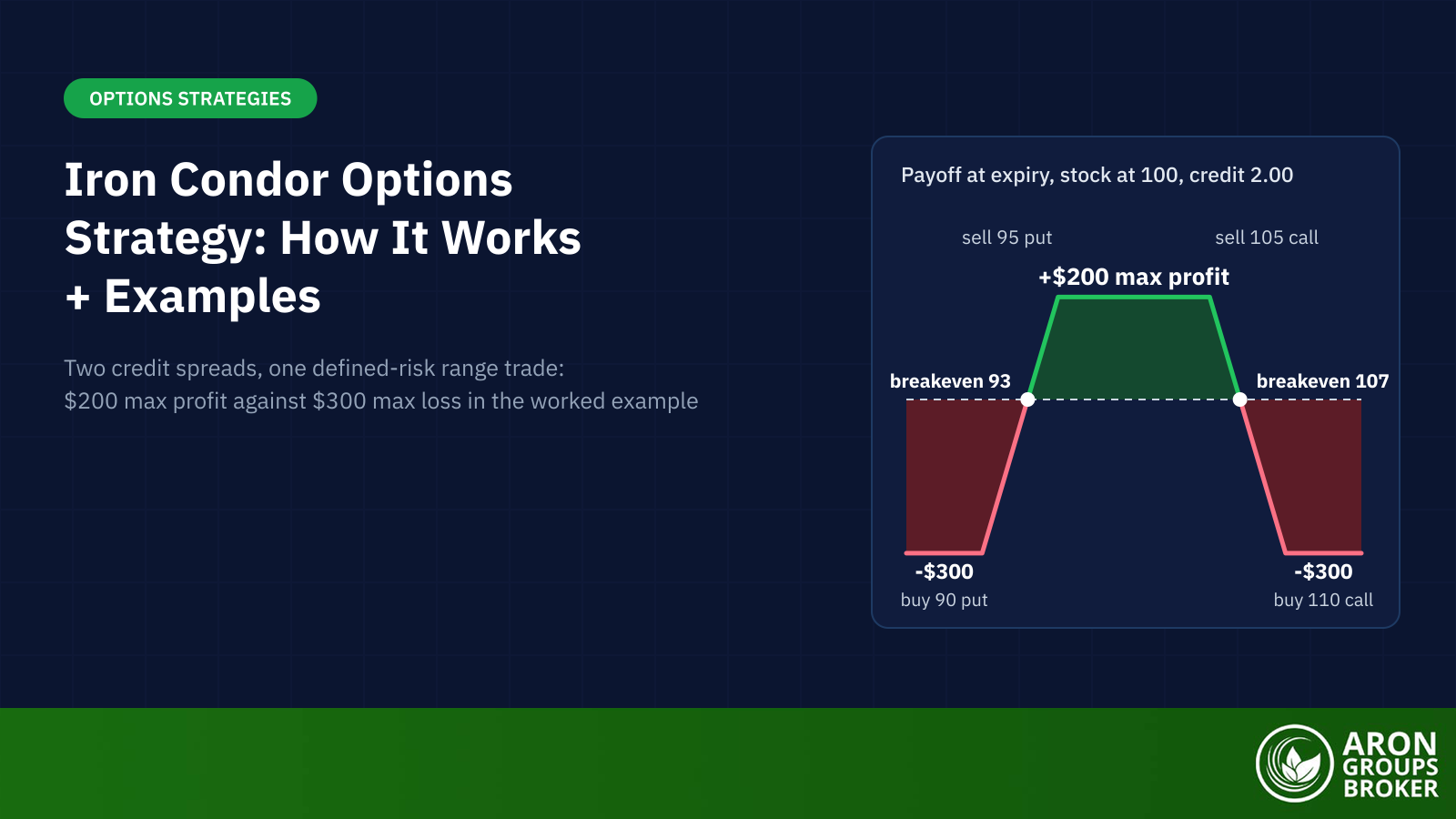
- Worked example: stock at 100, sell the 95 put and 105 call, buy the 90 put and 110 call for a 2.00 credit; max profit $200, max loss $300, breakevens 93 and 107, return on risk 67%.
- Margin on a defined-risk spread is its maximum risk, the wider wing minus the credit: $300 in the example and $3,600 on an illustrative S&P 500 condor with 50-point wings and a 14-point credit.
- The position is short vega and positive theta: a one-point fall in implied volatility adds about $9 per contract, and a day of decay adds about $2.50 at 45 days to expiry, rising to $5.20 at 21 days.
- Published backtests support closing near 50% of max profit and managing around 21 days to expiration; 0DTE condors, a record 66.2% of SPX volume in July 2026, carry far more gamma risk.
What Is an Iron Condor?
An iron condor pays a credit for betting that a stock or index stays in a range until expiry. You sell an out-of-the-money (OTM) put and call, then buy a cheaper put and call further out as insurance. Those long options are the wings: they give the trade a known worst case.
Risk Disclosure
Trading forex and CFDs carries a high level of risk and can result in the loss of all your capital. This content is educational and is not investment advice. Never risk money you cannot afford to lose.
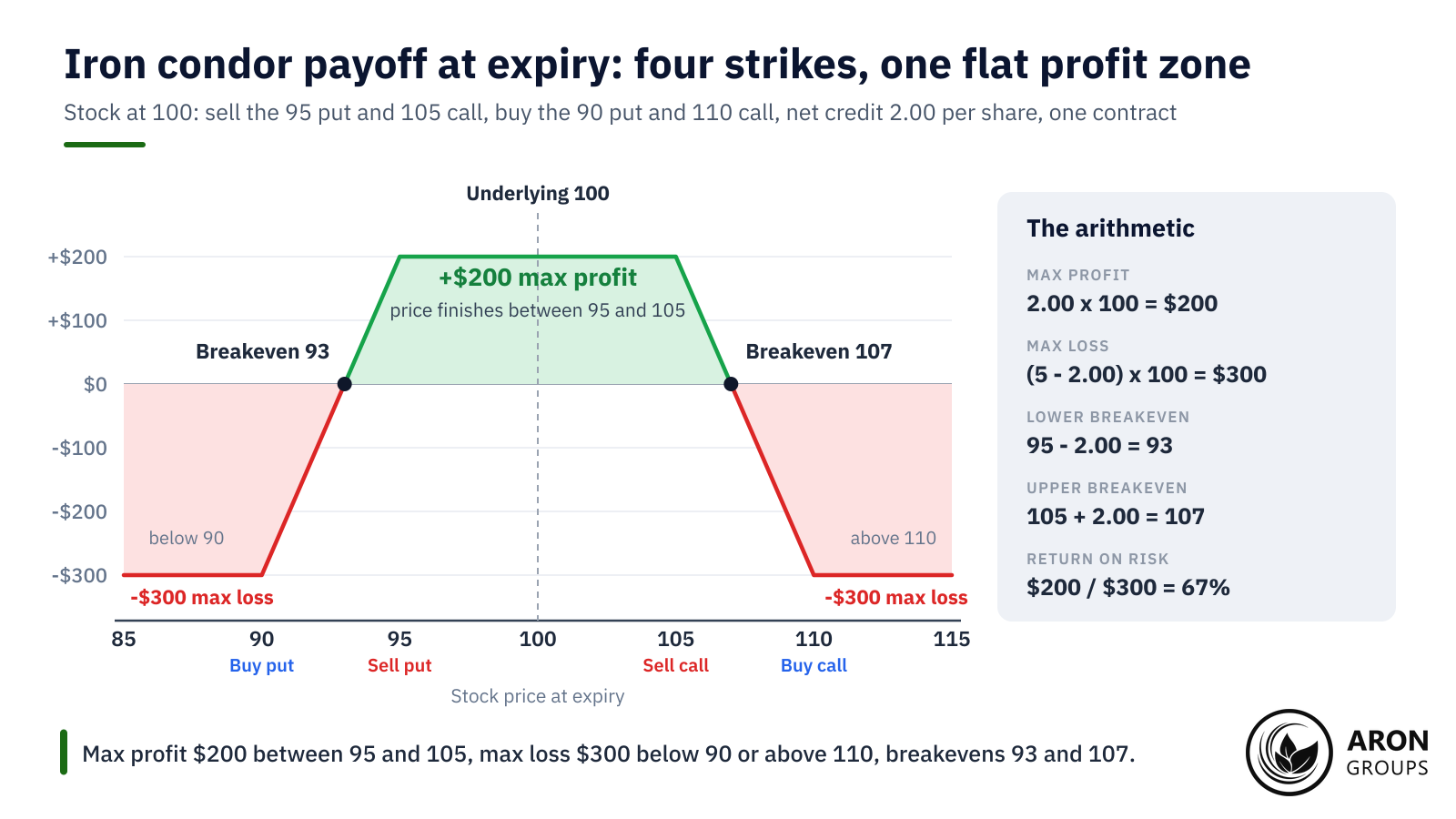
The four legs: body and wings
The two short options form the body; the two long options, each a fixed distance beyond its short strike, form the wings. That distance is the spread width. The SEC’s investor bulletin on options, updated on 16 July 2026, warns that some option contracts expose writers to unlimited potential losses. The wings cap that exposure at the width minus the credit.
The payoff: a bird with two wings
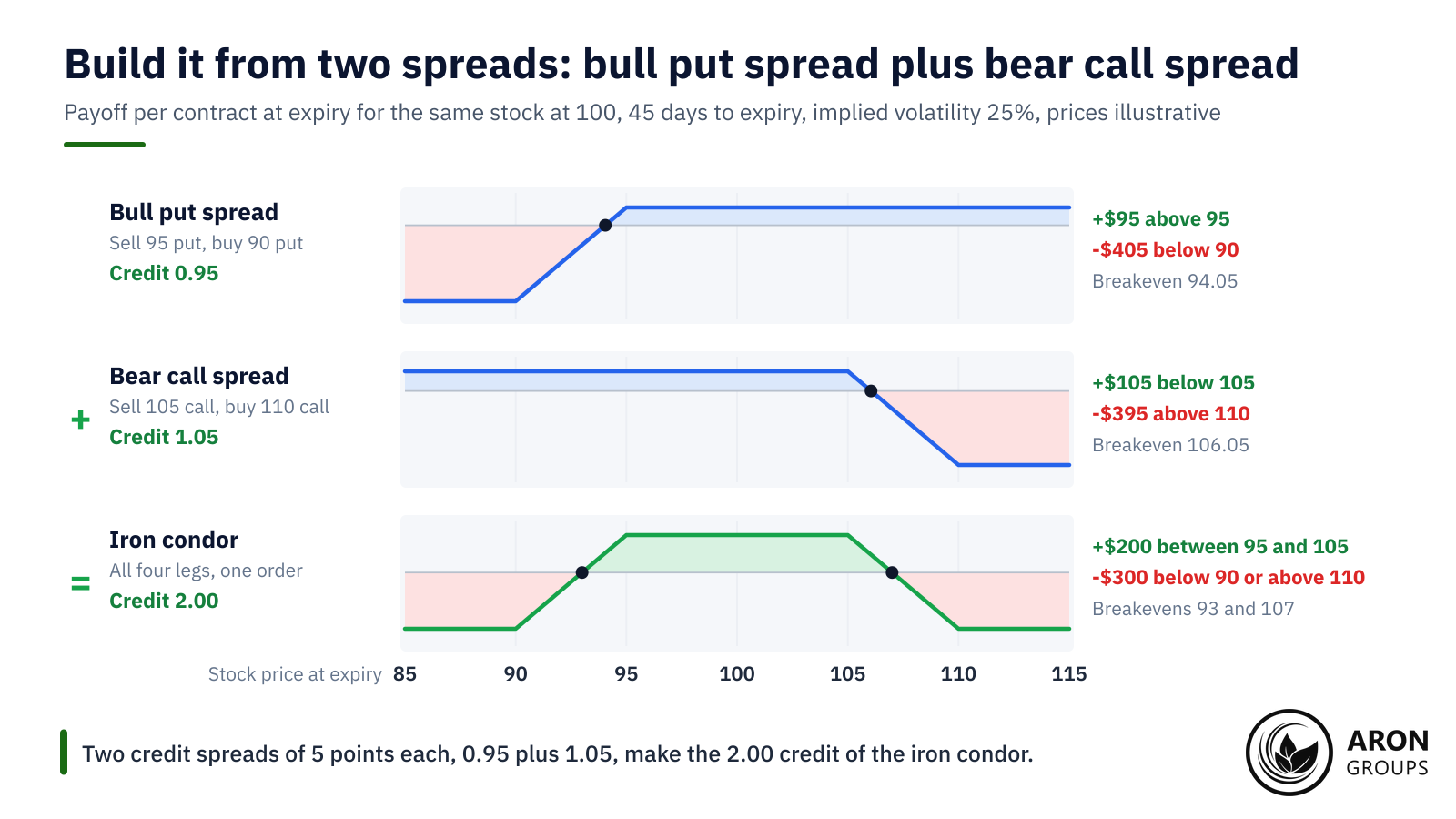
At expiration each option is worth only its intrinsic value, so the position settles into a flat top with sloping edges. Max profit is the net credit, earned between the short strikes; max loss is the width minus the credit, taken beyond either wing. The breakevens sit one credit outside each short strike.
How the Iron Condor Is Built from Two Credit Spreads
The standard iron condor is a net credit position because both halves are credit spreads. Each collects more for the option it sells than it pays for the one it buys. Here the bull put spread is 95/90 and the bear call spread 105/110.
At 45 days to expiry and 25% implied volatility, a Black-Scholes model prices the put spread near 0.95 and the call spread near 1.05. Only one half can ever lose in full, because the stock cannot finish below 90 and above 110 at once.
Mini Example: The 90/95/105/110 Condor Step by Step
Take a stock at 100. Sell one 95 put, buy one 90 put, sell one 105 call and buy one 110 call, all expiring in 45 days. The net credit is 2.00 a share, so one 100-share contract puts $200 in the account on day one.
Max profit is the credit: 2.00 x 100 = $200, earned if the stock closes between 95 and 105. Max loss is the wing width minus the credit: (5 – 2.00) x 100 = $300, taken below 90 or above 110. The breakevens are 95 – 2.00 = 93 and 105 + 2.00 = 107.
Return on risk is 200 divided by 300, about 67%: the trade risks 1.50 to make 1.00. The loss grows one point per point between a short strike and its wing, so at 92 the position is down $100.
A Real-Scale Iron Condor on the S&P 500
The S&P 500 closed at 7,811.54 on 9 October 2026 and the VIX at 14.84. At that volatility a one-standard-deviation move over 42 days is about 393 index points, roughly where delta-based strike selection places the body. Prices below are model values with a typical put skew, not quotes.
Sell the 7,400 put and buy the 7,350 put, sell the 8,200 call and buy the 8,250 call, all for 20 November 2026. Both short strikes sit near 15 to 16 delta and both wings are 50 points wide. The put spread brings in about 5.8 points and the call spread about 8.1: about 14 points, or $1,400 on the $100 multiplier.
Max loss and the margin requirement are the same number: (50 – 14) x 100 = $3,600. Return on risk is 14 divided by 36, about 39%, and the breakevens are 7,386 and 8,214. The put spread earns less despite sitting further away, because index put volatility is higher, the skew a risk reversal measures.
Why a high probability of profit comes with poor risk-reward
Probability of profit (POP) is the model’s estimate of finishing inside the breakevens: about 71% here, or 69% between the short strikes. The price of that comfort is the payoff. The trade must win 36 times in 50, or 72%, to break even if every loser is a full loser.
Expected value on the worked example makes the same point. Keep the $200 credit 70% of the time and take the full $300 loss otherwise. Expectancy is 0.70 x 200 minus 0.30 x 300, or $140 minus $90: $50 per contract before costs.
At a 60% win rate it is zero and at 55% a loss of $25. The S&P 500 condor on the same 70/30 split gives $980 minus $1,080, a loss of $100. Those break-even rates sit close to the model’s own probabilities, so a high POP buys nothing by itself.
When to Trade It: Implied Volatility, Theta and Vega
The iron condor suits a neutral view in a market calmer than its options imply. Range-bound regimes, where price oscillates around a value, are its natural habitat. Open it when implied volatility is high relative to its history: the credit is fatter and the position gains as volatility settles.
IV rank places today’s implied volatility between its 52-week low (0) and high (100); IV percentile counts the share of past-year days that closed lower. The seller’s edge is the volatility risk premium: implied volatility runs above realised volatility on average, as a September 2014 BIS Quarterly Review article shows. Forecasting volatility therefore matters more than forecasting direction.
Events supply the best entries and the worst traps. Earnings and central bank meetings inflate implied volatility, and the collapse afterwards, the IV crush, is what a condor seller harvests. High implied volatility also means the market expects a move, so a condor sold into a trend can breach a wing before theta earns anything.
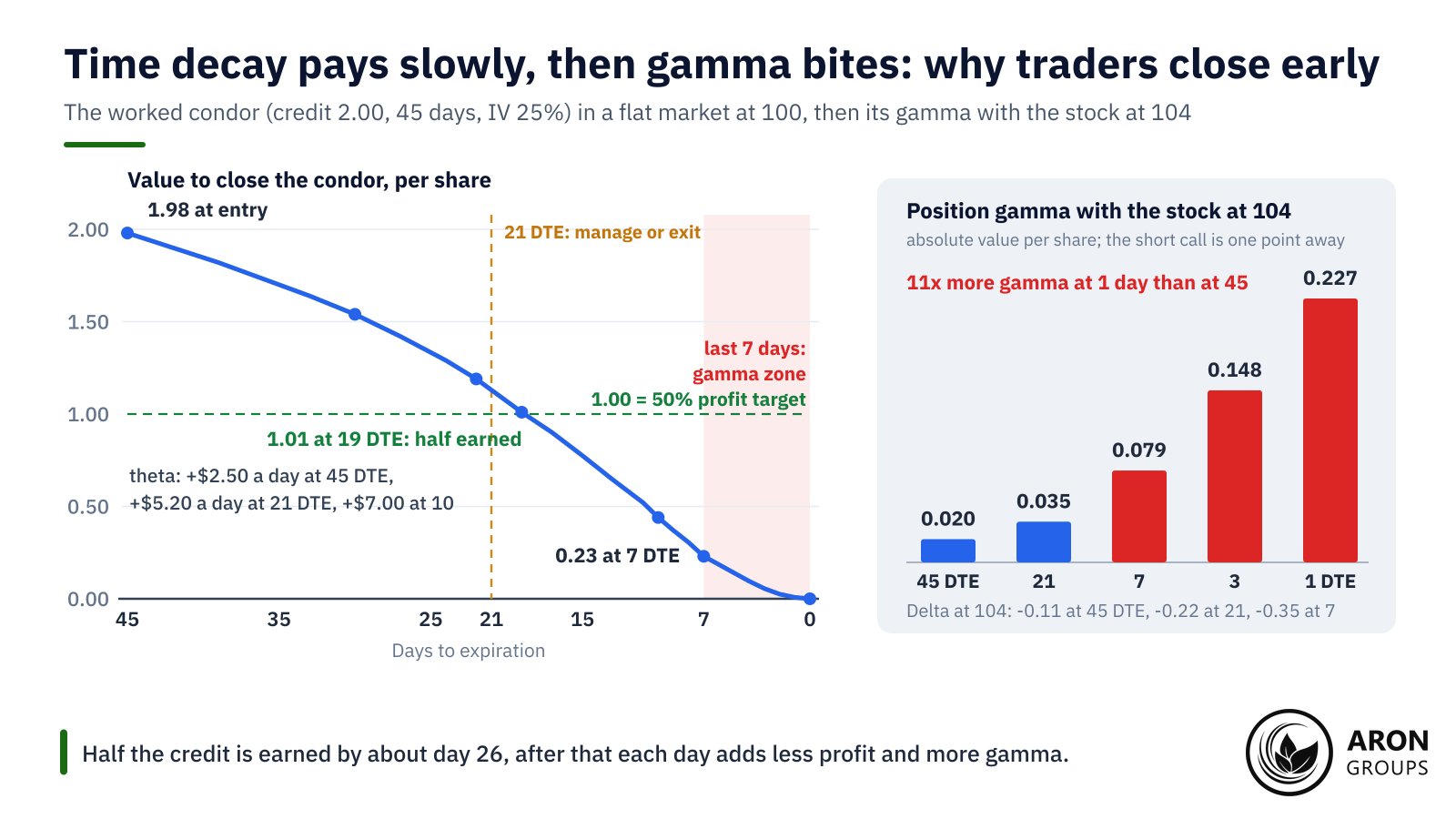
The worked condor is short about 0.091 vega per share. A one-point fall in implied volatility cuts the cost to close from 1.98 to 1.89, about $9 per contract. Theta works for the seller: about $2.50 a day at 45 days, $5.20 at 21 and $7.00 at 10, because decay accelerates towards expiry.
Iron Condor vs Short Strangle, Iron Butterfly and Reverse Iron Condor
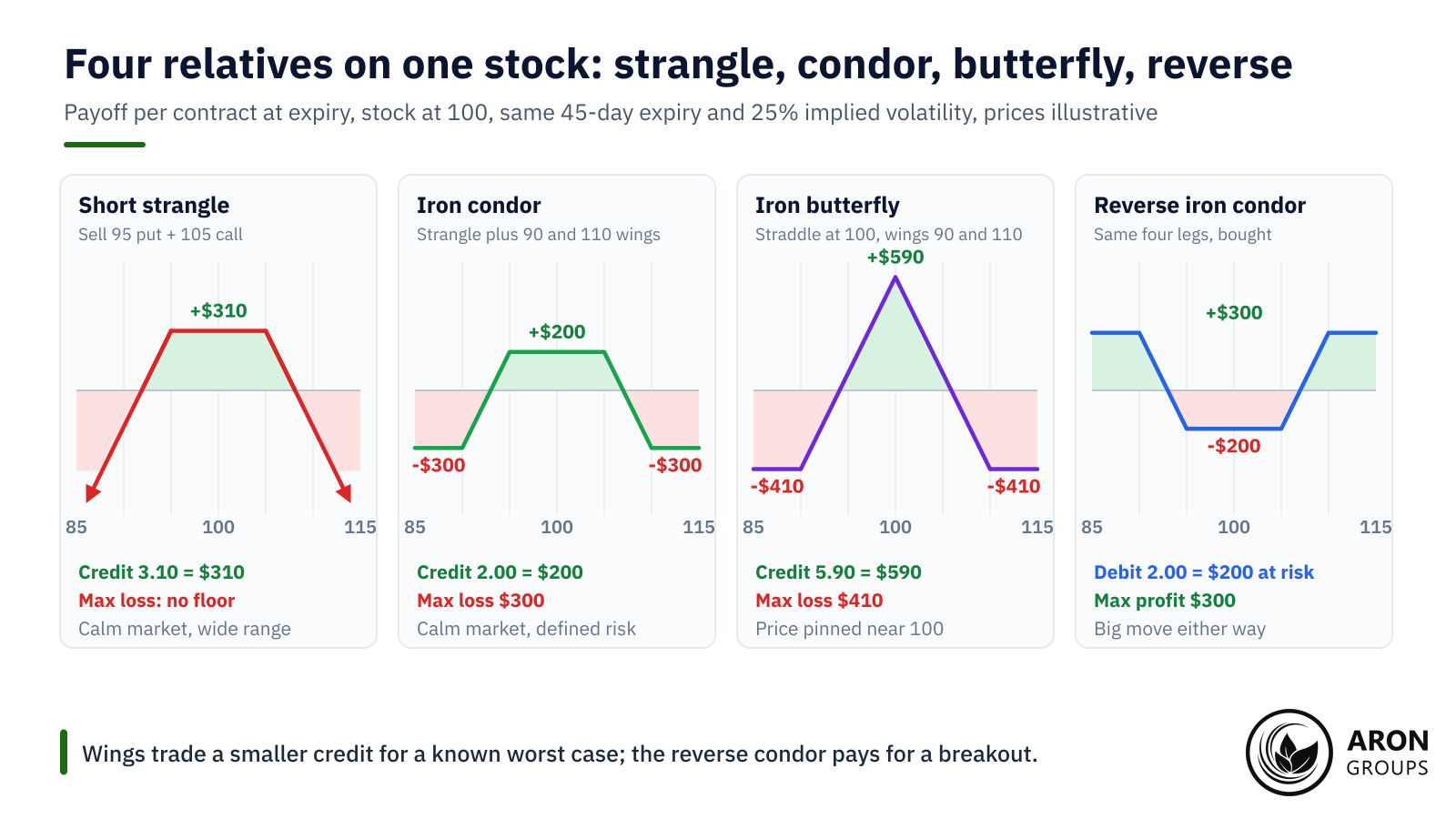
An iron condor is essentially a short strangle with protective long wings. Selling the 95 put and 105 call alone collects about 3.10, against 2.00 for the condor. The strangle’s loss is unlimited above and runs to zero below; the wings cost about 1.10 of credit and cap it at $300.
In an iron condor the short strikes are spread apart; in an iron butterfly both sit at one middle strike. Selling the 100 straddle with 90 and 110 wings collects about 5.90 against a $410 max loss: a bigger credit for a narrower zone. The band and the plant called Iron Butterfly are unrelated.
A reverse or long iron condor buys the same four legs for a net debit and profits from a breakout. Paying 2.00 for the 90/95/105/110 structure risks $200 to make $300 beyond 90 or 110: long volatility, not short. The table compares all four.
| Structure | Legs (stock at 100) | Credit or debit | Max profit | Max loss | Best market | Risk profile |
|---|---|---|---|---|---|---|
| Short strangle | Sell 95 put, sell 105 call | Credit 3.10 | $310 | Unlimited above, to zero below | Calm, wide range | Undefined risk |
| Iron condor | Strangle plus buy 90 put and 110 call | Credit 2.00 | $200 | $300 | Calm, range-bound | Defined risk, wide body |
| Iron butterfly | Sell 100 put and call, buy 90 put and 110 call | Credit 5.90 | $590 | $410 | Pinned near 100 | Defined risk, narrow body |
| Reverse iron condor | Buy 95 put and 105 call, sell 90 put and 110 call | Debit 2.00 | $300 | $200 | Breakout either way | Defined risk, long volatility |
One stock at 100, 45 days to expiry, 25% implied volatility; prices are model values, illustrative only.
A skewed or unbalanced iron condor bends the structure towards a view. Shifting the body up, to the 97 put and 107 call, adds a bullish lean. A wider put wing, say 90/95 against a 105/107 call wing, loads more risk on the side you expect to hold.
How to Manage an Iron Condor
Experienced sellers rarely wait for expiration. Backtests published by tastylive in August 2023 on 45-day SPY condors with 20-delta short strikes found that closing at 50% of max profit smoothed results. So did managing around 21 days to expiration, with wings of roughly one tenth of the share price working best. These are historical practices, not guarantees.
In a flat market at 100 the worked condor costs 1.98 to close on day one, 1.52 at 30 days and 1.01 at 19. Half the credit takes about 26 days. The last 1.00 takes 19 more days, while gamma with the stock at 104 climbs from 0.035 to 0.227. That is eleven times the entry level; gamma scalpers trade that force from the other side.
When one side is threatened, the usual adjustment rolls the untested side closer. With the stock at 106 and 21 days left, the condor costs about 2.13 to close and its delta is about -0.27. Rolling the 90/95 put spread up to 95/100 collects about 0.36 more: credit 2.36, breakevens 97.64 and 107.36, a narrower zone for more credit.
Q: Should I hold an iron condor to expiration to collect the full credit?
A: Most published research says no. Roughly a third of the credit is earned in the final two weeks, when gamma is highest and a one-day move can turn a winner into a full loser. Closing at about half the credit, or around 21 days out, gives up some profit in exchange for far fewer large losses and frees margin for the next trade.
Zero-day (0DTE) condors on SPX, about two thirds of SPX volume in July 2026, compress the same decay into hours. Gamma rises as expiry nears, so a 1% intraday index move can take a same-day condor from max profit to max loss before any adjustment.
Margin, Assignment and Settlement Rules
Cboe’s margin overview requires cash equal to the maximum risk, less the net credit, for any credit spread. The rule filing the SEC published on 31 May 2012 extends that principle to every spread shape. Its iron condor example fell from $1,500 to $1,000, because the two spreads can never lose at the same price.
Key Point
Margin equals the wider wing minus the credit. The worked example ties up $300; the S&P 500 illustration ties up $3,600. Unequal wings are margined on the wider one only.

Brokers gate access. The SEC’s bulletin on opening an options account, updated on 16 July 2026, describes five approval levels. It also names the mandatory OCC disclosure, Characteristics and Risks of Standardized Options. Spreads normally need a margin account and mid-level approval.
American-style SPY versus European-style SPX
SPY options are American-style and settle in shares. FINRA’s guidance on assignment, published on 14 December 2020, notes that a seller may be assigned on any open market day. If a long option limits the spread’s risk, it is up to the investor to exercise it. SPX options are European-style and cash-settled, which is why index condors mostly trade there.
Pin risk is a close at or near a short strike on expiration day, which heavy open interest tends to attract (the max pain effect). The holder decides, so a SPY seller learns only after the close whether shares will appear.
Dividend risk follows the ex-date: SPY went ex-dividend on 18 September 2026 at $1.89, a monthly expiration day. An in-the-money short call with less time value than the dividend may be exercised the day before. The seller is then short shares and owes the dividend.
The Honest Limits of the Iron Condor
The payoff is asymmetric by design: $300 at risk for $200 in the worked example, $3,600 for $1,400 on the S&P 500. One loser undoes a run of winners. The S&P 500 fell 4.84% on 3 April 2025 and 5.97% on 4 April, through the put wing of any one-standard-deviation condor sold that week.
Volatility can spike before price moves far. A BIS Bulletin of 29 October 2024 dissected 5 August 2024, when the VIX rose 180% pre-market to almost 66, a record one-day spike. A short-vega condor is marked at a large loss in such an hour, and wide dealer quotes push the exit far from the mid.
Costs weigh on a small credit. At a common US retail rate of $0.65 per contract, four legs cost $2.60 each way, $5.20 against a $200 max profit. Slippage on four bid-ask spreads can match that.
The SEC bulletin warns that investors can lose all of an initial investment and sometimes more. FINRA notes that each short leg is a separate obligation. Access to US-listed options also varies by country, and traders in restricted regions face added legal, access and custody risk.
Where Aron Groups Fits
Aron Groups does not offer options, so there is no iron condor to trade on its platform. On MetaTrader 5, SPXUSD and NDXUSD index CFDs carry the same range view: sell the top and buy the bottom at support and resistance levels. A stop-loss on every position stands in for the wing.
A CFD has no built-in maximum loss, and a gap can fill a stop beyond its level. Stop distance and position size therefore do the wings’ job. Aron applies a margin call at 100% margin level and a stop-out at 50%, or 40% on Islamic and VIP accounts. A demo account or a Nano account, from 0.01 nano lots, lets you test the approach first.
Conclusion
The iron condor options strategy is a short strangle with insured tails: two credit spreads that pay a known credit for a known maximum loss. In the worked example that is $200 against $300; on the S&P 500 about $1,400 against $3,600, with margin equal to the loss.
Its high probability of profit is priced in, so the edge must come from selling rich volatility, taking profits early and avoiding final-week gamma. Size it for the maximum loss, because that is the number you will eventually meet.
Frequently Asked Questions
Four short answers to common iron condor questions.
Is an iron condor good for beginners?
The known maximum loss makes it easier to size than a naked strangle, but it has four legs, four commissions and several ways to lose. Most brokers require mid-level approval and a margin account for spreads, so paper trade a few expiries first.
What is the maximum loss on an iron condor?
The wider wing minus the net credit, times the contract multiplier. In the worked example that is (5 – 2.00) x 100 = $300 per contract, reached beyond either long strike at expiration. Commissions and slippage come on top.
Iron condor vs iron butterfly: what is the difference?
An iron condor spreads its short strikes apart for a wider profit zone and a smaller credit. An iron butterfly sells both at one middle strike for a larger credit and a narrow zone. On the worked stock that is 2.00 and $300 against 5.90 and $410.
Can you lose more than the maximum loss?
Not on a position held to settlement, because the long wings cap the loss. Early assignment on an American-style short leg can leave a share position that moves before you close it, and costs come on top.