





Trading can be frustrating when the market keeps moving sideways. You enter a trade thinking the price will move in your favour, only for it to reverse and hit your stop-loss. This constant back-and-forth is what traders call a choppy market, and it can quietly eat away at your profits.
In this guide, you will learn how to spot choppy markets early, which tools and indicators can help, and simple strategies to trade safely or wait for better conditions.

- Chop is a market regime, not a bad day.
- Chop is characterized by low follow-through, not low movement.
- Your edge changes from taking trades to filtering trades.
- Costs are more important because the movement is lower.
- The best defence is fewer trades, better location, and stricter rules.
- Chop rewards patience, not activity.
Understanding Choppy Markets
Choppy conditions are not simply random price movement. They reflect a market phase where buying and selling pressure remain relatively balanced, preventing price from developing sustained momentum. In these periods, short-term fluctuations dominate while directional conviction remains limited.
Q: Why is it harder to trade choppy markets, even when the volatility is low?
A: Because the chop has more reversal activity. You are presented with more decision points, more stop-outs, and more transaction cost effects, even in situations that are otherwise quiet.
What Is a Choppy Market
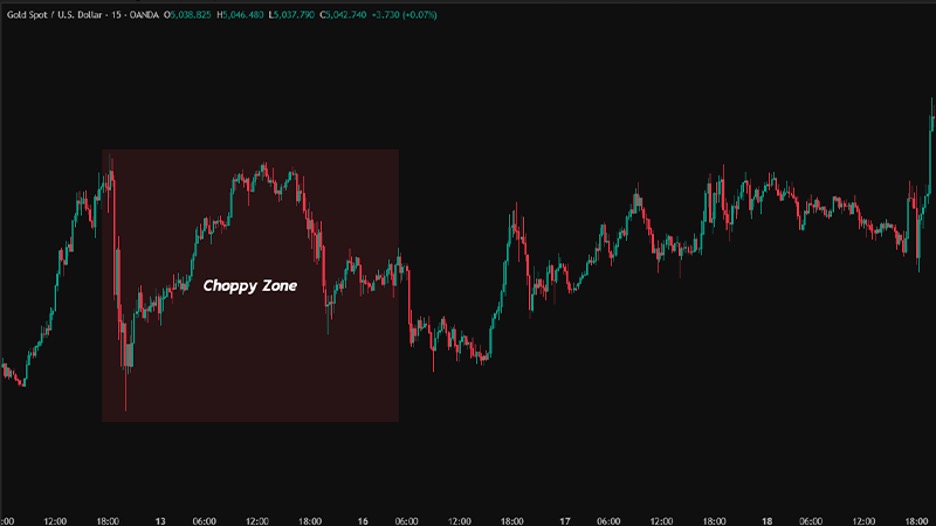
A choppy market refers to a trading environment where price moves within a relatively narrow range without establishing a sustained trend.
Rather than progressing steadily upward or downward, price oscillates between nearby support and resistance levels. Moves may begin with momentum, but they often fade quickly before developing into a broader trend.
In this environment, buyers and sellers frequently shift control of the market. As a result, price movements tend to be short-lived and directional conviction remains weak.

When markets become choppy, focusing on trade quality rather than trade quantity can help reduce unnecessary losses.
Choppy Market Meaning in Practice
For traders, a choppy market changes how trading signals behave.
Strategies that rely on momentum or trend continuation often become less effective because price rarely travels far before reversing. Signals that normally work well in trending conditions may therefore produce inconsistent results.
In practice, traders often notice that:
- Breakouts fail more often;
- Price returns to the middle of the range;
- Trades close at small gains or small losses;
- Stop-loss orders are triggered more frequently.
This environment does not necessarily mean the market is unpredictable. Instead, it simply reflects a different type of market behaviour that requires more selective trading decisions.
Key Characteristics of Choppy Markets
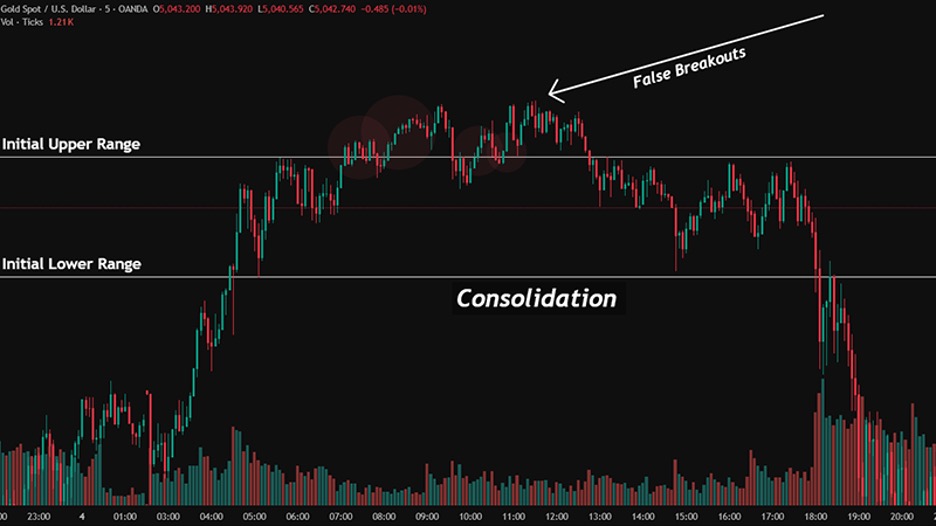
Be on the lookout for overlapping candles, rejected potential reversal zones, and range breaks that lead nowhere. Breakouts occur, and then nothing happens. Prices go back to the middle. Volatility on a higher timeframe can be calm, but it’s steady on a micro level. In a chop, “whipsaw and false breakouts are the default.”
Common Examples of Choppy Markets
Chop occurs in consolidation, before major releases, after strong directional moves that need to consolidate, and in low participation time frames. In equities, index drift with unstable leadership causes chop in the stock market. In forex markets, “chop occurs with the transition of sessions and with windows of low liquidity.” In commodities markets, “cattle market choppy” refers to two-sided markets with little follow-through.
Recognition of Choppy Markets.
You need not know what it is called. All you have to do is to know that it is already going on, to prevent feeding it new stuff into the same old range.
Q: How to check the chop as fast as possible and without any signs?
A: Search for repetitive reversion to the level of the middle of the range and breakout failure.
Choppy Markets Price Action and Market Structure.
Begin with structure, since it is easier to impersonate than indicators. Choppy markets record overlapping swings and shallow progress. Price keeps going back and forth between the mid-range and support and resistance are tapped too many times. The higher the frequency with which a level is being “respected,” the more it turns into the target of stop runs and fake breaks.
If the price reverts to the middle, the market is signalling a low entry opportunity into the trend.
How to Recognize a Choppy Market: A Rapid Checklist.
Checklist:
- Breakouts are short-lived and quickly revert to the previous range.
- There is an overcrowding of candles, and it lacks conviction.
- The price continues to revert to the mid-range.
- Greater time period volatility appears squashed.
- Moves begin, but not much travelling is done.
Three or more ticks are to be taken as an indicator of a choppy market until proven otherwise.
Choppy Markets Spotting Indicators.
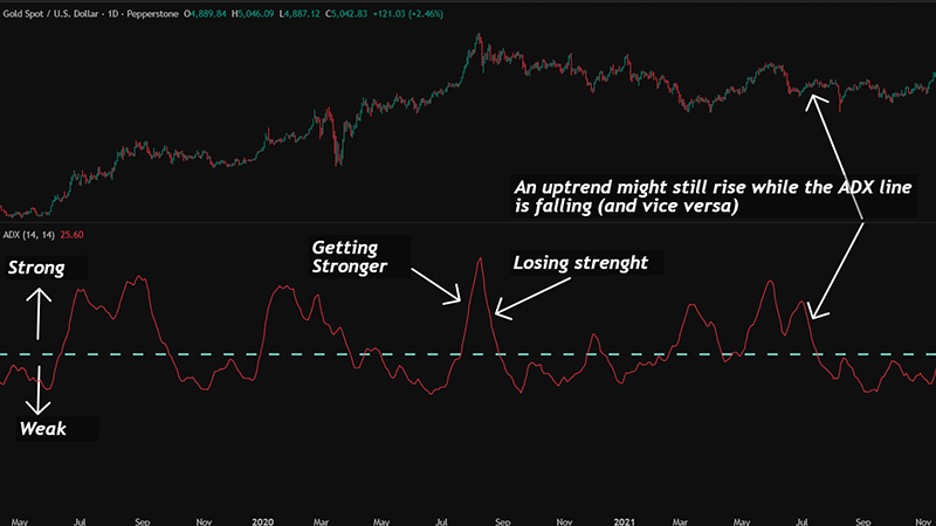
The structure’s proposal should be confirmed by indicators. A combination of tools for trading market ranges could include a trend-strength tool like ADX, and a volatility tool like ATR or a Bollinger Band squeeze.
| Tool Type | What It Tells You | How to Use It in Chop |
|---|---|---|
| Trendiness | Chop vs trend regime | If trendiness signals chop, reduce activity |
| Trend strength (ADX) | Trend power | If weak, avoid trend entries and chasing |
| Volatility (ATR or squeeze) | Expansion potential | If compressed, keep targets modest or stand aside |
Market Noise and High Frequency Trading Effects
The term ‘market noise’ describes price movements that have little/no value when judged against your time frame. Lower timeframes look choppier because micro-liquidity shifts and algorithmic noise create constant small oscillations.
. As a result, you will experience frequent reversals during periods of low volatility, increasing the likelihood that you will stop out or become fatigued.
Market Behaviour Insight:
- Chop can be classified as high risk due to market volatility.
- The primary risk in a market that is trending or chopping is churn.
H2: Tools and Indicators for Choppy Market Trading
There are tools designed to help you reduce or eliminate chop in the market, but they are not intended for use as an entry/exit signal. The reason is that there are tools that help identify, measure, and assess whether you should take a position in a choppy market, meaning they are not considered entry indicators.
Chop indicators help you identify three things: trend presence, trend strength, and volatility compression.
and quantify the trending and non-trending activity that is occurring in the market (regime filters); identifying the strength of the trend (trend strength); and, identifying the volatility that is occurring in the market (the potential for the market to expand to make a profit).
H3: Best Indicator for Choppy Market Conditions: What Actually Helps
The use of a ‘scorecard’ approach, comprising three components (1-trending, 2-trend strength, and 3-volatility), will help you make better trading decisions. When all three aspects indicate a slow trend and low volatility, then the best decision is to either trade smaller or not trade at all.
Your goal is fewer trades in chop, not more signals.
Choppy Market Indicator on TradingView: Setup, Thresholds, and Traps
TradingView offers many choppy market indicator scripts. The main trap is threshold obsession. Keep settings stable, test across symbols, and use the tool to change your playbook, not to force entries.
If a script looks perfect in history, assume curve fitting until proven otherwise.
Choppy Market Index Indicator on MetaTrader: MT4 and MT5 Use
Treat downloaded indicators as untrusted until proven. Check repainting, confirm signals only appear after candle close, and test with realistic costs. Chop exposes unrealistic backtests quickly because small edges disappear once spread and slippage are honest.
Additional Tools: Volume, Oscillators, and Consolidation Trackers
Volume analysis tools can hint whether participation is building within a range. Oscillators like Relative Strength Index can support mean reversion near range extremes, not mid-range. Consolidation trackers highlight compression zones and potential expansion points. Use these as context tools, not permission slips.
| Tool | Best Use in Chop | Common Mistake |
|---|---|---|
| Volume | Confirm participation at range edges | Treating any volume spike as a breakout |
| RSI or oscillator | Mean reversion near extremes | Using it in mid-range |
| Consolidation tracker | Mark compression zones | Assuming breakout direction from compression |
Strategies for Trading or Avoiding Choppy Markets
You have two valid choices: avoid chop and preserve capital for cleaner conditions, or trade chop intentionally with tactics designed for it. The worst choice is trading chop like a trend.
How to Avoid Choppy Markets Without Missing Real Breakouts
Avoidance is a strategy and often has a strong expectancy. Use a two-gate rule. Gate one is regime: high chop plus weak trend strength plus compressed volatility means you skip trend setups. Gate two is confirmation: only take breakouts that hold and continue, not quick spikes. If the first breakout fails fast, do not re-enter immediately.
In chop, no trade is a selective decision, not hesitation.
Choppy Market Strategy: Range Trading and Mean Reversion
Range trading fits chop because it matches the regime. Define range high and range low, then avoid the middle. Entries come near extremes after rejection evidence. Targets are realistic, often mid-range first.
H3: How to Trade Choppy Markets: False Breakout Fade Setup
Let price break a level, then wait for failure, ideally a close back inside the range. Enter after failure. Invalidation sits beyond the breakout extreme. Targets should be modest because chop often snaps back toward the middle.
You are trading the failure, not the breakout.
Squeeze Then Expansion: Bollinger Bands Squeeze Rules
A squeeze signals compression, not direction. In chop, first moves often fail. Require structure break plus follow-through, not just wider bands. If the breakout collapses immediately, treat it as regime information and step back.
The first move out of a squeeze is often a trap when chop persists.
Risk Management in Choppy Markets: Survival Rules
In chop, risk management is the edge. Reduce size, limit trades per session, and use time stops. Track transaction costs because spreads and commissions matter more when moves are smaller. Define a stop-trading rule before the day starts.
How to survive trading in a choppy market?
- Reduce position size.
- Trade fewer setups.
- Avoid mid-range entries.
- Use time stops.
- Respect daily loss limits.
Common Pitfalls in Choppy Markets
Chop tests temperament as much as it tests your system. Most damage comes from behaviour.
Whipsaws and False Breakouts: Why Chop Eats Trend Traders
Trend traders rely on continuation. Chop offers repeated interruption. Tight stops get farmed, and mid-range entries get punished. Defence starts with confirmation: candle close and follow-through.
Overtrading and Revenge Trades: The Chop Trap Loop
Chop produces many almost signals, increasing the urge to act. Small losses invite revenge trading. Add guardrails: maximum trades, maximum daily loss, and a mandatory break after two consecutive losses.
In chop, self control can be a bigger edge than pattern spotting.
The Most Common Mistakes Made When Interpreting Choppy Market Indicators
Typical mistakes include thinking that one tool is the best indicator, optimising settings until the chart looks perfect, and using a chop indicator as a buy or sell trigger. Curve fitting is typically that perfection in chop.
Case Studies and Actual Choppy Market Examples
Chop can be repeated. The names of the markets shift. The behaviour is still present.
An Example of a Choppy Stock Market
When the index fluctuates, but the leadership is erratic, stocks become choppy. Because of misaligned participation, breakouts don’t work. Selectivity is the answer: either lower frequency and wait for trend conditions, or trade only names with clean relative strengths.
Choppy Stock Market and Index Behaviour: What Changes
An index can look calm while individual names whip around during rotation. If your watchlist shows repeated failed follow-through, treat it as a regime signal.
Choppy Market Example in Forex
Forex chop clusters around session transitions, thin liquidity hours, and post-news digestion. Spreads and stop runs matter more. A practical adaptation is higher timeframe execution, session filters, and accepting that no trade can be the best trade.
Cattle Market Choppy: What Analysts Usually Mean
“Cattle market choppy” usually means two-sided trade, limited follow-through, and frequent reversals around known reference points. The takeaway is the same: range logic, lower frequency, and no forced trend narrative.
Lessons from Historical Choppy Markets
Choppy conditions tend to emerge when volatility contracts and market conviction weaken. This leads to more frequent decisions, which in turn increase errors and churn. Traders who endure these phases treat chop as a shift in market regime and focus on preserving capital until more favorable conditions return.
Conclusion
A choppy market is an environment where being overly active is penalised, and patience pays off. Recognise chop early by analysing market structure and using basic filters. Decide upfront whether to engage or stay out. If you choose to trade, operate near range boundaries, require confirmation, and aim for modest targets. If you choose to avoid it, do so with intent, and protect your capital for clearer, higher-probability setups.
FAQ
Q: How can I identify a choppy market on different time scales?
A: Start by looking at the bigger picture first. If the higher time frame is moving sideways in a range, and the lower time frame shows prices overlapping and reversing often, this usually signals a choppy market. You can confirm this by using a trend filter to check if there is a clear direction, and a volatility tool to see if price swings are small and inconsistent.
Q: What are the best indicators for choppy markets?
A: There is no single indicator that works best in choppy markets. Instead, combine a trend strength tool, like the ADX, to see if there is a strong trend, with a volatility measure, such as ATR or a Bollinger Band squeeze, to spot when the market is quiet. The goal is to use indicators that help you avoid trading when the market conditions are poor.
Q: How can I avoid choppy markets without missing real breakouts?
A: Use a two-step process. First, avoid markets that are showing a lot of choppy movement, weak trends, and low volatility. Second, only consider trades when there is a breakout that not only moves past the range but also holds above or below it, showing that the move is likely to continue.
Q: What are the differences between choppy stock and forex markets?
A: In Forex, choppy conditions are often affected by the timing of trading sessions and the size of the spread, which can make trading costs and sudden stop-outs more common. In stocks, choppy markets usually happen when the overall index is drifting or when sectors rotate, causing momentum to fade.
Q: What does “Choppies market cap” refer to, and why is it different from trading?
A: This just refers to the total market value of Choppies Enterprises, which is a company. It is not related to the trading term ‘choppy market.’