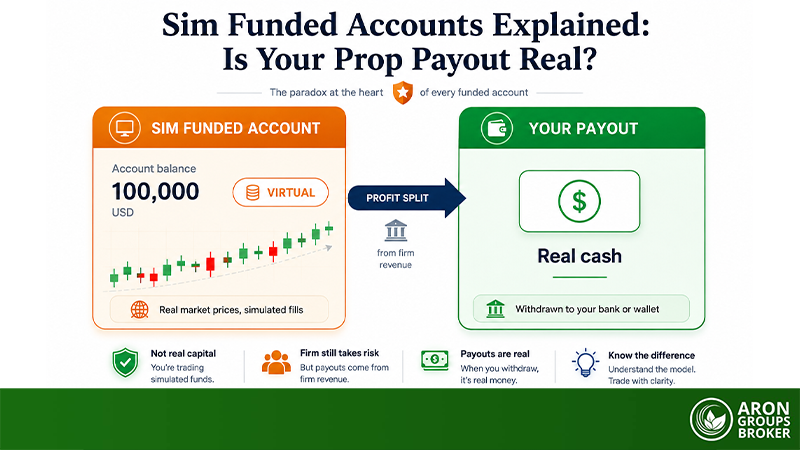

A sim funded account is the stage after you pass a prop firm evaluation where you keep trading simulated capital in an environment built to mirror the live market, while the payouts you earn on your simulated profits are paid to you in real money. That single sentence contains the whole confusion: the capital is virtual, but the cash is not. Understanding how those two facts sit together is the difference between an informed trader and a disappointed one.
Most explainers skate over the uncomfortable core, which is where the payout money actually comes from. It does not come from your trades hitting the market. It comes from the firm’s own revenue, largely the evaluation fees paid by thousands of other traders. That is not automatically a scam, but a firm that will not say it plainly is telling you something.
This guide defines the sim funded model, follows the money, compares demo, sim funded, and live funded side by side, explains what changes when execution goes live, and gives you a transparency test to judge any firm. It ends with an honest verdict on the scam question and the one mindset trap that quietly costs traders their accounts.
- A sim funded account uses virtual capital in a live-mirroring environment; the profits are simulated, but the payouts are real cash.
- Payouts are funded mainly by the firm's evaluation-fee revenue, not by your trades reaching the market.
- Demo, sim funded, and live funded differ on capital at risk, who pays you, execution quality, and psychology, not just on the label.
- Going live introduces slippage, partial fills, and latency that a simulator smooths over, often worth a tick or several per fill.
- The model itself is legal, but the industry is lightly regulated, so the real test is disclosure quality: judge the firm, not the label.
What Is a Sim Funded Account?
A sim funded account, also called a simulated funded account, is a post-evaluation account that trades virtual capital in conditions designed to replicate live markets, with real payouts on any simulated profit. You are not handed a bank account full of the firm’s cash. You are given a simulated balance, real market prices feed your charts, and if you trade within the rules and stay inside the drawdown limits, the firm pays your profit split from its own funds. The word funded describes your permission to earn, not a pile of live money with your name on it.
Risk Disclosure
CFDs are complex instruments and come with a high risk of losing money rapidly due to leverage. You should consider whether you understand how CFDs work and whether you can afford to take the high risk of losing your money. Past performance is not indicative of future results. This content is provided for educational purposes only and does not constitute investment advice.
Why This Is Not the Same as Live
The distinction matters because funded does not always mean live. Many firms keep traders in simulation indefinitely, paying real profit splits the entire time, and never route a single order to a real exchange. Others use simulation as a probation stage before a genuine live account. Both can be legitimate. The problem is only when a firm blurs the two on purpose so you assume your orders are reaching the market when they are not.
Where the Payout Money Actually Comes From
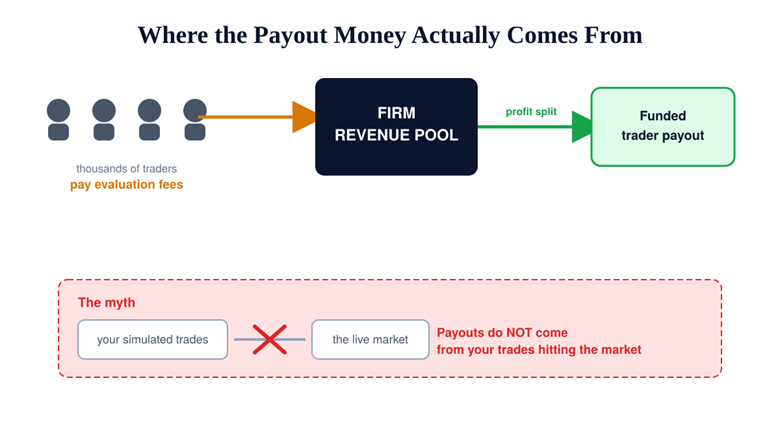
Here is the honest core that most pages bury. When you withdraw a payout from a sim funded account, that money does not come from your trades making a profit on a real exchange. Your trades never went to an exchange. The cash comes from the firm’s operating revenue, and for most retail prop firms the largest single source of that revenue is evaluation fees: the challenge fees paid by the thousands of traders attempting to get funded, most of whom do not pass.
Stated plainly, you trade virtual money, and you are paid real money from the firm’s reserves. This creates an obvious structural tension, because a firm that pays winners out of challenge fees has an incentive to keep the bar high. That is not proof of bad faith, and well-run firms manage the tension openly, but it is exactly why capital preservation and reading the rulebook matter more here than the marketing suggests.
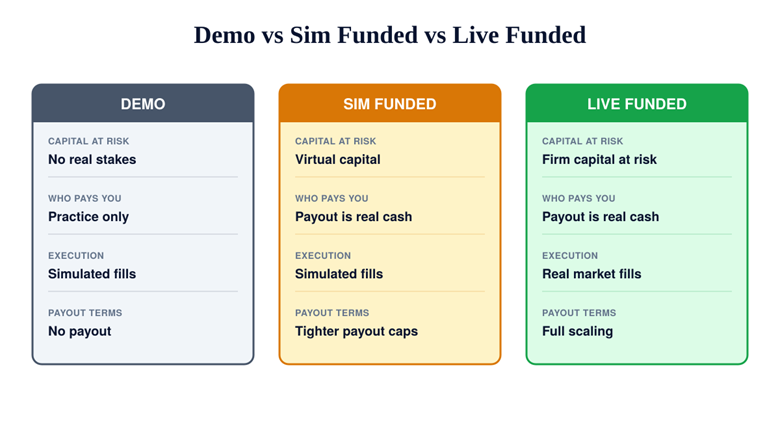
Demo vs Sim Funded vs Live Funded
The three account types are easy to confuse because they can look identical on a screen. What separates them is what is genuinely at stake, whose money pays you, and how orders are executed.
| Dimension | Demo / paper | Sim funded | Live funded |
|---|---|---|---|
| Capital at risk | None | None; virtual balance | The firm's real capital |
| Who pays you | Nobody | The firm, from its revenue | The firm, from market profits and revenue |
| Order routing | Simulated | Simulated, live-mirroring | Real market execution |
| Fills and slippage | Idealised | Idealised, near-perfect | Real slippage and partial fills |
| Payout | None | Real cash, tighter caps | Real cash, fuller scaling |
| Psychology | Casual | Real stakes on payout | Real stakes throughout |
Q: If a sim funded account never touches the market, is the payout still real?
A: Yes. The profit you generate is measured in simulation, but the payout is real money transferred from the firm to you. The simulation decides how much you are owed; the firm’s revenue is what actually pays it. Both things are true at once, which is why the model confuses people.
Why Firms Use the Sim Model
From the firm’s side, simulation solves two problems at once. The first is risk management: if no client order reaches a real exchange, the firm’s market exposure on funded traders is effectively zero, and its only outflow is the payouts it chooses to honour. The second is scale. A simulated environment can onboard thousands of traders at once, offer higher leverage and faster scaling than a regulated brokerage could, and do it without the capital requirements of routing real orders.
There is also a historical reason the retail prop industry looks the way it does. After the Volcker Rule curtailed proprietary trading inside US banks, a new breed of independent, retail-facing prop firms grew up outside that perimeter, selling evaluations instead of hiring salaried traders. The simulated funded account is the model that scaled best, which is why it now dominates. If you want the fuller picture of whether this path suits you, our guide on prop trading and where to start goes deeper.
Did You Know? A sim funded account is cheap for the firm to run and easy to scale. That is not sinister by itself, but it does mean the firm's interests and yours are not automatically aligned. Read the rules as if that were true, because it is. |
What Changes When You Go Live
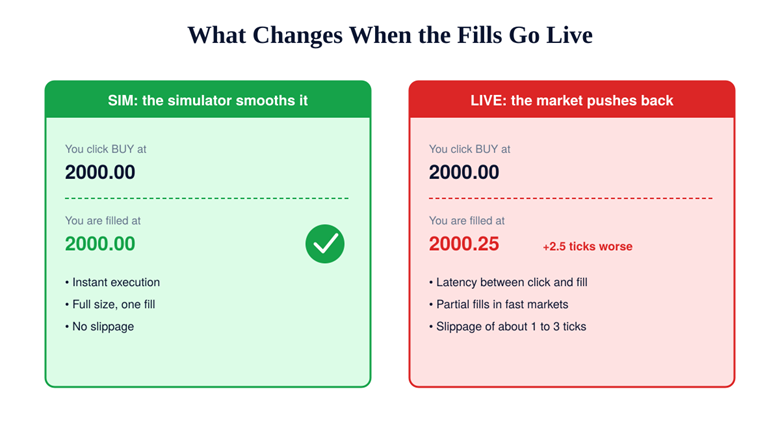
The moment real orders reach a real venue, a set of frictions that a simulator quietly smooths over appears all at once. Real routing brings slippage, the gap between the price you clicked and the price you actually got. It brings partial fills, where only part of your order executes in a fast market. And it brings latency, the delay between your click and the confirmation. In calm conditions the difference is small, but sim fills and live fills can still diverge by a tick or several, and in volatile conditions the gap widens sharply.
Two other things usually change at the same time. Payout caps and buffers are often looser once you are genuinely live, and the drawdown terms may shift too, so the number you learned in the evaluation is not always the number you keep. Transitions from sim to live are usually milestone based, triggered by a set number of payouts or a cumulative profit figure. None of this is hidden by a good firm, and understanding how a firm calculates drawdown at each stage is part of doing your homework.
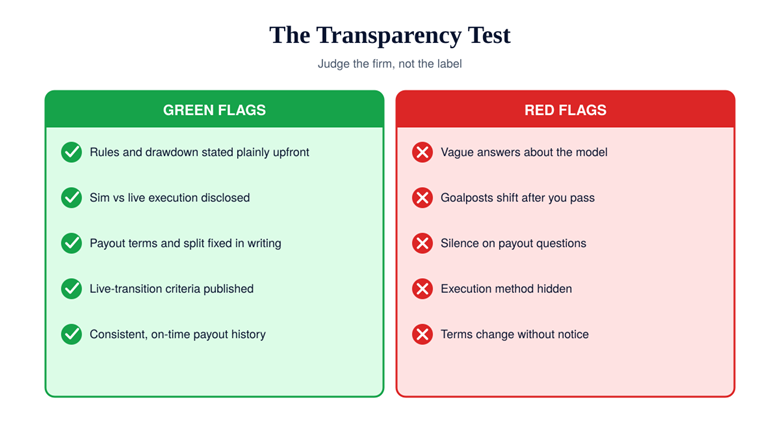
The Transparency Test
Because the model itself is neutral, the thing you are really evaluating is disclosure. A firm that clearly states its sim-phase rules, its payout terms, and its live-transition criteria upfront, and then pays out on performance without moving the goalposts, is running a legitimate process. Use a simple checklist and treat any failure as a warning.
- Are the trading rules and drawdown terms stated plainly before you pay, not buried in the terms of service?
- Does the firm disclose whether your funded account is simulated or routed to a real market?
- Are the payout split, caps, and withdrawal schedule fixed in writing?
- Are the criteria for moving from sim to live actually published?
- Does the firm have a consistent, verifiable history of paying on time?
The red flags are the mirror image: vague answers about the execution model, goalposts that shift after you pass, and silence when you ask direct payout questions. If you want a fuller field guide to the warning signs, we keep one in our piece on how to spot the red flags of a questionable prop firm.
Is a Sim Funded Account a Scam?
The balanced verdict is that the sim funded model is legal and, done honestly, a reasonable way to match skilled traders with payouts. The risk does not live in simulation as such; it lives in the quality of disclosure and in how lightly the industry is regulated.
The regulatory picture in 2026 makes the point sharper. The most prominent enforcement action in the sector, the US regulator’s case against one of the largest retail prop firms, collapsed: in May 2025 a federal judge dismissed it with prejudice and sanctioned the agency for its conduct, leaving the United States without the precedent it had sought. In Europe and Australia, regulators are instead tightening the edges through leverage caps and marketing rules rather than prop-specific law. The practical lesson is not that the label is safe or unsafe, but that you must judge the individual firm on its disclosures. That is also the theme of our dedicated look at whether prop trading is a scam.
The Mindset Trap
The most expensive misunderstanding is treating a sim funded account as a permanent income stream. It is designed as a probation stage, a way to prove a durable edge, not a salary. Traders who lean on small monthly payouts as income tend to trade scared, and regulators repeatedly warn that most retail speculators lose money over time, which is the base rate you are fighting.
Simulation also distorts behaviour in a subtler way. Without real capital on the line, it is easy to take risks you would never take live, which builds habits that fall apart the moment the money is real. The antidote is to trade the simulation exactly as if it were live: fixed position sizing, a systematic approach, and the discipline of a professional trader. If you would rather build that discipline on your own capital, even a small live account teaches lessons no simulator can.
Where Aron Groups Fits
If you want to test the discipline a funded account demands without paying an evaluation fee, Aron Groups runs a No Deposit PROP Challenge: a demo-based evaluation with a real profit target and a clear drawdown limit, so you can rehearse the exact skills under the exact pressure at no cost. Practise on the MetaTrader 5 environment, hold yourself to the same rules a funded account would impose, and treat a smooth equity curve as the real goal rather than a single lucky month.
Conclusion
A sim funded account is exactly what its two halves say it is: simulated capital, and a real payout. The trades live in a simulator, the profit is measured there, and the cash that reaches your bank comes from the firm’s revenue, mostly the evaluation fees of traders who did not make it. None of that is a scam on its own.
What separates a fair opportunity from a trap is disclosure, and the burden is on you to check it. Read the rules before you pay, confirm how execution and payouts work, and treat the account as probation rather than a paycheck. Do that, bring genuine trading discipline, and the label matters far less than the firm behind it.
Frequently Asked Questions
What is a sim funded account in simple terms?
It is an account you earn by passing a prop firm evaluation, where you keep trading a simulated balance in a live-mirroring environment. Your profits are virtual, but the payouts you withdraw on them are real money paid by the firm.
Do prop firms use real money?
Often not for funded traders. Many firms keep accounts in simulation and pay your profit split from their own revenue, mainly evaluation fees, rather than routing your orders to a real exchange. Some promote proven traders to genuinely live capital after milestones.
Are sim funded payouts real?
Yes. The money you withdraw is real and spendable. What is simulated is the trading that decides how much you are owed, not the payment itself, which comes from the firm’s funds.
How can I tell if a sim funded firm is trustworthy?
Check disclosure. A trustworthy firm states its rules, drawdown terms, payout split, and sim-to-live criteria upfront and does not change them after you pass, and it has a consistent record of paying on time. Vagueness and shifting goalposts are the warning signs.