
icon icon Home
icon icon Accounts
icon icon Quick start
icon icon Symbols

How Currency Strength Is Determined: The Economic Factors Behind a Currency’s Value

Author
Abe Cofnas
Abe Cofnas
calendar Last update: 10 August 2026
watch Reading time: 9 min

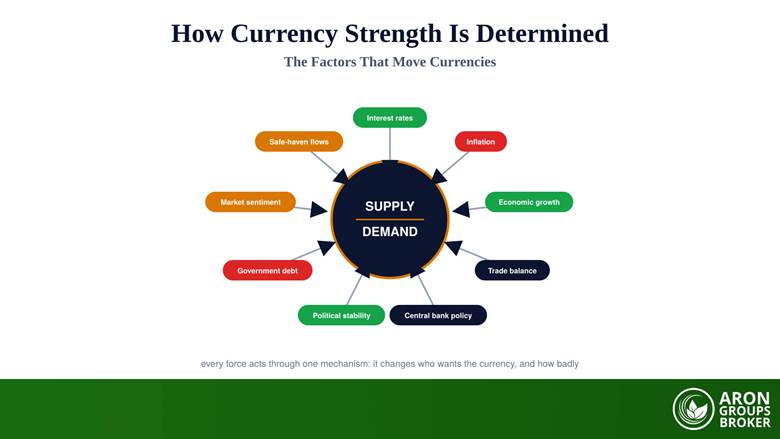
At its root, a currency’s value is set by supply and demand in the global foreign exchange market, the largest financial market in the world by the BIS’s own turnover statistics. What determines the value of a currency, then, is whatever moves that supply and demand: interest rates, inflation, economic growth, trade balances, central bank policy, political stability, government debt, market sentiment, and safe-haven flows. And strength is always relative, because a currency is only ever priced against another currency.

That relativity is worth stating twice, because it changes how every driver below should be read. There is no absolute scale on which the dollar scores an eight and the yen a three; there is only the exchange rate between them, which reflects the balance of forces acting on both at once. A currency can weaken while its own economy improves, simply because the currency on the other side of the pair improved faster. Currency pair strength is the honest unit of measurement.

This guide walks through each core driver, shows why no single factor decides the outcome, explains the two ways strength is calculated, covers how currency strength meters rank the eight majors in practice, separates floating from fixed exchange rate regimes, and closes with how traders actually use strength, along with the honest limits of measuring it.

bookmark
Key Takeaways
  • A currency's value is set by supply and demand, and strength is always measured relative to another currency, never on an absolute scale.
  • The core drivers are interest rates, inflation, growth, trade balance, central bank policy, political stability, government debt, sentiment, and safe-haven flows.
  • Higher interest rates usually strengthen a currency and high inflation erodes it, an inverse rule of thumb that anchors most fundamental analysis.
  • Strength is calculated two ways: fundamental-based, from economic data, and price-based, from relative movement across pairs, often referenced to the DXY.
  • Strength meters rank the eight majors from a weighted, smoothed index of past movement; they describe what has happened, not what happens next.

How Is Currency Strength Determined?

Like any freely traded asset, a currency is worth what buyers will pay for it, so the direct answer is supply and demand. When more capital wants to hold dollars, for trade, for investment, or for safety, the dollar strengthens against the currencies that capital is leaving. What makes currencies interesting is that the demand has so many independent sources: an exporter converting revenue, a fund chasing higher bond yields, a central bank managing reserves, and a speculator with a view are all pushing on the same price. The drivers below are simply the forces that move those flows, and the same logic applies to any fiat currency, whose value rests on confidence and demand rather than on a commodity backing.

sms-star

Risk Disclosure

CFDs are complex instruments and come with a high risk of losing money rapidly due to leverage. You should consider whether you understand how CFDs work and whether you can afford to take the high risk of losing your money. Past performance is not indicative of future results. This content is provided for educational purposes only and does not constitute investment advice.
Always Relative, Never Absolute

Every statement about strength hides a comparison. The euro is strong means the euro is strong against something, usually the dollar, sometimes a basket. This is why the same week’s headlines can call a currency both strong and weak and both be right: EURUSD and EURJPY are different contests with different opponents. Keeping the opponent in view is the single habit that makes the rest of this subject coherent.

The Core Drivers of Currency Strength

Nine forces do most of the work, and each acts through the same mechanism: it changes the attractiveness of holding the currency, which changes the flows, which changes the price. The table condenses them; the sections after it explain the interactions that the table cannot show.

DriverTypical effect when it rises or improvesWhat traders watch
Interest ratesAttracts foreign capital; strengthensCentral bank decisions, rate differentials
InflationErodes purchasing power; weakensCPI releases against forecasts
Economic growthAttracts investment; strengthensGDP, PMI, employment data
Trade balanceSurplus lifts demand; deficit pressuresCurrent account, export data
Central bank policyTightening supports; easing and QE weakenStatements, guidance, balance sheets
Political stabilityConfidence supports the currencyElections, policy continuity, geopolitics
Government debtHeavy debt raises risk; weakensFiscal deficits, ratings, bond yields
Market sentimentSpeculative flows amplify movesPositioning, risk appetite
Safe-haven flowsCrisis demand can override everythingUSD, JPY, CHF in risk-off episodes

Nine drivers, one mechanism: each changes who wants the currency and how urgently.

Interest Rates and Inflation: The Inverse Rule of Thumb

These two anchor everything else, and they pull against each other. Higher interest rates attract foreign capital hunting yield, which strengthens the currency; high inflation erodes what the currency buys, which weakens it. The rule of thumb is inverse: central banks raise rates to fight inflation, so hot inflation data often strengthens a currency in anticipation of the hikes it forces, then the inflation itself corrodes value if the hikes fail. Reading the pair together, rates against prices, is the beginning of fundamental literacy.

Growth, Trade, and the Current Account

A growing economy attracts capital: investors buy its equities, its bonds, and its businesses, and every purchase requires its currency first. Trade works the same way from the goods side. A trade surplus means foreigners must continuously buy the currency to pay for exports, lifting demand, while a persistent deficit means the country is continuously selling its own currency to pay for imports, pressuring it. The current account bundles these flows into one figure worth tracking.

Central Banks, Debt, and Political Stability

Central bank policy is a primary driver because it sets the price of the currency’s own money. Tightening and rate rises support it; easing, and especially quantitative easing, expands supply and weakens it. Around that sit the slower variables: heavy government debt raises questions about future inflation or default and weighs on the currency, while political stability does quiet, constant work, because capital pays a premium for predictability and charges one for chaos.

Sentiment and Safe-Haven Flows

Markets trade expectations, not press releases, so speculative positioning can move a currency before any data justifies it and stretch moves beyond what the data supports. Safe-haven flows are the extreme case: in a crisis, money floods into the dollar, the yen, and the franc almost regardless of their domestic fundamentals. Safe-haven demand is the one force that routinely overrides everything else on this list, which is exactly why it belongs at the end of it.

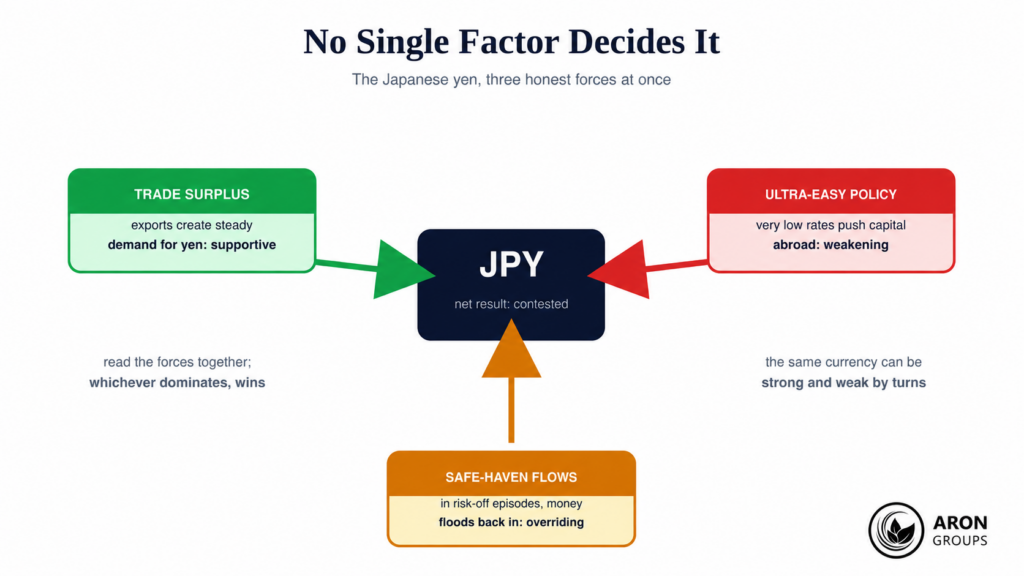
No Single Factor Decides It

The drivers interact, and sometimes they conflict, which is where mechanical reading of the list fails. The Japanese yen is the standing example: trade surpluses supply steady demand for it, ultra-easy monetary policy simultaneously pushes capital abroad and weakens it, and safe-haven flows episodically override both. Which force dominates decides the direction, and dominance shifts. The dollar told the same story from the other side when it strengthened against currencies such as the rupee even while US inflation ran hot, because aggressive rate rises, and the capital they attracted, outweighed the inflation that provoked them.

The Core Drivers of Currency Strength

Three honest forces on one currency: the direction belongs to whichever force currently dominates.

Q: If the drivers conflict, how do I know which one is winning?

A: Price tells you. When a currency rises through supportive and hostile news alike, the market has picked its dominant theme, and the calendar tells you when that theme is next tested. Fundamentals propose; price disposes. Watching both is the entire craft.

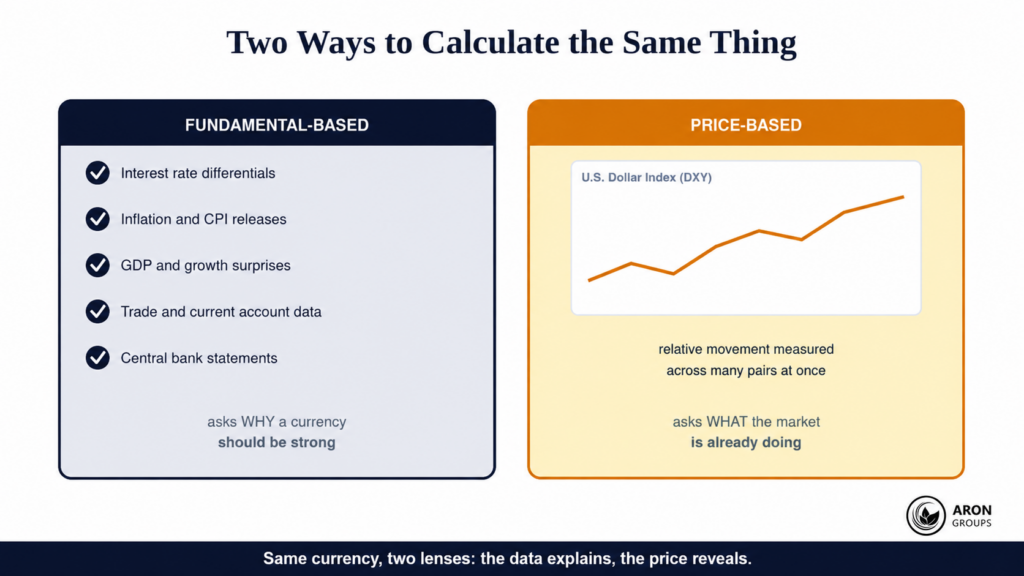
The Two Ways Currency Strength Is Calculated

Everything above describes fundamental-based strength: a judgement built from interest rates, inflation, growth, and the rest of the economic record. The second approach is price-based strength, which ignores the reasons and measures the result: how a currency has actually moved against the others, often referenced to a benchmark such as the U.S. Dollar Index, which tracks the dollar against a basket of major currencies. The two describe the same thing from different angles, the data explaining why strength should exist and the price recording whether it does, and disagreements between them are themselves information.

How Currency Strength Is Determined: The Economic Factors Behind a Currency's Value

Fundamental analysis asks why a currency should be strong; price-based measurement asks what the market is already doing.

How Strength Meters Measure It in Practice

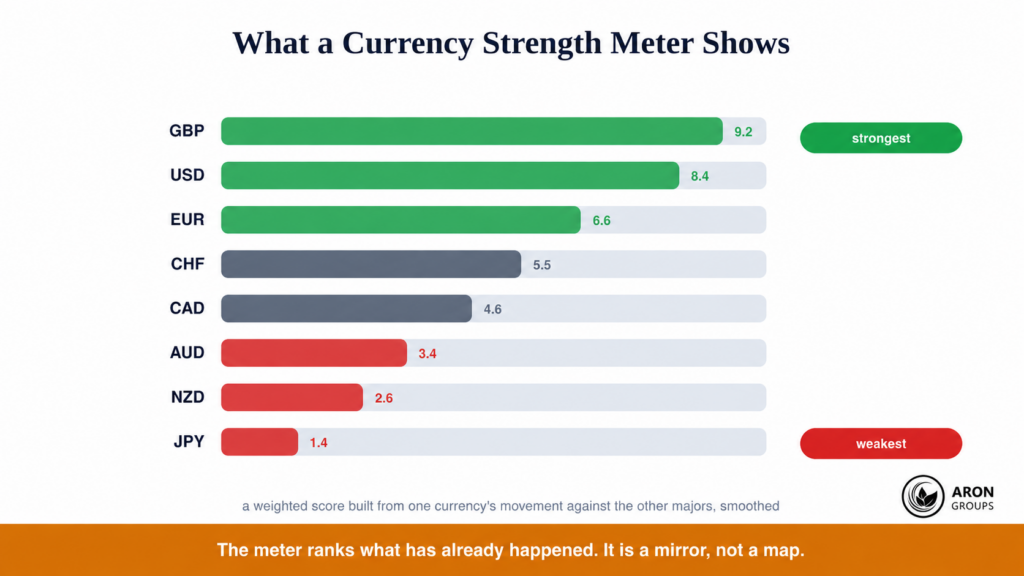
A currency strength meter operationalises the price-based approach. It tracks one currency against the other majors across many pairs at once, weights and smooths the movements, and outputs a single score, ranking the eight major currencies, the dollar, euro, pound, yen, franc, and the Canadian, Australian, and New Zealand dollars, from strongest to weakest. The practical use is pair selection: pairing a currently strong currency against a currently weak one, rather than two strong or two weak ones, is how traders hunt cleaner trends, and a legitimate input to a trading edge, provided the ranking is treated as a snapshot and validated like any other input through out-of-sample backtesting.

How Strength Meters Measure It in Practice

A ranked snapshot of the eight majors: useful for pairing strong against weak, honest only about the past.

Mini Example: Pairing Strong Against Weak

A trader’s meter shows the pound strongest and the yen weakest over the past sessions. Rather than trading EURUSD, where both sides are mid-table and the reading is ambiguous, they focus on GBPJPY, where the strength differential is widest and a trend, if one exists, has the most fuel.

The meter chose the battlefield, nothing more. Entry, stop, and size still come from structure and a written plan, and if the calendar shows a Bank of Japan decision tonight, the snapshot may be stale by morning. The tool narrowed the search; it did not make the decision.

Floating vs Fixed Exchange Rates

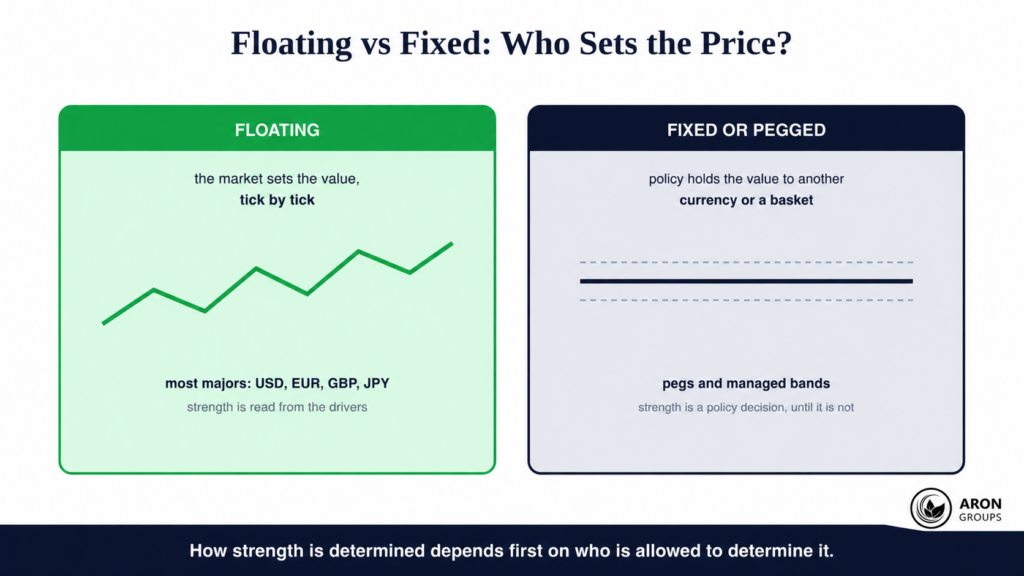
One structural fact sits underneath everything above: who is allowed to set the price. Most major currencies float, meaning the market determines their value tick by tick, and every driver in this article acts on them continuously. Some currencies are instead fixed or pegged, held by policy at a set rate against another currency or a basket, with the central bank buying and selling to defend the level. For a pegged currency, strength is a policy decision rather than a market verdict, which holds right up until defending the peg becomes too expensive, and history’s most violent currency moves have come from exactly those breaks.

How Currency Strength Is Determined: The Economic Factors Behind a Currency's Value

Floating currencies answer to the market; pegged ones answer to policy, until the policy gives way.

Why Currency Strength Matters for Trading

For a trader, strength analysis earns its keep in three places. It selects pairs, by matching strong against weak. It frames bias, because knowing the dollar is in a rate-driven uptrend tells you which side of dollar pairs deserves the benefit of the doubt. And it schedules attention, because the economic calendar lists the exact moments, rate decisions, CPI prints, GDP releases, when the fundamental picture is re-marked. None of this replaces execution skills: entries still need structure, every position still needs a defined risk-to-reward ratio, and sizing still comes from rules rather than conviction, which is where deliberate position sizing does the quiet work.

The Honest Framing: What Strength Readings Cannot Do

Three limits keep this subject honest. Strength is relative and constantly shifting, so today’s ranking is a photograph of a race, not its result. The drivers can flip, sometimes inside a single press conference, so a fundamental thesis needs a date on it. And strength meters are lagging by construction: they summarise movement that has already happened, which makes them a mirror rather than a forecast. Use them with the calendar and with price action, never instead of either. The base rates argue for humility too, since European regulators found the large majority of retail accounts lose money on leveraged products, and investor-education guidance on leveraged strategies is blunt that amplified exposure amplifies every misjudged driver.

Track It With Aron Groups

The practical toolkit is compact: the DXY for the dollar’s side of almost everything, the economic calendar for the scheduled re-pricings, and a chart platform to read the result. All three live comfortably in a workflow built on the MetaTrader 5 platform at Aron Groups, with alerts at the levels your analysis cares about, and the mechanics beneath it are covered in our guide on how to trade forex.

Combine strength with structure rather than trading it naked: let the ranking pick the pair, let the chart pick the level, and rehearse the whole routine on a demo account before capital is involved. When it goes live, a small account with micro volumes keeps the tuition affordable, and sound risk management decides whether the lesson compounds or repeats.

Conclusion

Currency strength is determined by supply and demand, and supply and demand are determined by a familiar cast: interest rates and inflation pulling in opposite directions, growth and trade creating flows, central banks setting the terms, stability and debt setting the risk premium, and sentiment and safe-haven episodes amplifying or overriding the lot. No single factor decides it, and the currencies that confuse beginners, the yen above all, are simply the ones where the conflict is loudest.

Measure it both ways, fundamentally for the why and price-based for the what, treat strength meters as ranked history rather than prophecy, and put the reading to work the way a professional trader would: to choose battlefields, not to skip the discipline of fighting well. The edge, as always, lives in the systematic process built around the information, with capital preservation ahead of any single view.

Frequently Asked Questions

Quick answers to the questions readers ask most about what determines a currency’s value and how strength is measured.

What determines the value of a currency?

Supply and demand in the foreign exchange market, driven by interest rates, inflation, economic growth, trade balances, central bank policy, political stability, government debt, sentiment, and safe-haven flows. The value is always expressed relative to another currency.

What makes a currency strong or weak?

Rising interest rates, solid growth, low and stable inflation, trade surpluses, and political stability tend to strengthen a currency, while high inflation, easy monetary policy, heavy debt, and instability tend to weaken it. In practice the drivers interact, and the dominant one sets the direction.

What is a currency strength meter?

A tool that tracks one currency against the other majors across many pairs, weights and smooths the movements, and ranks the eight major currencies from strongest to weakest. It summarises past movement, so it is best used for pair selection alongside the calendar and price action, not as a forecast.

Why can a currency stay strong despite bad news?

Because strength is relative and multi-driven. A currency can absorb negative data if a stronger force, such as aggressive rate rises or safe-haven demand, dominates, or if the currency on the other side of the pair is deteriorating faster. The market weighs all drivers at once and prices the balance.

Continue Reading
not-found
calendar 10 August 2026
Rate this article

Leave a Reply

Your email address will not be published. Required fields are marked *

No thanks