
icon icon Home
icon icon Accounts
icon icon Quick start
icon icon Symbols

Prediction Market Arbitrage: How Cross-Platform Spreads Work, and Why “Risk-Free” Has a Catch

Author
Abe Cofnas
Abe Cofnas
calendar Last update: 12 October 2026
watch Reading time: 10 min

Prediction market arbitrage is the practice of buying the same event at different prices on two prediction markets, or both sides of one market. Either way the position pays out whatever happens. Because the profit does not depend on the outcome, people call it risk-free. In practice it is low-risk work with real frictions, not free money.

It matters now because the venues have grown fast. The Block’s data put combined Kalshi and Polymarket volume at $45.33 billion in August 2026, against about $1.9 billion a year earlier. Arbitrage in its textbook sense promises profit without risk, and prediction markets test that promise daily.

This guide covers how Yes and No shares price probability, the two types of arbitrage, why gaps appear, and the frictions that eat the edge.

bookmark
Key Takeaways
  • A Yes share pays $1 if the event happens and $0 if not, so its price is the market's probability, and a full Yes plus No set is always worth exactly $1 at resolution.
  • Cross-platform arbitrage buys the cheap Yes on one venue and the cheap No on another for less than $1 in total; on 17 October 2024 Polymarket priced a Trump win near 62% while Kalshi showed about 57%.
  • Fees are the first catch: Kalshi, Polymarket US and Polymarket's crypto markets all charge takers about 7% of price times one minus price, which is 1.75 cents a share at 50 cents, on each leg.
  • Research on Polymarket found about $40 million of arbitrage profit extracted between April 2024 and April 2025, and a 2026 study of NBA markets found a median window of just 3.6 seconds.
  • The two legs are hedged only if both venues read the event the same way; on 8 February 2026 Kalshi settled its Cardi B halftime market at 26 cents while Polymarket paid $1.

What Is Prediction Market Arbitrage?

Prediction market arbitrage is a trade that combines event contracts whose payouts cancel, bought for less than the fixed $1 they return together. The trader is not forecasting the event, only the gap between prices. The position earns the same amount whichever outcome arrives.

sms-star

Risk Disclosure
Trading forex and CFDs carries a high level of risk and can result in the loss of all your capital. This content is educational and is not investment advice. Never risk money you cannot afford to lose.
How prediction markets price an event

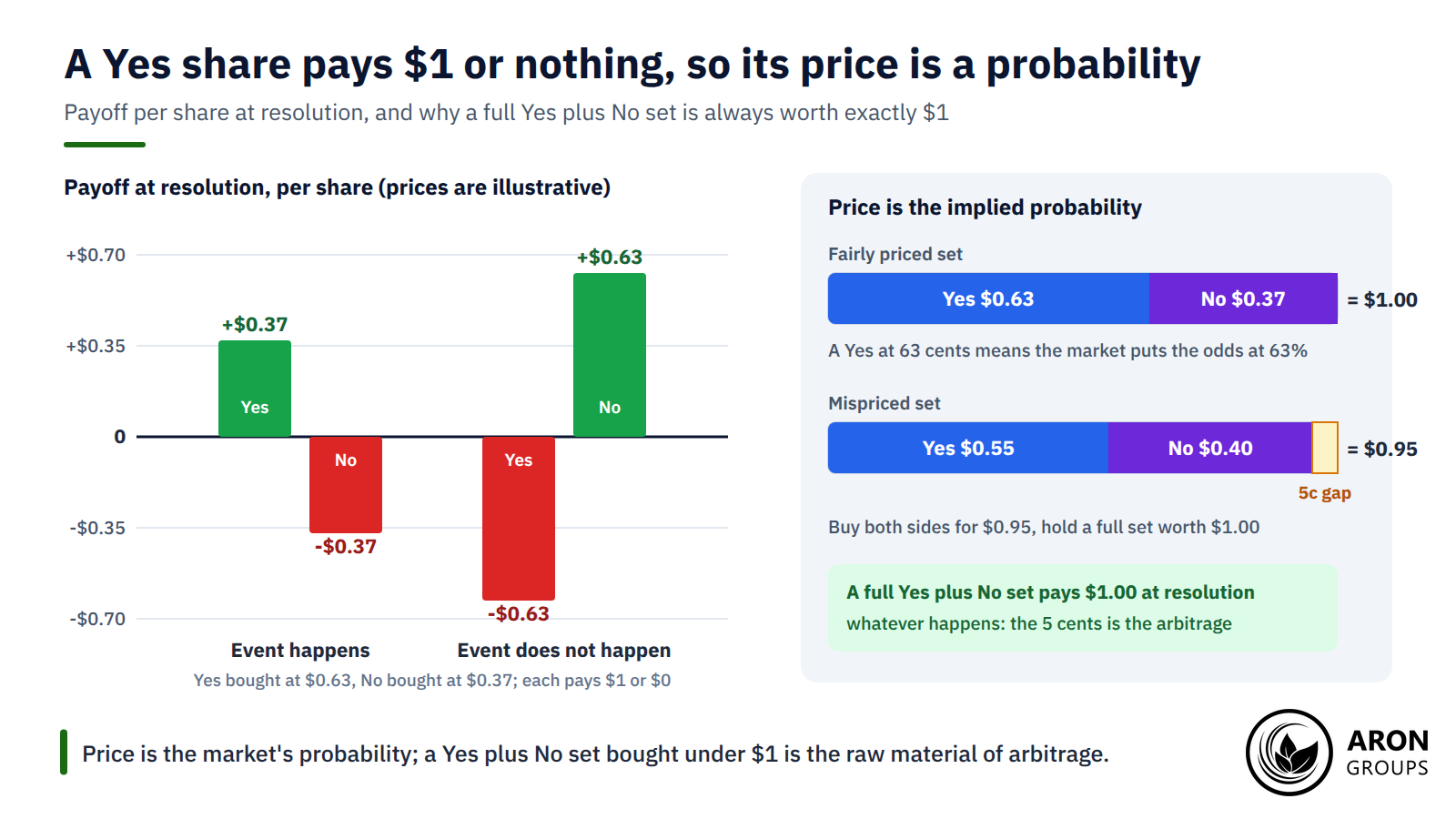
A prediction market lets you trade on whether a real-world event happens: an election, a Fed decision, a match result or a crypto price level. A Yes share pays $1 if the event happens and nothing if it does not. A No share pays the reverse.

The price of a Yes share is therefore the market’s implied probability: a Yes at 63 cents says the crowd puts the odds at 63%. The payoff has the all-or-nothing shape of a binary option. The FCA banned the sale of binary options to retail consumers from 2 April 2019, calling them “gambling products dressed up as financial instruments”.

Why Yes plus No should cost one dollar

Exactly one of Yes and No pays, so a full set is always worth $1 at resolution. On Polymarket, splitting $1 of collateral creates one Yes and one No token, and merging a full set returns the $1. Kalshi contracts are priced from 1 to 99 cents on the same logic.

Whenever Yes plus No can be bought for less than $1, the price has drifted from the structure. That drift, not any view on the event, is what the arbitrageur trades.

Price is probability, and a full Yes plus No set bought for $0.95 is a guaranteed $1.00 at resolution, before fees and resolution risk.

Cross-Platform Arbitrage: One Event, Two Prices

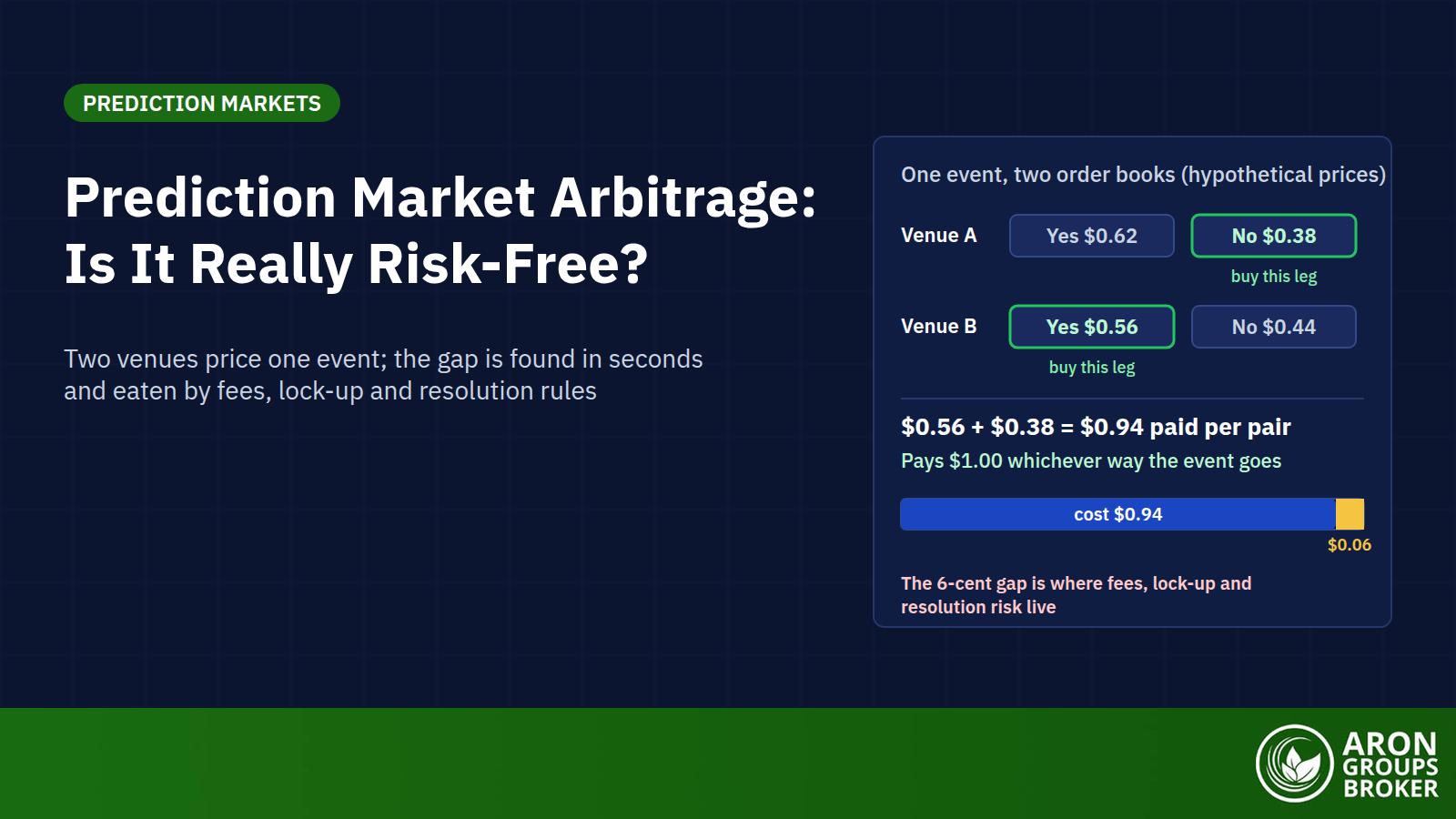
Cross-platform arbitrage buys the cheap Yes on one venue and the cheap No on another, so the pair costs less than $1 but pays exactly $1. Yes at 56 cents on venue B plus No at 38 cents on venue A costs 94 cents. That locks six cents either way, with no directional risk.

Real gaps have been large. On 17 October 2024, reports put a Trump election win near 62% on Polymarket against about 57% on Kalshi. Trump Yes on Kalshi plus Trump No on Polymarket then cost about 95 cents for a pair worth $1.

Mini Example: A Hypothetical Fed Decision on Two Venues

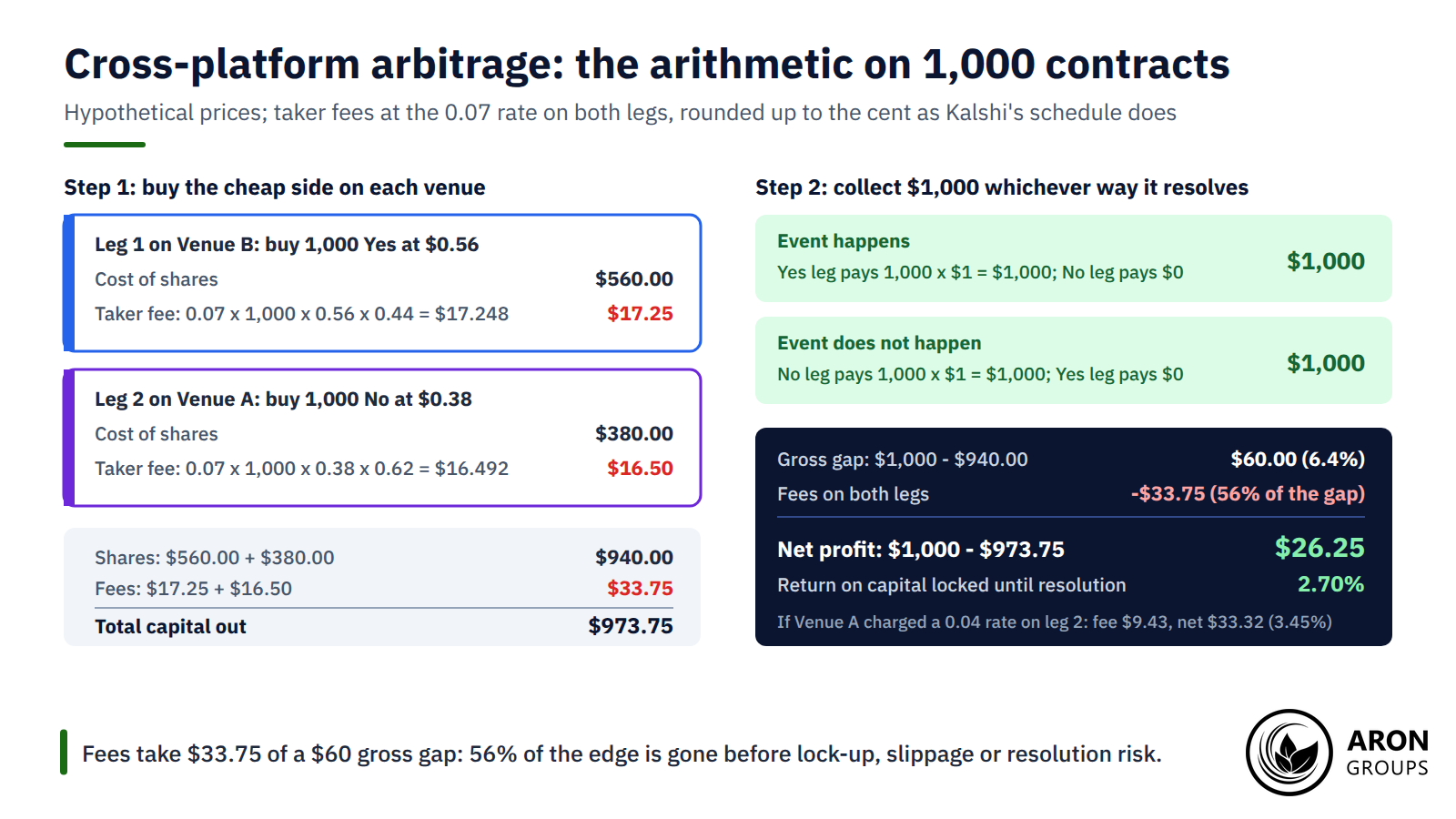
Take a market on whether the Fed cuts rates at a given meeting, with made-up prices. Venue A quotes Yes at $0.62 and No at $0.38; venue B quotes Yes at $0.56 and No at $0.44. You buy 1,000 Yes on B for $560 and 1,000 No on A for $380, a total of $940 for a pair that pays $1,000.

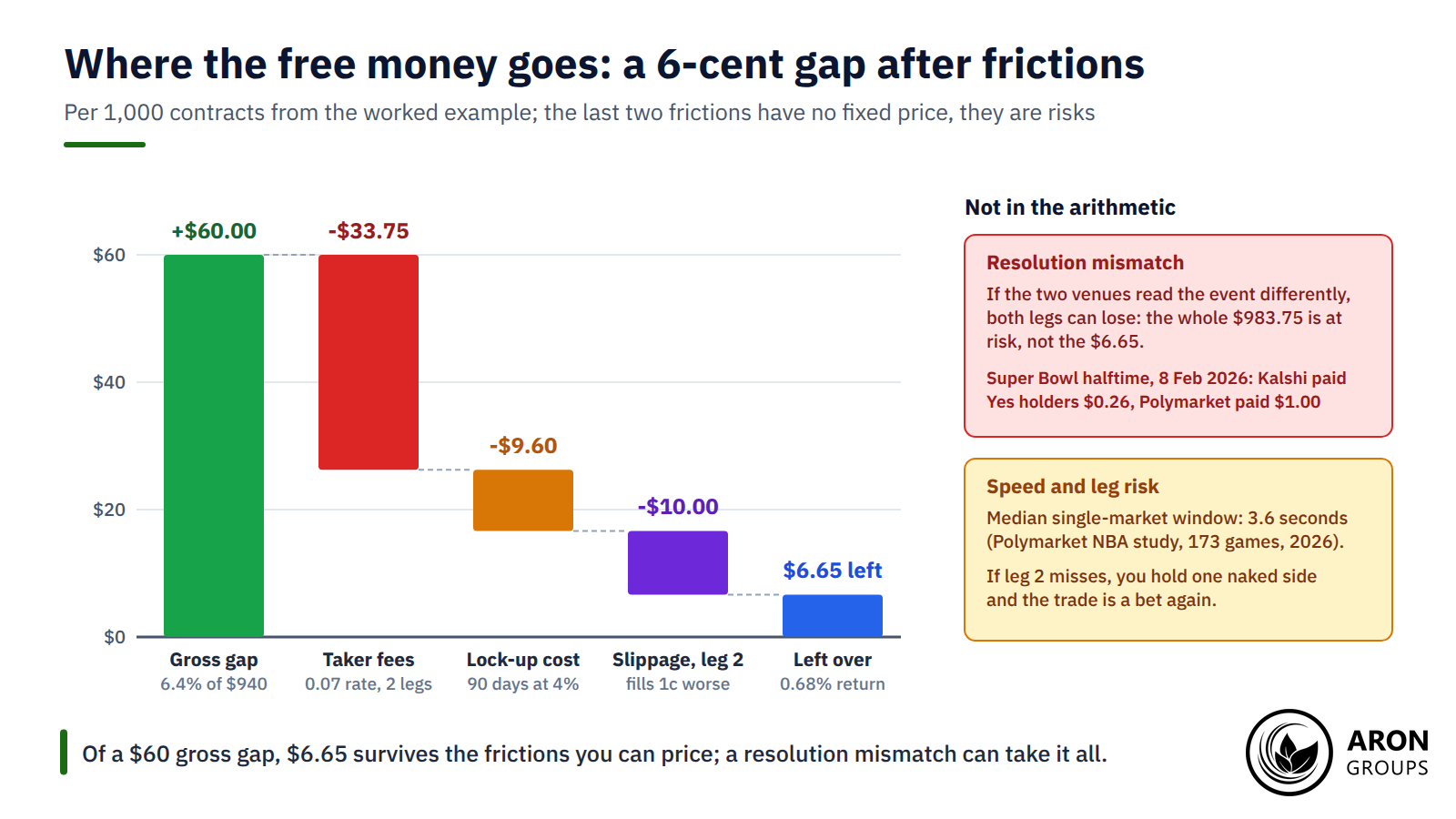
Now add taker fees at the 0.07 rate that Kalshi and Polymarket’s crypto markets charge, rounded up to the cent as Kalshi’s schedule does. The B leg costs 0.07 x 1,000 x 0.56 x 0.44, which is $17.25. The A leg costs 0.07 x 1,000 x 0.38 x 0.62, which is $16.50. Fees total $33.75, capital out is $973.75, and the net profit is $26.25, or 2.70%.

Fees have taken 56% of the six-cent gap. At a 0.04 rate on leg A, Polymarket’s rate for finance markets, the net would be $33.32, or 3.45%. Either way the money is locked until the Fed meets, and any slip in the second leg comes off the remainder.

Fees of $33.75 on both legs take 56% of a $60 gross gap, leaving $26.25 on $973.75 of locked capital in the hypothetical example.

Within-Market Arbitrage and Negative Risk

Within-market arbitrage buys Yes and No in the same market when the two cost less than $1 together. A Yes at 55 cents and a No at 40 cents cost 95 cents for a set that pays $1. On Polymarket a full set can be merged back into collateral at once, with no wait for the event.

The multi-outcome version is called negative risk. Where exactly one candidate wins, the Yes prices across all candidates should add up to $1. If they add up to more, buying No on every candidate costs less than the fixed payout those shares return.

What the research found on Polymarket

A 2025 study by researchers at IMDEA Networks and the Oxford Internet Institute measured both kinds on Polymarket between 1 April 2024 and 1 April 2025. Across 17,218 conditions they estimated about $40 million of realised arbitrage profit, most of it from rebalancing multi-outcome markets. It accrued to a handful of addresses, and the top address earned just over $2 million. Polymarket charged no fees then; it now charges takers on most markets.

Why Prediction Market Price Gaps Exist

Gaps exist because prediction markets are fragmented. Each venue has its own order book, users and rules, so a price reflects local supply and demand. Kalshi serves US customers under CFTC rules, Polymarket grew up among crypto-native traders abroad, and until late 2025 US residents could not trade on Polymarket at all.

The October 2024 election gap shows the mechanism. One trader deployed about $25 million across linked Polymarket accounts, putting a floor under the Trump price. US residents who might have sold into it were barred from the site, and others feared the buyer knew something, so the gap persisted for weeks.

News is the other source. The venue with more automated traders reprices within seconds while the other lags, and on a thin book a small order moves the price by several cents. Liquidity risk creates the gap and caps how much can be traded into it.

Who closes the gaps

Professional firms and automated systems close them. Susquehanna International Group, one of the largest options market makers, became Kalshi’s first institutional market maker on 3 April 2024. Both venues publish APIs that let algorithmic trading systems read every book and post orders in milliseconds.

The table compares the three venues an arbitrageur would most likely pair, as their own documents describe them in early October 2026.

FeaturePolymarket (global)Polymarket USKalshi
Regulatory statusOffshore exchange; paid a $1.4 million CFTC penalty in January 2022 and blocked US usersQCX LLC, a CFTC designated contract market since 9 July 2025CFTC designated contract market since 3 November 2020
CollateralpUSD, backed by the USDC stablecoin, on the Polygon blockchainUS dollars through a CFTC-registered clearing houseUS dollars
Taker fee at 50 cents, per 100 shares$1.00 to $1.75 by category; world-events markets fee-free$1.74 (0.0695 rate)$1.75 (0.07 rate, rounded up)
Maker feeNone, plus rebates of 15% to 25% of the taker feeRebate at a 0.0125 rateNone on most markets
ResolutionUMA optimistic oracle: $750 bond, 2-hour challenge window, token-holder vote on disputesExchange rules and clearing houseExchange rules; an ambiguous outcome can settle at the last traded price

Venue rules compared from Polymarket’s documentation, the Polymarket US fee schedule effective 1 October 2026 and Kalshi’s fee schedule effective 7 July 2026.

The Frictions That Eat the Free Money

Four frictions decide whether a gap becomes a profit: fees on both legs, capital locked until resolution, partial fills with slippage, and the speed of the competition. Each is small on its own. Together they usually exceed the gap.

Fees on both legs

All three venues now charge takers roughly 7% of price times one minus price per share. At 50 cents that is 1.75 cents on Kalshi, 1.74 cents on Polymarket US and 1.75 cents on Polymarket’s crypto markets. Polymarket’s politics and finance markets charge 1 cent. An arbitrage pays this twice, and the fee peaks where prices are least certain.

Makers pay nothing on Polymarket and on most Kalshi markets. A resting order cannot know that the other leg will fill, though, so the saving is bought with leg risk.

Capital locked until resolution

The payout arrives when the event resolves, which can be months later. In the worked example $973.75 sits idle for 90 days to earn $26.25. At the 3.75% to 4.00% federal funds range set on 16 September 2026, that cash could have earned about $9.60 without risk. A cross-platform pair cannot be merged early.

Partial fills and slippage

The two legs sit on different systems, so one can fill while the other does not. If the second book moves by a cent, the edge shrinks by a cent per share. If it moves by six, the trade is a plain bet on the event. Slippage is the normal result of hitting a thin book after a faster trader has taken the best price.

Fees, 90 days of idle capital and one cent of slippage leave $6.65 of the example's $60 gross gap, and a resolution mismatch could remove the rest.

Speed: windows close in seconds

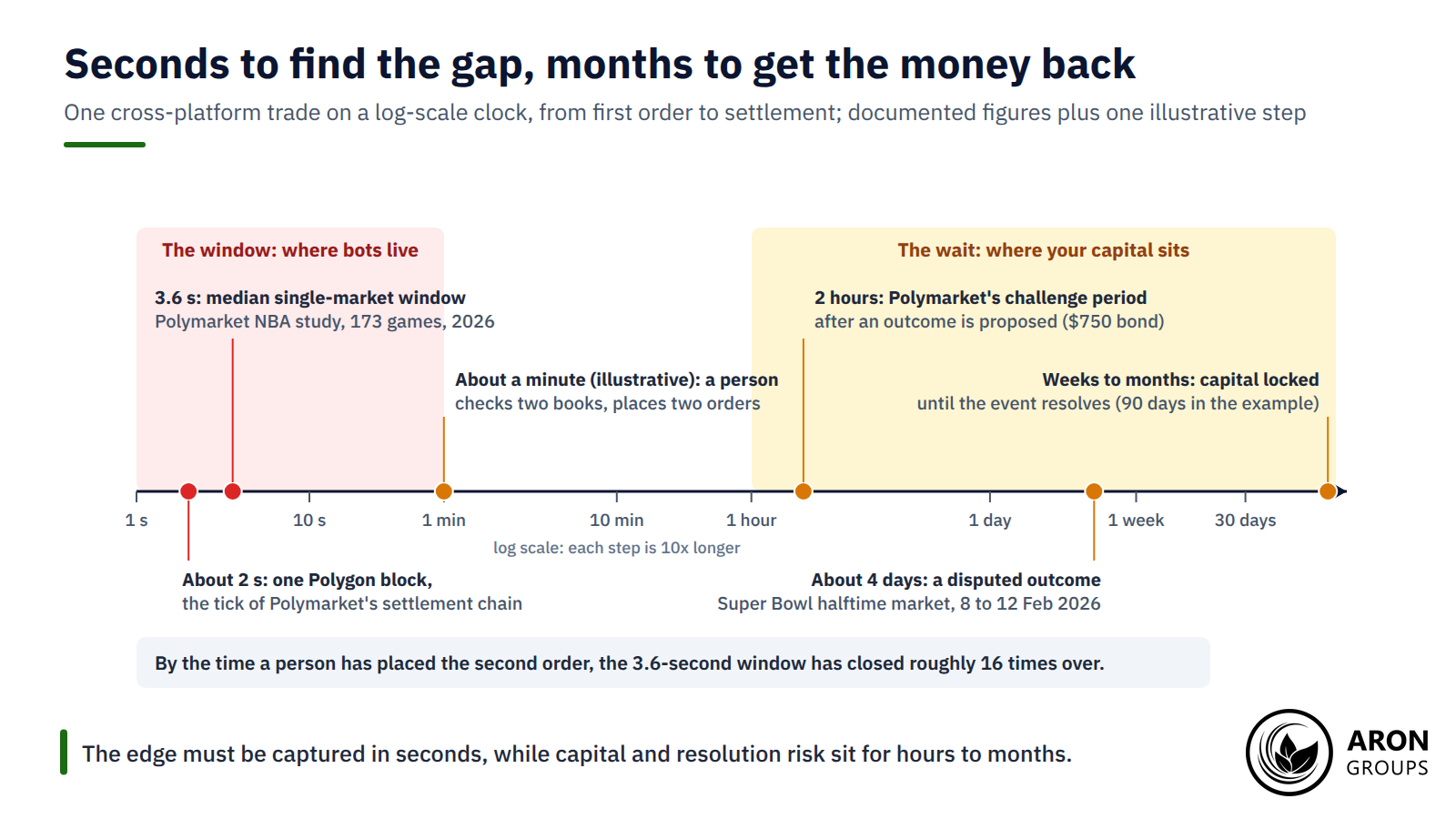
A 2026 study of Polymarket’s NBA markets used more than 75 million order-book snapshots across 173 games. It found only seven executable single-market opportunities, with a median life of 3.6 seconds. Its 290 combinatorial opportunities returned a median 101 basis points, but 76.9% could absorb an average of only 14.8 shares. At that size a 1.75-cent fee per leg wipes out a 1% edge.

Trading bots that read both books over an API and net out fees are what actually take these trades. This article endorses no scanner; the research simply shows the market has already been automated.

A median single-market window of 3.6 seconds closes long before a person has placed a second order, while the capital then waits hours to months for settlement.
sms-star

Key Point
Price the trade in this order: net of fees on both legs, then annualised over the expected lock-up, then only if both venues' rules describe the same event in the same words.


Resolution Risk: When the Same Event Settles Differently

Resolution risk is the possibility that two venues settle the “same” event differently, so a hedged pair loses on both legs. Polymarket’s global exchange resolves through the UMA optimistic oracle: a proposer posts a $750 bond and the result stands unless disputed within two hours. Kalshi settles under its exchange rulebook, which lets it declare an outcome ambiguous.

The Super Bowl halftime show on 8 February 2026 produced exactly that split. Both venues asked whether Cardi B would perform; she appeared during Bad Bunny’s set but did not clearly sing. Kalshi invoked Rule 6.3(c) for ambiguity and settled at the last traded price on $47.3 million of volume. Yes holders received 26 cents and No holders 74 cents. Polymarket resolved Yes at $1 after a UMA dispute.

A trader long Yes on Kalshi and long No on Polymarket, a textbook hedge, collected 26 cents and zero: a loss on both legs.

Q: If I hold Yes on one venue and No on another, can both legs lose?
A: Yes. The legs offset only if both venues settle on the same reading of the event. If one declares the outcome ambiguous, or its rules name a different source or deadline, you can collect a partial payout on one side and nothing on the other. Read both rules texts before trading and treat any difference in wording as unhedged risk.

Regulation, Access and Venue Risk

Venue risk means the platform itself, not the event, decides what you get. On 3 January 2022 the CFTC fined Polymarket’s operator $1.4 million for running an unregistered facility offering event-based binary options, more than 900 markets since June 2020. US users were then blocked for almost four years.

The picture changed in 2025. Polymarket bought the licensed exchange QCEX for $112 million in July 2025. The CFTC lists QCX LLC, now Polymarket US, as a designated contract market from 9 July 2025. A CFTC no-action letter granted reporting relief on 3 December 2025, the day the US app opened to its waitlist. Kalshi has been a designated contract market since 3 November 2020 and won its election-contracts case against the CFTC in September 2024.

State law is the open front. The Third Circuit ruled on 4 April 2026 that Kalshi’s sports contracts are swaps under exclusive federal jurisdiction. The Ninth Circuit held on 28 August 2026 that they are bets Nevada may regulate. New Jersey asked the Supreme Court to settle the split on 2 September 2026. A venue can pause a market, change a rule or lose a state while your capital sits inside it.

Platform access varies by country, and users in restricted regions face added legal, access and custody risk on top of the trading risks above.

The Honest Limits of Prediction Market Arbitrage

Prediction market arbitrage is real, but it is neither free money nor risk-free. The gap is a few cents on the dollar and fees take about half of it. The money then waits, and the hedge holds only while both venues agree on what happened. The research shows a few automated accounts collect most of the profit.

The same lesson runs through forex and crypto. Covered interest parity, which the BIS calls “the closest thing to a physical law in international finance”, has failed to hold since 2008. The reason is that balance sheet space is “rented, not free”: the capital an arbitrage ties up costs more than the gap pays. Cross-exchange crypto arbitrage adds transfer times and withdrawal limits as its lock-up.

Cross-book arbitrage between sportsbooks and event contracts adds one more cost: bookmakers limit accounts that only take the favourable side. Whenever a strategy is sold as risk-free, look for which catch it is quietly paying: fees, time, leg risk, resolution or the venue.

Where Aron Groups Fits

Aron Groups does not offer prediction markets or binary options, and this article is not an invitation to trade them. What transfers is the discipline of pricing every edge after costs. In forex and crypto CFDs those costs are the spread, any commission and the slippage between the price you saw and the price you got. On MetaTrader 5 a market order on an ECN account fills at the live price with floating spreads.

Events that move prediction markets, such as Fed decisions, move currencies and gold in the same minute, and the economic calendar lists them in advance. A demo account lets you measure your own fill times and slippage around those releases. The Nano account, with micro volumes from 0.0001 lots and no commission, keeps that practice cheap.

Conclusion

Prediction market arbitrage rests on one fact: a Yes share and a No share on the same event are together worth exactly $1. Buying that pair for less, on one venue or across two, locks a profit. The gap is real, but small, brief and fiercely contested.

The “free” money is paid for in fees, months of locked capital, second legs that slip, and venues that read an event differently. The Cardi B settlement shows the hedge can fail on both sides at once.

Treat every risk-free claim, in prediction markets or anywhere else, as a list of frictions you have not yet priced.

Frequently Asked Questions

Short answers to the questions people ask most about prediction market arbitrage.

Is prediction market arbitrage legal?

Trading on a regulated venue such as Kalshi or Polymarket US is legal for eligible US customers. Access is the issue: Polymarket restricts users from a number of countries, and several US states are contesting sports contracts. Users in restricted regions carry legal and custody risk.

How much can you make from prediction market arbitrage?

Gaps are usually a few cents on the dollar before fees of up to 1.75 cents a share on each leg. A 2025 study found about $40 million of arbitrage profit on Polymarket in a year, most of it taken by a few automated accounts.

Do you need a bot for prediction market arbitrage?

In practice, yes. The median single-market window in the 2026 NBA study was 3.6 seconds. That is far shorter than a person needs to check two books and place two orders.

What is negative risk in prediction markets?

Negative risk describes a multi-outcome event where exactly one outcome can win, so the Yes prices should add up to $1. If they add up to more, buying No on every outcome costs less than the fixed payout it returns.

Continue Reading
not-found
calendar 12 October 2026
Rate this article

Leave a Reply

Your email address will not be published. Required fields are marked *

No thanks