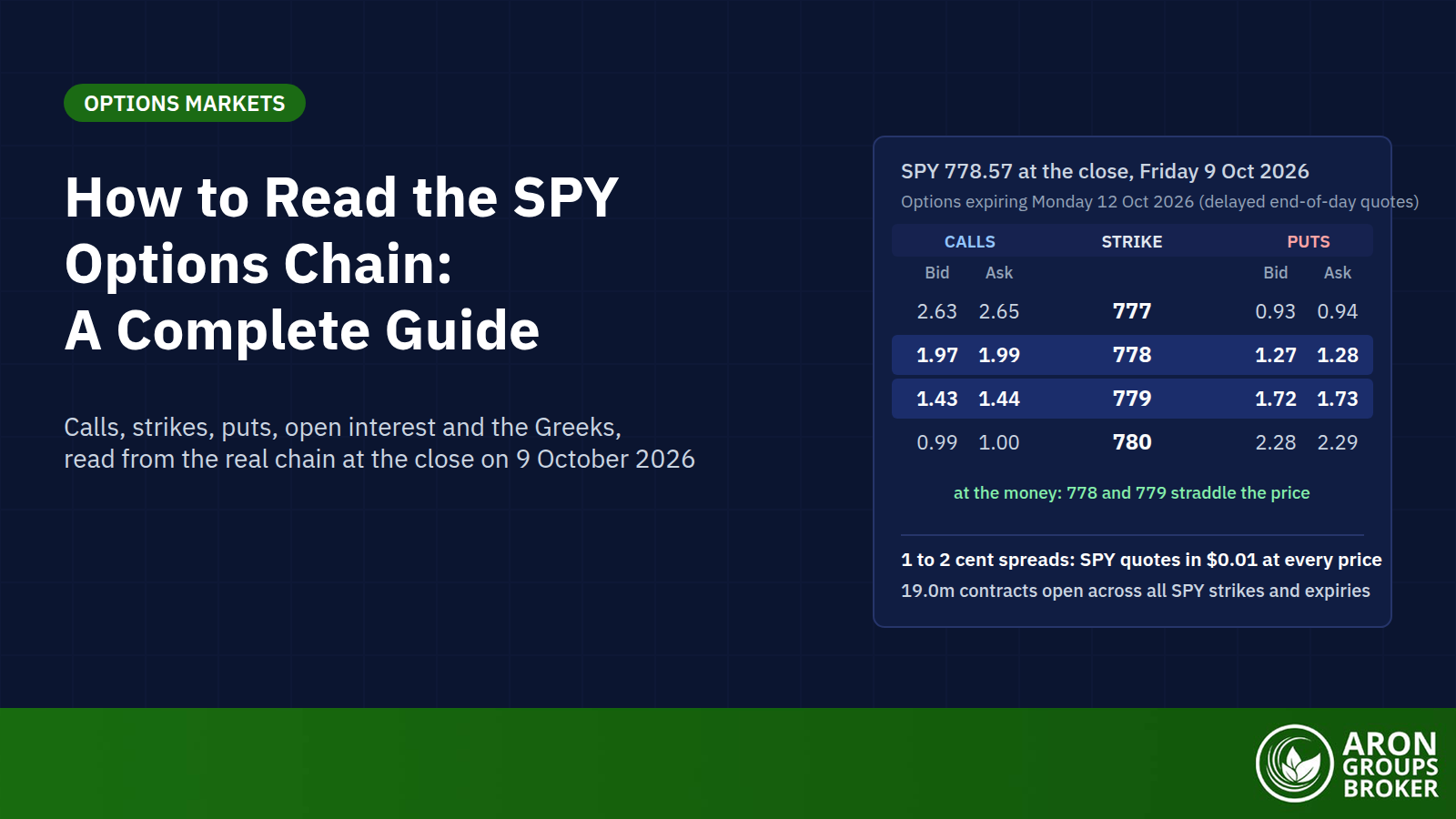

The SPY options chain is the table listing every call and put on SPY, the SPDR S&P 500 ETF, by expiration date and strike. For each contract it shows the bid, the ask, the last trade, the day’s volume, open interest, implied volatility and the Greeks.
It is the most watched chain in the world because SPY is the most liquid options market. At the close on Friday 9 October 2026, SPY ended at 778.57 with 19.0 million contracts open. The exchange-traded fund held $817.2 billion on 8 October 2026 and tracks the S&P 500 index at about one tenth of its level.
This guide reads a real dated chain column by column. It then covers expirations from 0DTE to LEAPS, SPY against SPX, trading hours and the chain as a map for index CFD traders.
- The SPY options chain lists every call and put on SPY by expiration and strike. Calls sit on the left, strikes in the middle and puts on the right, with the at-the-money strike highlighted.
- SPY quotes in $0.01 increments at every price under the Penny Interval Program. At-the-money spreads were 1 to 2 cents at the close on 9 October 2026, while the 776 call for 16 October was 13 cents wide.
- Volume is today's trading and open interest is standing positions. The 780 call expiring 16 October 2026 held 20,909 contracts open, 3.3 times the 778 call, which marks it as a level to watch.
- At the money, delta sits near 0.50: the 778 call for 16 October showed 0.55 and the 779 put -0.49. Implied volatility slid from 9.9% at the 775 strike to 9.0% at 785, the volatility skew.
- SPY options are American-style and settle in shares. SPX options are European, cash-settled, about ten times the size and taxed under Section 1256. SPY options trade 9:30 am to 4:15 pm ET, with no overnight session as of 11 October 2026.
What Is the SPY Options Chain?
The SPY options chain is a grid of contracts, one row per strike price and one tab per expiration date. Calls sit on the left and puts on the right, and the columns mean the same thing on every broker.
Risk Disclosure
Trading forex and CFDs carries a high level of risk and can result in the loss of all your capital. This content is educational and is not investment advice. Never risk money you cannot afford to lose.
Why SPY Is the Chain Everyone Watches
On 9 October 2026, 10.3 million SPY contracts traded, and the 15-session average was about 12.3 million, per third-party end-of-day exchange data. Cboe’s second-quarter 2026 review put SPY at 42% of all ETF options volume.
Depth is why SPY quotes so tightly. Under the exchanges’ Penny Interval Program, most classes quote in $0.01 below $3.00 and $0.05 above. SPY, QQQ and IWM quote in $0.01 at every price.
As the SEC’s investor bulletin notes, an option contract generally represents 100 shares of the underlying stock, and SPY is no exception. At the 9 October 2026 close of 778.57, one contract controlled $77,857 of SPY. The S&P 500 closed at 7,811.54, so an SPX contract, also with a 100 multiplier, covered $781,154: 10.03 times as much.
The Layout of the SPY Options Chain: Calls, Strikes, Puts
The standard layout puts calls on the left, strike prices down the middle and puts on the right. The at-the-money strike, nearest SPY’s price, is highlighted. Pick an expiration first, then read the strikes a few dollars either side of the price.
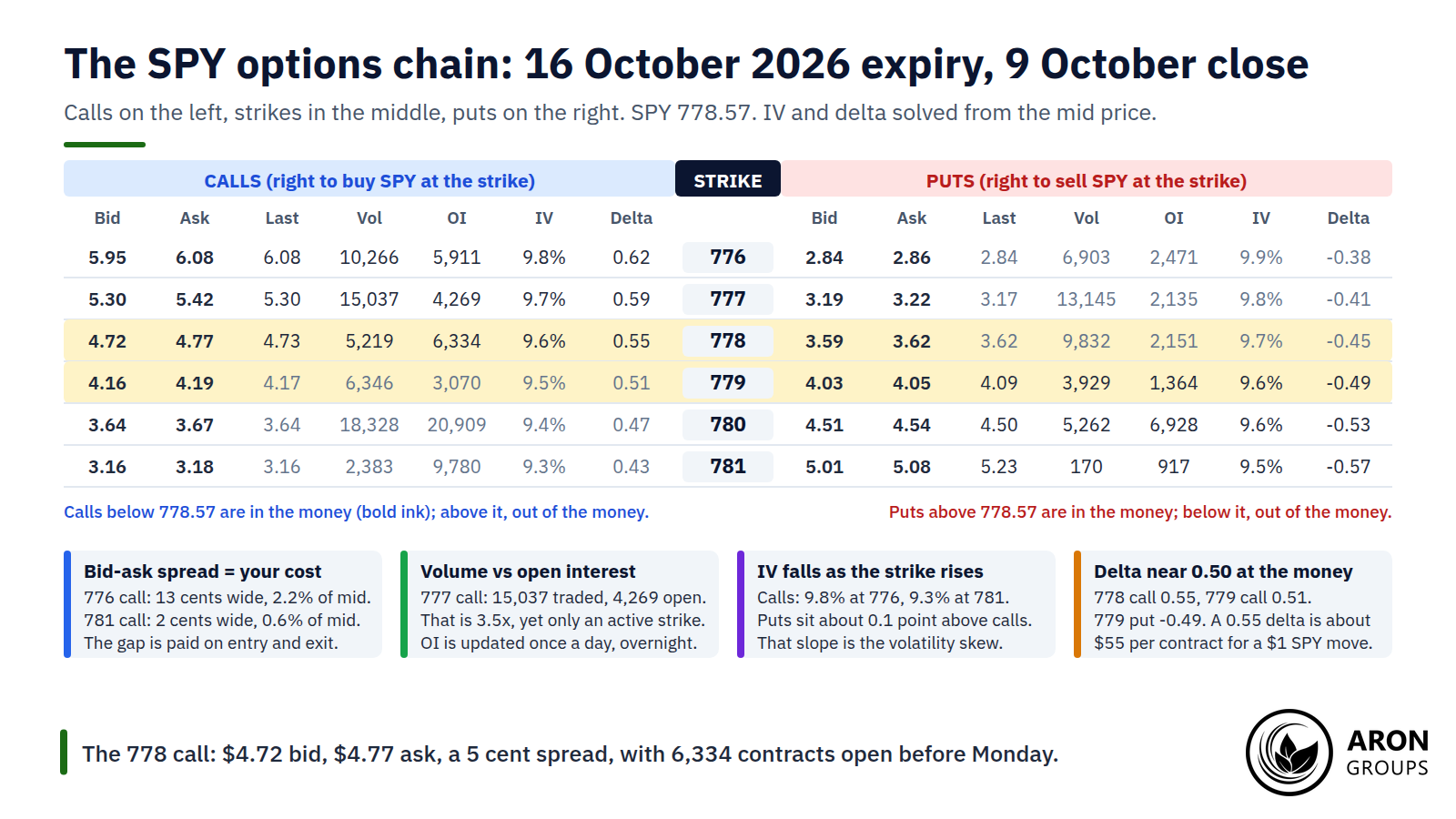
Moneyness reads from the strike column. A call below the price is in the money because it carries intrinsic value. With SPY at 778.57, the 778 call for 16 October 2026 had a mid of about $4.75: $0.57 intrinsic and about $4.18 time value. Calls above the price, and puts below it, are out of the money and hold time value only. Figure 1 shows the six strikes nearest the price.
Reading Each Column: Bid, Ask, Volume, Open Interest, IV and Greeks
The bid is what you can sell at and the ask what you can buy at. The gap is the bid-ask spread, a real cost paid on entry and again on exit, and the quickest liquidity check. For 16 October the 778 call was 5 cents wide, 1.1% of its mid, and the 776 call 13 cents, 2.2%.
Last is the most recent trade and goes stale on thin strikes. The 781 put for 16 October last traded at $5.23, above its $5.01 to $5.08 quote, after only 170 contracts all day.
Volume counts contracts traded today and resets each morning. Open interest counts contracts outstanding: standing positioning, updated once a day after clearing. Implied volatility (IV) is the volatility the price implies: how expensive the option is for the movement expected.
The Greeks measure risk per unit of change. Delta is the price change per $1 move in SPY; gamma is the change in delta per $1. Theta is the decay per day; vega is the change per one-point move in IV.
Mini Example: Reading Two Strikes on the 16 October 2026 Chain
Take the 778 call at the 9 October 2026 close: bid $4.72, ask $4.77, last $4.73, volume 5,219, open interest 6,334. Its IV was 9.6%, delta 0.55, gamma 0.038, theta -0.34 and vega 0.43. One contract costs $477 at the ask, and the 5 cent spread is $5 per contract each way.
With the 100 multiplier, a delta of 0.55 means about $55 of gain for a $1 rise in SPY. Gamma of 0.038 then lifts the delta to about 0.59. Theta of -0.34 costs about $34 a day; vega of 0.43 means a one-point fall in IV costs about $43.
The 779 put reads $4.03 bid, $4.05 ask, last $4.09, volume 3,929, open interest 1,364. Its IV was 9.6% and its delta -0.49: just in the money, moving almost one for one against the 778 call.
Open Interest: The Market's Footprints by Strike
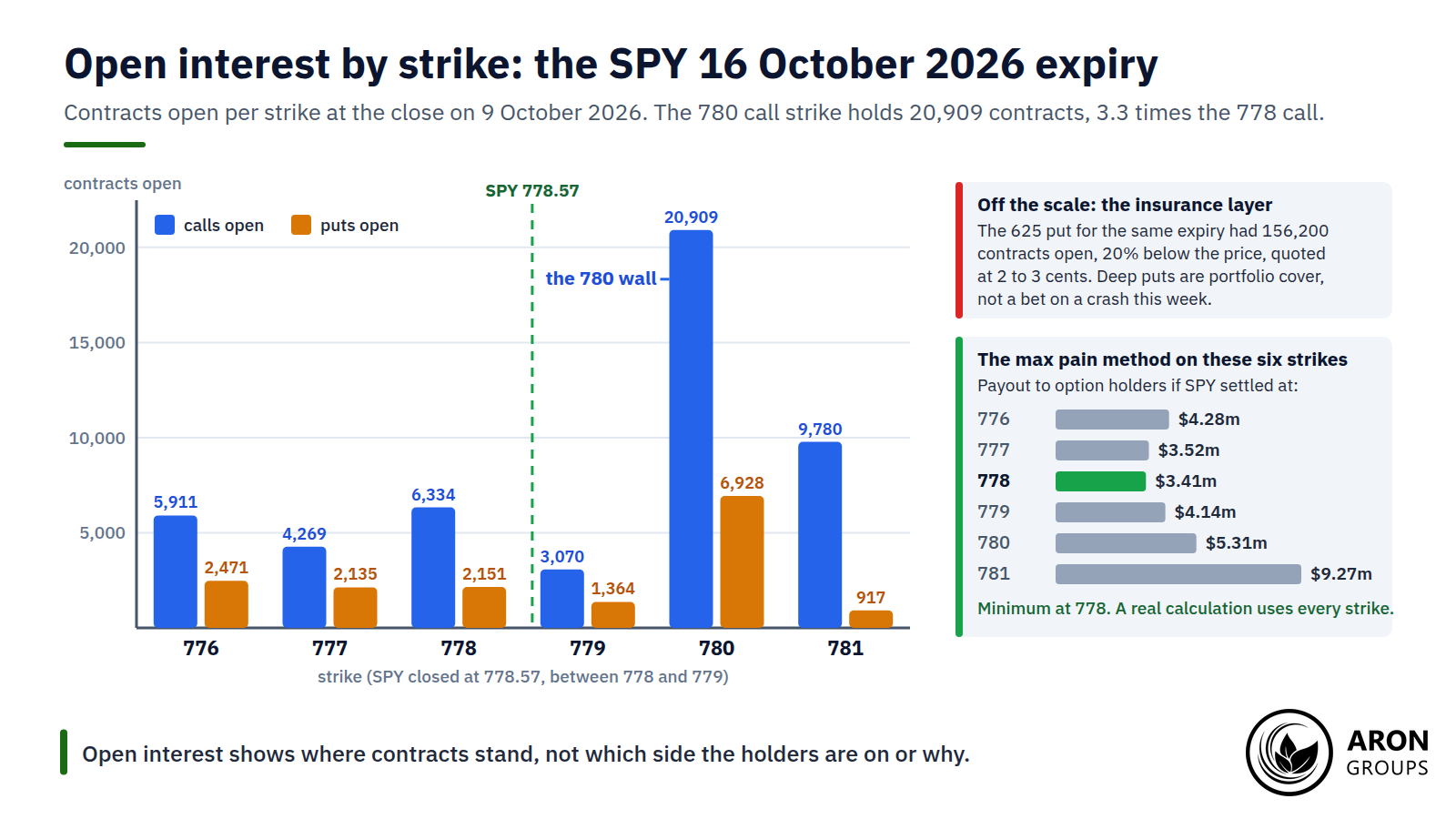
High open interest at a strike marks a level where many contracts stand, and such strikes often act as support or resistance. On the 16 October chain the 780 call held 20,909 contracts open, 3.3 times the 778 call’s 6,334. No other strike from 776 to 781 topped 10,000. Traders call that a wall.
The mechanism is dealer hedging. Market makers short those 780 calls hold SPY shares in proportion to delta: about 983,000 shares at 0.47 if fully hedged on one side. Each $1 move shifts that hedge by roughly 82,000 shares. Near expiration that rebalancing can pin price to a high-OI strike, as gamma scalping shows from the dealer’s side.
Open interest cannot say which side holders are on. A contract needs a buyer and a seller, so 20,909 open calls could be speculation, covered calls or one leg of a spread. Chain-wide, 13.1 million puts stood open against 5.9 million calls, a put/call open interest ratio of 2.22 that mostly reflects portfolio insurance.
Max Pain Starts from the Same Table
Max pain is the settlement price at which option holders, taken together, would receive the smallest payout, computed strike by strike from open interest. On the six strikes in Figure 2, settlement at 778 would pay holders $3.41 million, against $5.31 million at 780 and $9.27 million at 781. A full calculation uses every strike, and max pain describes positioning, not a forecast.
Volume vs Open Interest and the Unusual Activity Flag
Volume is today’s trading; open interest is accumulated positioning. A common rule of thumb flags volume above about three times open interest as unusual activity, a possible large or informed order. It is a convention, not a documented statistic, and works best where open interest is stable: far-dated or far-from-the-money strikes.
Near the money it misfires. The 777 call for 16 October traded 15,037 contracts against 4,269 open, 3.5 times, yet it was simply an active strike near the price. On the 9 October same-day (0DTE) contracts the 778 call traded 883,336 against 14,305 open, 62 times.
Q: If a strike’s volume is three times its open interest, is someone making a big bet?
A: Not necessarily. The ratio shows that new positions may be opening. Near the money and on short expirations it is routine, because standing positions are small and traders cycle in and out within the day. Treat it as a prompt to check the trade sizes, the expiry and the strike’s distance from the price, not as a signal in itself.
Implied Volatility, Skew and the Greeks on the Chain
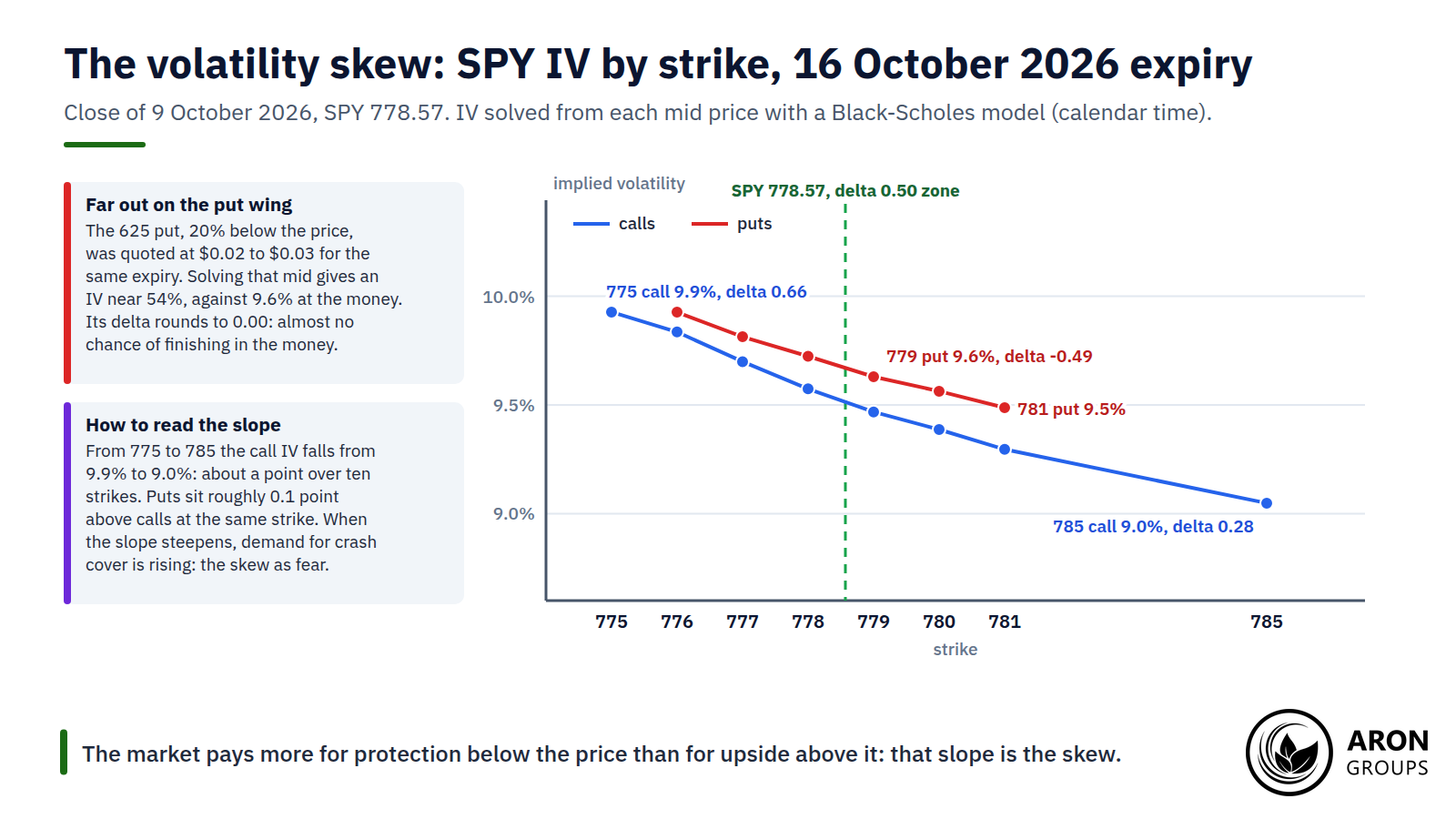
Implied volatility varies by strike, and that variation is the volatility skew. On the 16 October expiry the call IV fell from 9.9% at 775 to 9.0% at 785. Puts sat about 0.1 point above calls at the same strike. Far down the put wing the 625 put, 156,200 contracts open at 2 to 3 cents, implied a volatility near 54%. The market pays more for protection below the price than for upside, and a risk reversal measures that gap.
Delta tracks moneyness. An at-the-money option has a delta near 0.50 for calls and -0.50 for puts: the 778 call showed 0.55 and the 779 put -0.49. It fades toward zero out of the money: 0.28 on the 785 call, 0.00 on the 625 put.
Vega and IV Crush Around Events
The 778 call’s vega of 0.43 means a one-point fall in IV takes about $43 off the contract. That is the mechanism behind IV crush: implied volatility is bid up before a scheduled event and collapses once the news is out.
Key Point
Read the chain in a fixed order: expiration first, then the at-the-money strike, then the spread, then volume against open interest, then IV and delta. Each step narrows the next, and the order stops you comparing a 0DTE quote with a monthly one.
SPY vs SPX Options: Style, Settlement, Size and Tax
SPY and SPX options track the same index but are different instruments, and an index CFD is different again. The table compares the three ways to trade S&P 500 exposure.
| Feature | SPY options | SPX options | S&P 500 index CFD on MT5 |
|---|---|---|---|
| Underlying | SPY, the SPDR S&P 500 ETF (778.57 at the 9 Oct 2026 close) | The S&P 500 index (7,811.54 at the 9 Oct 2026 close) | The index price, quoted as SPXUSD at Aron Groups |
| Exercise style | American: exercisable on any trading day | European: at expiration only | No exercise; positions are opened and closed at market |
| Settlement | Physical: 100 SPY shares per contract | Cash, against the settlement value | Cash: profit or loss settles in the account currency |
| Size at the 9 Oct 2026 close | 100 x 778.57 = $77,857 per contract | 100 x 7,811.54 = $781,154 per contract | Lots, from 0.01 nano lots on the Nano account |
| Expirations | Every trading day, plus monthlies and LEAPS | Every trading day (SPXW, PM-settled) plus AM-settled third-Friday series | None; a position stays open until closed, with overnight swap |
| Trading hours (ET) | 9:30 am to 4:15 pm; no overnight session as of 11 Oct 2026 | 9:30 am to 4:15 pm, plus Curb and Global Trading Hours 8:15 pm to 9:25 am | Set by the symbol specification in MT5 |
| Dividends and early exercise | Quarterly ex-dividend on the monthly expiry Friday; in-the-money calls face early exercise | No dividend and no early exercise | Not applicable; swaps follow the account type, with swap-free days on Nano and Islamic |
| US tax treatment (high level, not advice) | Equity option: gains taxed by holding period | Section 1256: 60% long-term, 40% short-term, marked to market at year end | Depends on your own jurisdiction |
SPY options, SPX options and an S&P 500 index CFD compared at the 9 October 2026 close.
Dividends are where SPY and SPX part ways. SPY goes ex-dividend on the third Friday of March, June, September and December, the monthly expiration day. The 18 September 2026 distribution was $1.89, about 0.24% of the price. In-the-money SPY calls are often exercised the day before, so a short call can become short stock overnight. SPX pays nothing and cannot be exercised early.
Section 1256 in One Paragraph
Under Section 1256 of the US tax code, SPX options are nonequity options. Open positions are marked to market at year end, and gains count as 60% long-term and 40% short-term, whatever the holding period. SPY options are equity options taxed by holding period. This is a high-level description, not tax advice.
Can You Trade SPY Options After Hours?
As of 11 October 2026, no. SPY options trade from 9:30 am to 4:15 pm ET, with no overnight session. The SEC approved OCC’s extended-hours clearing framework on 23 September 2026. NYSE American has pencilled in 19 October 2026 for a 7:30 am ET early session covering SPY, QQQ and IWM, pending regulatory effectiveness. Overnight S&P 500 options exposure exists only through SPX and XSP on Cboe.
Expirations on the SPY Chain: 0DTE, Weeklies, Monthlies and LEAPS
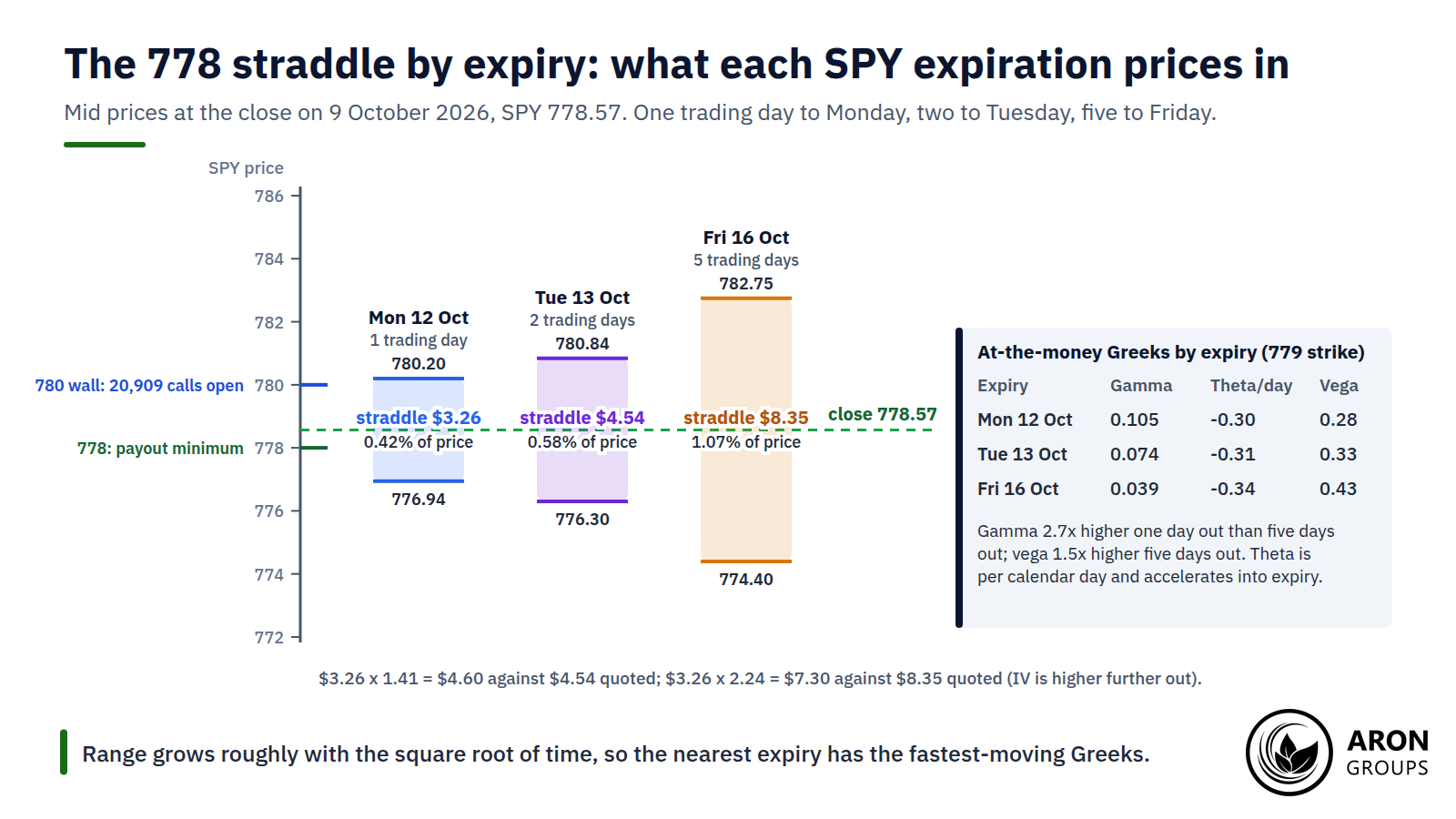
SPY lists same-day (0DTE), weekly, monthly and long-dated expirations. The SEC approved Tuesday and Thursday expirations for SPY and QQQ on 9 November 2022. That completed the daily calendar alongside the Monday, Wednesday and Friday weeklies. Monthlies expire on the third Friday, and LEAPS run more than a year out.
Each expiration prices a different range. A straddle is a call plus a put at the same strike. At the 9 October close the 778 straddle cost $3.26 for Monday 12 October, $4.54 for Tuesday and $8.35 for Friday 16 October. At-the-money gamma on the 779 strike was 0.105 one day out against 0.039 five days out, vega 0.28 against 0.43.
Near dates carry the most volume, the tightest spreads and the highest gamma, so they react fastest to price. Longer dates carry more vega but less liquidity.
0DTE and the Last 30 Minutes
Same-day options dominate index volume. Cboe put 0DTE contracts at a record 66.2% of SPX options volume in July 2026. The BIS found they were more than 50% of SPX options volume in August 2023, up from just 5% in 2016. On SPY, the 9 October 2026 0DTE 778 call alone traded 883,336 contracts.
Two things change late on expiration day. Spreads can widen as market makers pull quotes. At the 9 October close the 0DTE 777 call was quoted $1.68 to $1.73, 5 cents wide, against 1 to 2 cents for Monday’s expiry. Platforms may also show Greeks as 0.00 a few dollars from the price, because the true values round away at two decimals.
The Honest Limits of the SPY Options Chain
The chain shows positions, not intentions. Open interest is a day old by the time you read it and never says whether a contract was bought or sold to open. The 780 wall could be covered calls as easily as a bullish bet. Pinning and max pain describe tendencies, not rules.
The Greeks and IV are model outputs. Solve the 12 October 778 call on calendar time and its IV is 5.4%; on trading days it is 8.2%. Compare figures within one source, not across two.
The costs are real and the record is poor. The SEC’s bulletin warns that holders risk the entire premium paid and that some writers face unlimited losses. A 2023 Journal of Finance study found retail options traders lose money on average. Access to US-listed options also varies by country, and users in restricted regions face added legal, access and custody risk.
Where Aron Groups Fits
Aron Groups offers no options and no ETFs, so the SPY chain itself cannot be traded here. It offers index CFDs on MetaTrader 5, including SPXUSD, NDXUSD and DJIUSD, and the chain is useful context for them. A SPY strike maps to the index at roughly ten times its level. The 780 wall for 16 October 2026 therefore sat near 7,800 on the S&P 500, a level to mark alongside max pain.
A demo account lets you test that reading against live index moves with no capital at risk. The Nano account trades from 0.01 nano lots with no commission. The Islamic account carries discounted swaps with swap-free days, six on indices, rather than no swaps at all. Margin call sits at 100% and stop-out at 50%, or 40% on Islamic and VIP.
Conclusion
The SPY options chain is a complete map of S&P 500 positioning: calls, strikes and puts, then bid, ask, volume, open interest and the Greeks. On 9 October 2026 it showed a 5 cent spread on the week’s at-the-money call and a 20,909-contract wall at 780. Its skew priced crash cover above upside.
The spread is your cost, open interest is standing positioning that dealers hedge, and IV by strike is the price of protection. The expiration decides how fast all of it moves.
Use the chain as context, not a signal. Whether you trade the options or an index CFD, its levels matter only alongside your own risk limits.
Frequently Asked Questions
Short answers to common questions about the SPY options chain.
How many shares does one SPY options contract represent?
100 shares. At SPY’s 9 October 2026 close of 778.57, one contract controlled $77,857 of the ETF, about one tenth of an SPX contract’s $781,154. Premiums are quoted per share, so an ask of $4.77 costs $477.
What is the difference between SPY and SPX options?
SPY options are American-style, settle in 100 SPY shares and carry dividend and early exercise risk. SPX options are European-style, cash-settled, about ten times larger and taxed under Section 1256 for US taxpayers. SPX also trades overnight on Cboe.
How do traders day trade SPY options with the chain?
They usually work the nearest expirations, where spreads are 1 to 2 cents and gamma is highest. They read the at-the-money straddle for the priced range. The chain gives levels, not an edge.
What does open interest tell you on the SPY chain?
It tells you where contracts stand, not which way holders lean. A strike with far more open interest than its neighbours can act as support or resistance. The 780 call, with 20,909 contracts for 16 October 2026, was one.